

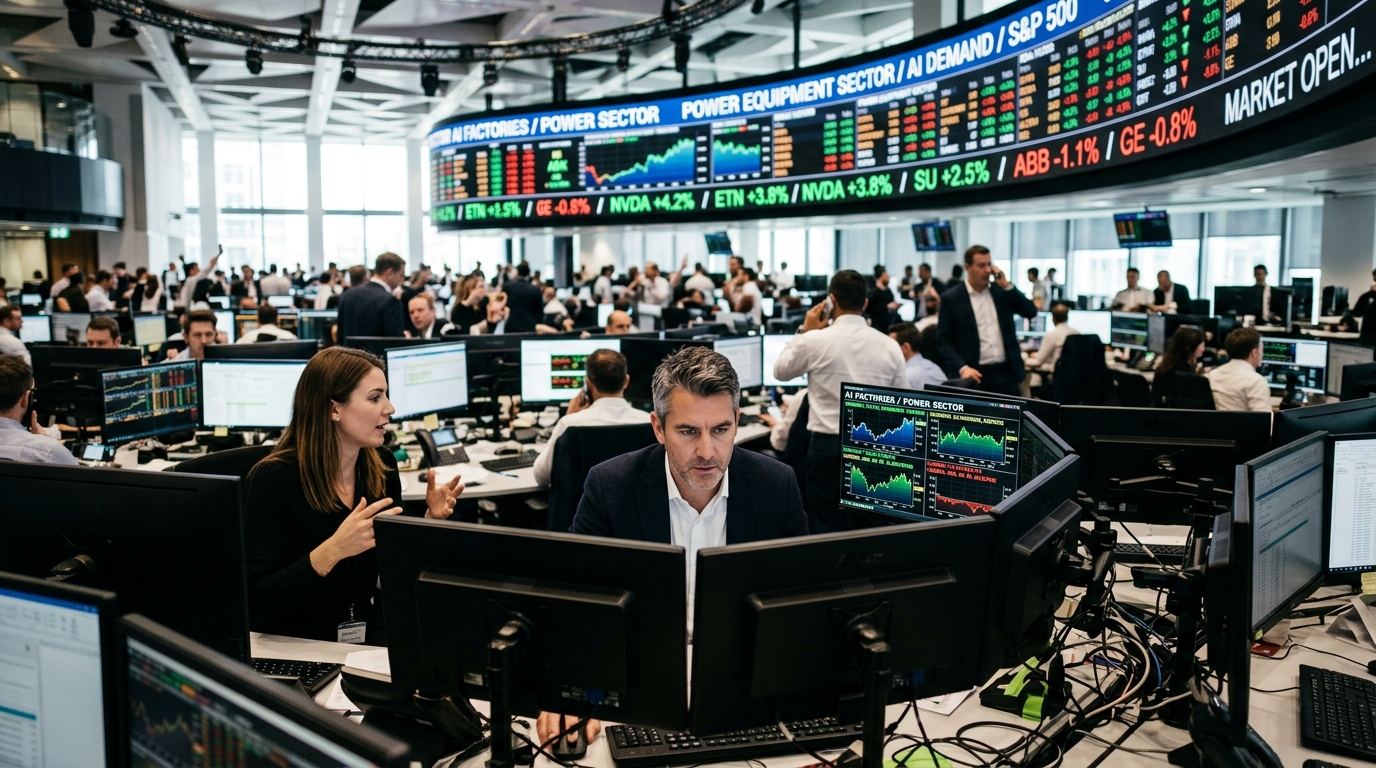
The meteoric rise of Artificial Intelligence (AI) is not just changing how we write code or generate content; it is fundamentally reshaping the planet's physical infrastructure. According to recent data, so-called "AI Factories"—massive data centers designed exclusively for training and operating next-generation models—are generating an unprecedented demand for power equipment. This shift is causing a violent decoupling between firms capable of meeting these new requirements and those left behind, tethered to obsolete technologies.
The power equipment market, once considered a "boring" sector of steady but slow growth, is now at the epicenter of the technological revolution. With forecasts pointing to a market value exceeding $200 billion annually by 2026, the race to supply transformers, switchgear, and cooling systems has taken on geopolitical significance.
The Transition from Data Centers to AI Factories
For decades, data centers were designed to host websites, cloud applications, and databases. These infrastructures required stable but relatively predictable power supplies. AI Factories, however, are an entirely different entity. The use of Nvidia's GPUs and other specialized chips demands a power density 5 to 10 times greater than that of a traditional server rack.
This need for "concentrated" energy means traditional equipment simply isn't enough. The companies leading today are those offering medium- and high-voltage solutions capable of handling massive loads without losses or overheating risks. Schneider Electric, Eaton, and Vertiv have already announced record backlogs, as hyperscalers like Microsoft, Google, and Amazon scramble to secure their spot in the manufacturers' priority queues.
Winners: The Dominance of Liquid Cooling and Smart Grids
In this new world, winners emerge through innovation in thermal management and energy digitalization. Traditional air cooling is reaching its limits; liquid cooling is transforming from a niche solution into an absolute necessity. Companies like Vertiv, which specialize in such systems, are seeing their valuations skyrocket.
- Schneider Electric: With an emphasis on energy management software, the French firm is transforming from a plug manufacturer into a provider of intelligent systems.
- Eaton: Its ability to produce large-scale transformers in short timeframes makes it an indispensable partner for new grids.
- ABB and Siemens: These European giants are investing billions in grid automation, allowing AI Factories to connect to renewable energy sources more efficiently.
Conversely, the "losers" are those firms relying on fragmented supply chains and lacking the necessary technological infrastructure to support modular deployment. The lead time for a large transformer has ballooned from 6 months to 2 years, and anyone unable to deliver quickly is missing the AI train.
The Grid Challenge and the Energy Crisis
Beyond the equipment within the walls of AI factories, the greatest challenge remains the power grid itself. In many regions of the US and Europe, demand from data centers threatens to exceed the capacity of existing transmission lines. This creates a new market for Battery Energy Storage Systems (BESS) and microgrids.
"We are no longer in a phase where software runs the world; physical infrastructure is what sets the limits on the progress of Artificial Intelligence," states a Bloomberg Tech analyst.
The push for "Green AI" adds another layer of complexity. AI Factories must prove they are not burdening the environment, which requires even more sophisticated equipment for interfacing with wind and solar farms. Companies that can offer "bundled" solutions—from the transformer to the optimization software—are the ones that will reap the lion's share of the $200 billion prize.
Conclusion: The Industrialization of Intelligence
The AI revolution is no longer just a Silicon Valley affair. It is an industrial challenge requiring steel, copper, and advanced power electronics. As we head into the second half of the decade, a country's or a company's ability to build and power these "digital factories" will become the new measure of economic and technological prowess. Investors are looking past pure software companies and finding value in the "blacksmiths" of the digital age.





