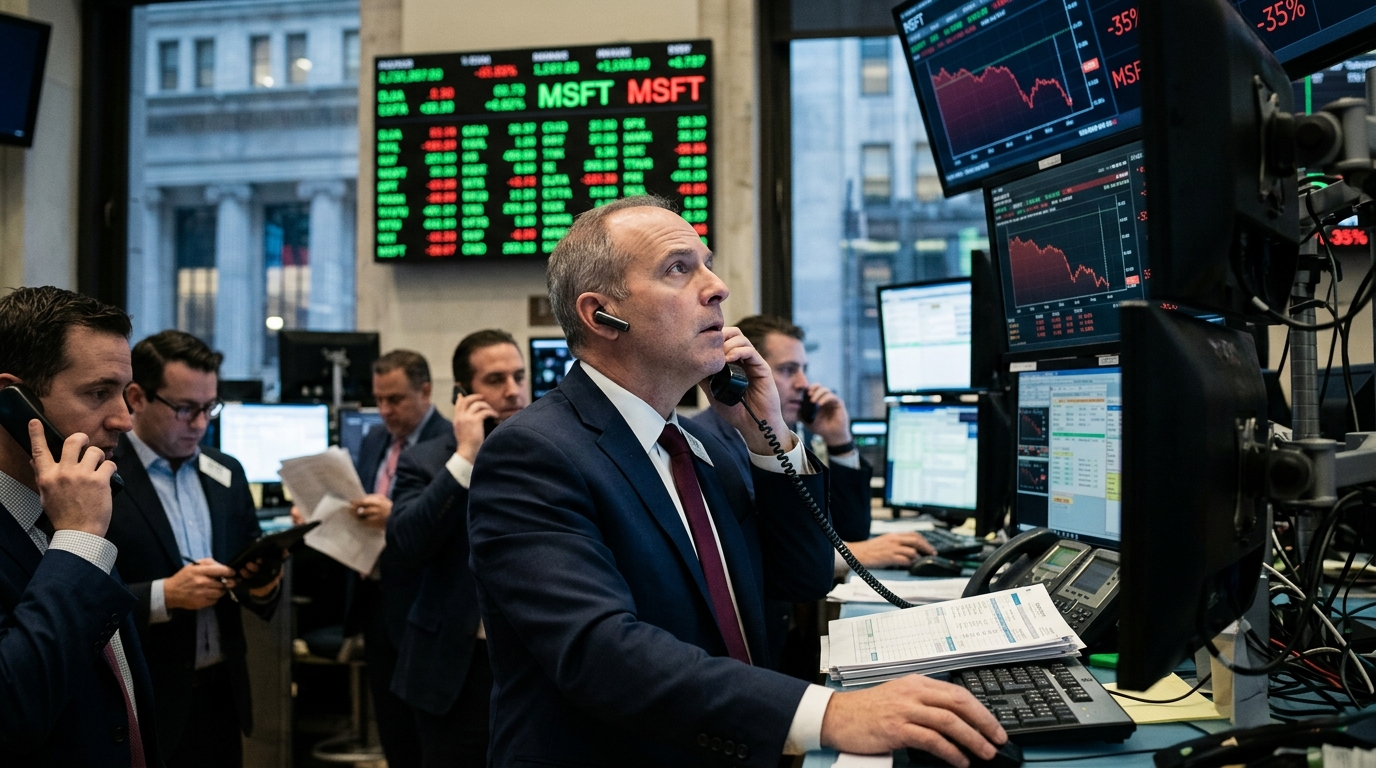
The New York stock market is currently at a critical crossroads, with Artificial Intelligence (AI) serving as both the greatest catalyst for growth and the primary source of investor anxiety. Recently, Microsoft stock found itself at the center of a "panic wave," experiencing a significant correction that reached 35% from its historical highs during certain periods of high volatility. However, behind the headlines whispering about the end of the AI euphoria, a different narrative is unfolding: "smart money" and large institutional portfolios are aggressively buying the dip, believing the market is unfairly punishing the leader of the new technological revolution.
The Anatomy of Panic: Why Are Investors Afraid?
Current skepticism is not about AI's ability to generate text or images, but about the ability of corporations to convert billions in investment into net profit. Microsoft, under Satya Nadella's leadership, has channeled massive capital into OpenAI and Azure infrastructure. Critics argue that capital expenditure (CAPEX) is rising at a rate not justified by current Copilot revenues. This "revenue gap fear" has led many retail investors to liquidate their positions, fearing a repeat of the 2000 dot-com bubble.
Furthermore, the operational costs of data centers and energy consumption have become central issues. The market worries that Microsoft's profit margins might be squeezed as competition from Google and Amazon intensifies. However, this perspective ignores the deep strategy developed by the Redmond giant, which isn't just selling a "tool," but the entire infrastructure upon which the future global economy will be built.
The Counter-Attack of Smart Investors
So why are seasoned fund managers "loading up" on the stock? The answer lies in the ecosystem. Microsoft is not a single-product company. Azure AI is not just a cloud service; it is the foundation for thousands of businesses migrating their operations to AI. The integration of Copilot into Office 365 creates a subscription base that is nearly impossible to disrupt, as the switching costs for a business to move to another ecosystem are prohibitive.
- Cloud Dominance: Azure continues to gain market share, with AI now accounting for 30% of its growth.
- OpenAI Synergies: Exclusive access to the most advanced models gives Microsoft a two-year lead over the competition.
- Cash Flow: Despite heavy spending, Microsoft remains a "money-printing machine," with free cash flows allowing for continuous share buybacks and dividend distributions.
Wall Street analysts point out that 30-35% corrections in leading tech companies have historically been the best entry points. "Buy when there is blood in the streets, even if the blood is your own," veteran traders often say, and in Microsoft's case, the dip seems to be more a result of macroeconomic jitters than fundamental failure.
The Future: From Hype to Real Value
2026 is considered the year of "crystallization." Investors buying now are betting that AI will transition from the experimentation phase to the full productivity phase. Microsoft has already begun reporting that its customers are seeing real time and money savings through its AI tools. When these benefits translate into contract renewals and price increases, the current stock dip will look like a minor blip on a long-term upward chart.
"Artificial Intelligence is not a cycle; it is a paradigm shift. Those focusing only on the next quarter are missing the bigger picture of the next decade," says a leading strategic analyst.
In conclusion, the "AI panic" offers a rare gift to patient investors. Microsoft, with its fortress balance sheet and leadership in next-generation infrastructure, remains the safest way to invest in the future of technology, provided one can withstand the noise of short-term volatility.