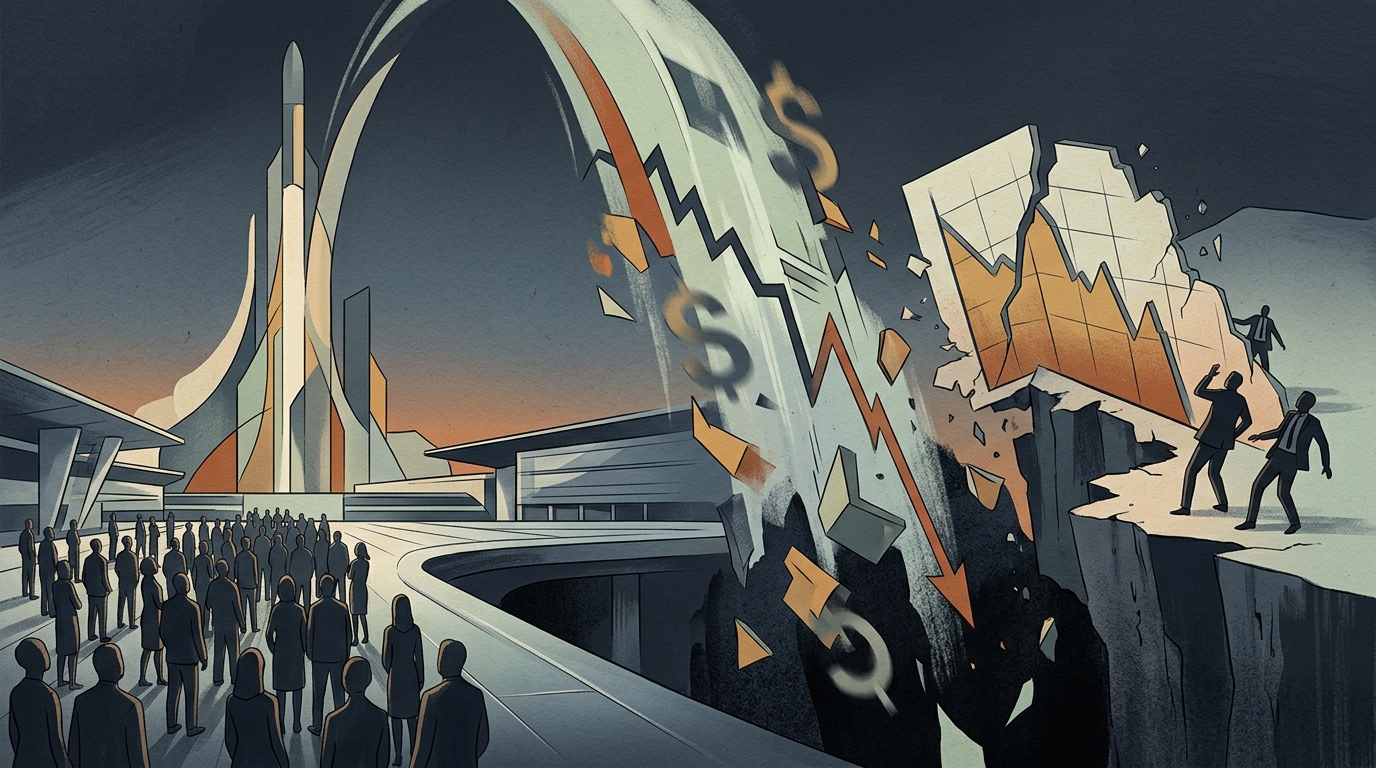
June 23, 2026, will be etched in financial history not for a technological breakthrough, but for the unprecedented destruction of wealth that unfolded on the floor of Wall Street. SpaceX, the company that promised to make humanity a multi-planetary species, saw its market capitalization shrink by an astronomical $400 billion in a single trading session. This decline exceeds the total GDP of many developed nations and raises serious questions about the sustainability of valuations in the space technology sector.
The chronicle of the crash began with a series of liquidations by institutional investors, which triggered a domino effect of panic among retail investors. SpaceX, which had debuted on the stock market with a valuation nearing $1.2 trillion—fueled by the success of the Starlink network and expectations for the Starship program—found itself facing the harsh reality of numbers. This correction was not merely a technical move, but a violent readjustment of expectations toward a vision that many now consider overvalued.
The Anatomy of a Market Storm
What led to this unprecedented collapse? Analysts point to three main factors. First, recent delays in NASA's Artemis program, where SpaceX plays a central role, created doubts about revenue streams from government contracts. Second, competition in the satellite communications sector has intensified, with Amazon and Chinese consortia squeezing Starlink's profit margins. Third, and perhaps most importantly, was the market's "fatigue" with Elon Musk's personality.
Musk's management of SpaceX, previously seen as the billionaire's "Midas touch," began to come under fire. Investors are concerned that his dispersion of attention among Tesla, X (formerly Twitter), and his new political activities leaves SpaceX vulnerable to operational errors. The market, which once forgave every failure due to the vision, now demands profitability and stability—two concepts that often clash with the explosive nature of Musk's ventures.
The Liquidity Factor and the "Herd Mentality"
The $400 billion drop also highlights the risks of excessive leverage. Many investors had taken positions in SpaceX stock using borrowed capital, betting on an eternal ascent. When the price began to retreat, forced sales (margin calls) accelerated the decline. The "herd mentality" worked in reverse: the same momentum that launched the stock to the heavens was now pushing it into the abyss.
- Market cap dropped from $1.2 trillion to $800 billion.
- Institutional investors withdrew over $150 billion in 6 hours.
- Stock volatility hit historic highs for the aerospace industry.
Despite the massive loss, SpaceX remains the dominant player in the industry. However, this "evaporation" of value serves as a loud message that even the most innovative companies cannot escape the laws of gravity on Wall Street. The space economy is entering a phase of maturity, where spectacular launch videos are no longer enough to keep stocks in an upward orbit.
The Future of the Space Economy Post-Shock
The aftermath finds SpaceX at a crossroads. It must prove it can generate steady cash flows without relying solely on the enthusiasm of Musk's fans. The $800 billion valuation remains extremely high, suggesting there is still room for further corrections if the next Starship milestones are not met on schedule.
"What we saw was the collision of limitless imagination with the limited patience of the markets," says a leading analyst at Goldman Sachs.
In conclusion, the fall of SpaceX is a lesson for the entire tech industry. Innovation is the engine of progress, but the capital market is the judge of efficiency. The $400 billion wipeout does not mean the end of SpaceX, but it does mark the end of the age of innocence for space investments. The market now demands proof that space is not just humanity's "final frontier," but also a profitable business frontier.