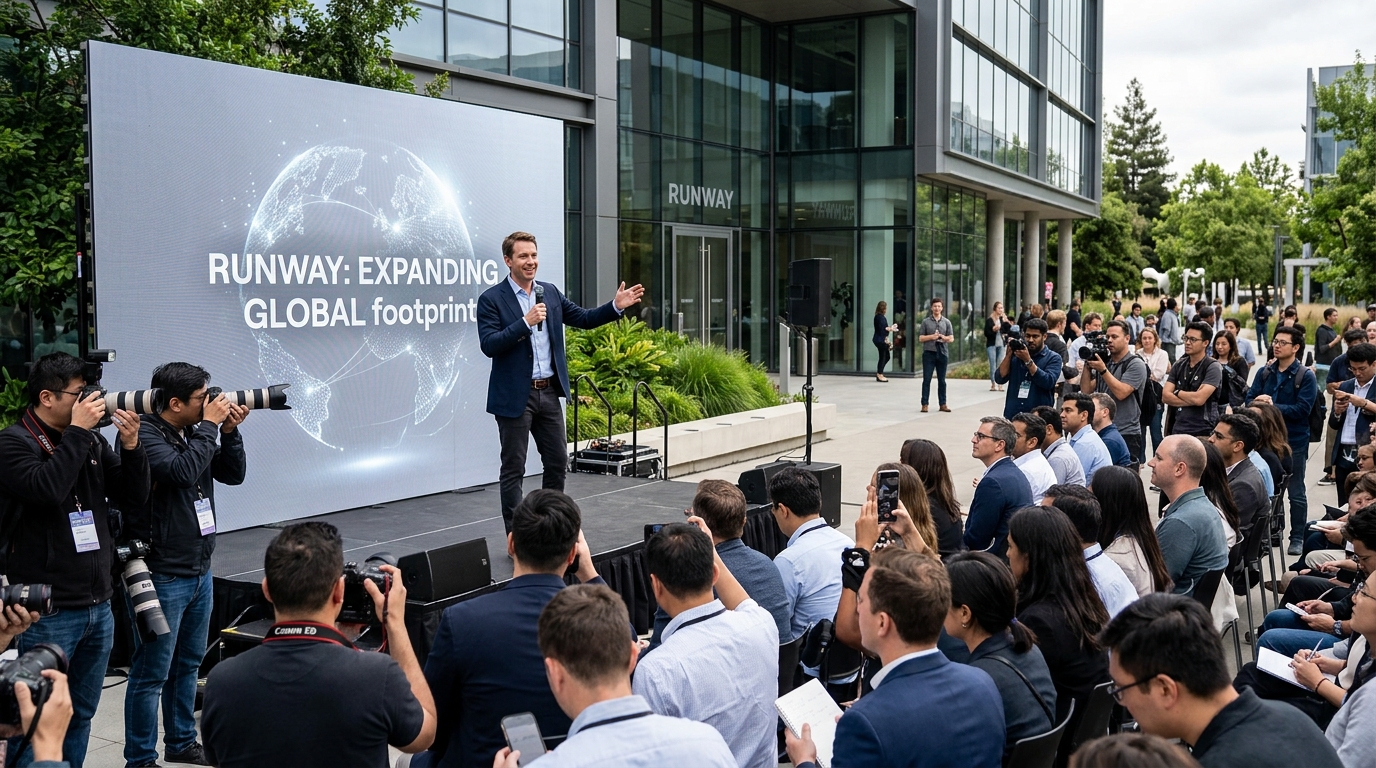
July 6, 2026, marks a pivotal turning point for the generative AI industry. Runway, the company that pioneered AI-driven video generation, has announced an aggressive global expansion strategy, establishing new research and business hubs in London, Tokyo, and Paris. With a committed investment of $300 million over the coming years, this move is not merely corporate scaling; it is a strategic positioning at the heart of the world's cultural and technological capitals.
The Strategic Choice of Hubs: London, Tokyo, Paris
The selection of these specific cities is far from accidental. Each represents a critical pillar of the creative and technological industries. London remains the global epicenter for advertising and visual effects (VFX), boasting a talent pool that Runway aims to leverage to integrate its tools into major Hollywood and streaming productions. Tokyo offers access to the massive anime and gaming markets, where generative AI could revolutionize production speeds. Finally, Paris, bolstered by the recent rise of the French AI ecosystem (featuring companies like Mistral), serves as Runway's bridge to European cinematic tradition and the EU’s stringent yet progressive regulatory framework.
Co-founder and CEO Cristóbal Valenzuela, speaking on Bloomberg Tech, emphasized that a physical presence in these markets is essential for understanding local creative needs. "AI is not a one-size-fits-all product. The way a Japanese animator uses AI is fundamentally different from a filmmaker in Paris," Valenzuela noted, highlighting the importance of cultural adaptation for their models.
$300 Million Investment: Research and Infrastructure
The $300 million investment will primarily target two areas: recruiting top-tier AI researchers and expanding computational infrastructure. Runway is in a constant arms race with giants like OpenAI (Sora) and Google (Veo), as well as emerging Chinese powerhouses like Kling. The ability to generate high-fidelity video that maintains temporal consistency remains the industry's "Holy Grail."
Runway is betting on the theory of "World Models." Instead of their models simply learning what pixels look like, they attempt to understand the laws of physics, gravity, and the movement of objects in 3D space. This approach requires massive capital and specialized personnel, which the company hopes to find beyond the narrow confines of Silicon Valley.
The Creator Challenge and AI Ethics
Despite the financial optimism, Runway's expansion comes at a time of intense controversy regarding copyright. Artists in London and Paris have expressed serious concerns about how these models are trained. Runway has sought to differentiate itself through "Runway Studios," an initiative that collaborates directly with creators, offering grants and tools rather than aiming to replace them.
"Our goal is not to make movies without people, but to empower people to make movies that were previously impossible due to cost or technical constraints," Valenzuela stated.
However, the pressure for transparency in training data remains. With its presence in Europe, Runway will be required to comply fully with the AI Act, which mandates detailed documentation of data sources. This could serve as either a hurdle or a competitive advantage if the company can prove the ethical superiority of its methods over its rivals.
The Future of Visual Storytelling
Runway's global expansion signals the end of the "experimental tool" era. We are now entering the age of "creative operating systems." The ability for a creator in Tokyo to produce a photorealistic trailer in minutes, utilizing local aesthetic elements, changes the rules of the game. Runway is no longer just selling software; it is selling the infrastructure upon which the entertainment of the future will be built. With $300 million and a global footprint, the bet is whether it can remain a leader in a market shifting at the speed of light.