

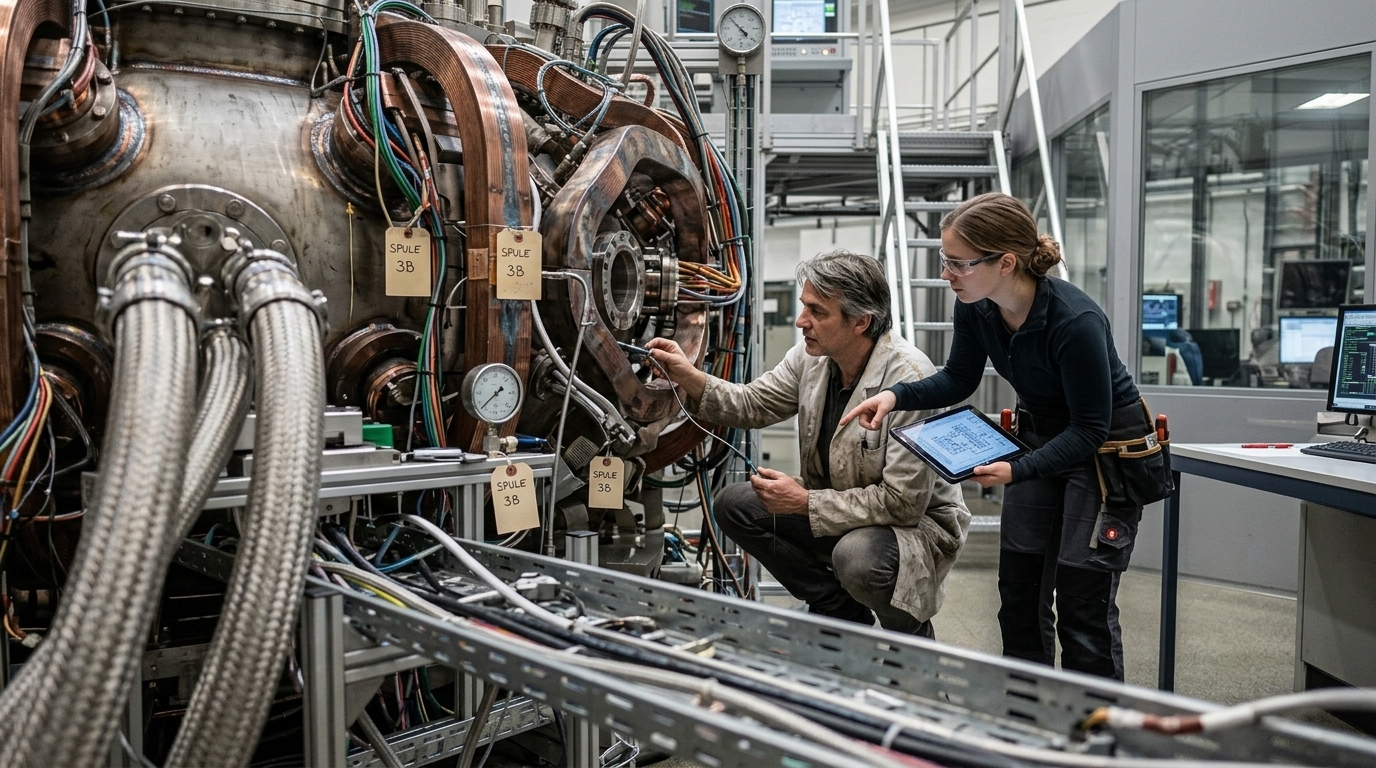
In the heart of Munich, a team of scientists and engineers is working on what many consider the 'Holy Grail' of physics: nuclear fusion. Proxima Fusion, a high-tech spin-out from the renowned Max Planck Institute for Plasma Physics (IPP), has managed to capture the attention of the global investment elite, with Google participating in a massive €411 million funding round. This move is not merely a capital allocation; it is a strategic statement about the future of energy in the age of Artificial Intelligence.
Nuclear fusion—the process that powers the sun and stars—promises virtually unlimited, clean energy without the carbon emissions of fossil fuels or the long-lived radioactive waste of traditional nuclear fission. However, replicating these conditions on Earth remains one of humanity's greatest scientific challenges. Proxima Fusion is betting on a specific architecture: the stellarator.
The Stellarator Revolution vs. The Tokamak
For decades, the dominant approach to fusion has been the Tokamak-style reactor—a donut-shaped device that uses magnetic fields to confine plasma. While Tokamaks, such as the international ITER project, have made significant strides, they face inherent instability issues that make continuous operation extremely difficult. This is where Proxima Fusion enters with the stellarator.
The stellarator is a much more geometrically complex device, but it offers a crucial advantage: stability. Instead of relying on electrical currents flowing through the plasma itself (as Tokamaks do), the stellarator uses external magnetic coils with incredibly intricate shapes to keep the plasma in equilibrium. Proxima Fusion leverages the legacy of Wendelstein 7-X, the world's largest stellarator located in Germany, to create the first commercial version of this technology.
"Fusion is no longer a dream for the next century; it is a necessity for the survival of our industrial civilization," company executives state.
Why is Google Investing in Fusion?
Google’s involvement (via its investment arm GV and other channels) in Proxima Fusion is no coincidence. The explosive rise of Artificial Intelligence has created an insatiable thirst for electricity. The data centers training models like Gemini consume vast amounts of energy, and traditional renewable sources like wind and solar are intermittent—they don't produce power 24/7.
Google is seeking a "baseload" energy source that is both clean and steady. Furthermore, there is a deep synergy between Proxima and Google in the software domain. Designing a stellarator requires immense computational power and advanced optimization algorithms to shape the magnetic fields. Using AI to design reactors is where Google's expertise meets Proxima's physics.
- Stability: Stellarators allow for continuous operation without the "disruptions" common in Tokamaks.
- Computational Design: Proxima utilizes digital twins to accelerate development cycles.
- European Sovereignty: The company represents Europe's heavy hitting response to US-based Commonwealth Fusion Systems and Helion Energy.
Energy Geopolitics and the European Ecosystem
Germany, despite its controversial decision to abandon traditional nuclear power (fission), is investing billions into fusion research. Proxima Fusion has become the symbol of this new approach. With the €411 million funding, the company plans to expand its Munich facilities and proceed with the construction of a prototype demonstrating the economic viability of energy production.
However, challenges remain. The materials science required to withstand extreme temperatures (millions of degrees Celsius) and the management of high-energy neutrons are issues that have not been fully resolved. Proxima Fusion promises results within the next decade, but the history of fusion is littered with missed deadlines. The difference today is the involvement of the private sector and the maturity of digital design tools.
In a world struggling to decarbonize without sacrificing economic growth, Proxima Fusion and its backers, like Google, are betting that the solution lies not in austerity, but in technological transcendence. If they succeed, Munich will no longer be known just for its automotive industry, but as the place where humanity successfully 'planted' the first terrestrial sun.





