

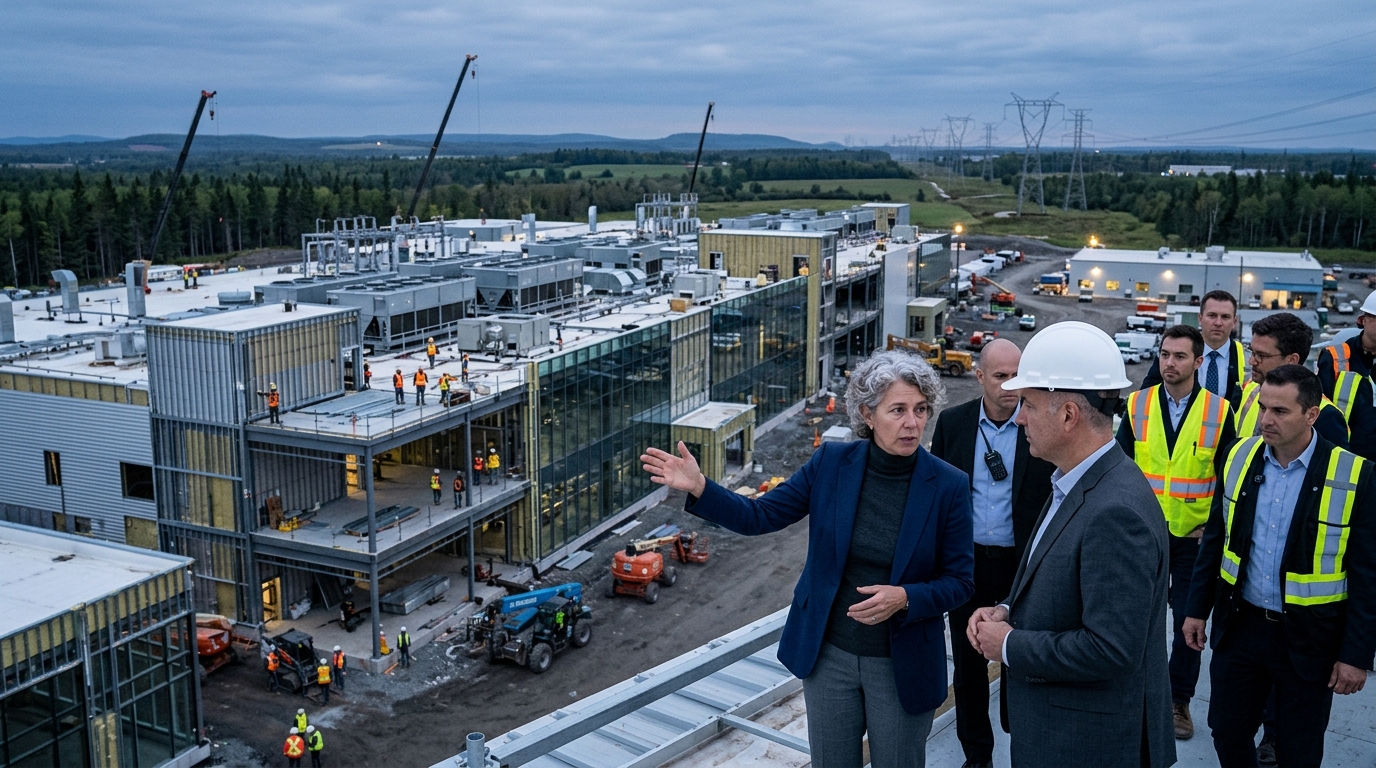
In a move that underscores Silicon Valley's relentless pivot toward artificial intelligence infrastructure, social media giant Meta has announced plans to invest billions of dollars in its first AI-dedicated data center in Canada. This facility is not merely an expansion of the company’s existing footprint; it is slated to be Meta’s largest data center outside the United States, a strategic decision that reshapes the geopolitical landscape of the technology sector.
This announcement comes at a time when the demand for raw computing power has reached a fever pitch. Meta, led by Mark Zuckerberg, is striving to maintain its lead in open-source AI through its Llama models. This Canadian investment is a declaration of intent: Meta is prepared to spend whatever it takes to ensure it is not outpaced by Microsoft, Google, or Amazon in the escalating AI arms race.
Why Canada? The Intersection of Energy and Climate
The choice of Canada as the host for this gargantuan project is a calculated one. AI data centers are notoriously energy-hungry and require sophisticated cooling mechanisms. Canada offers two critical advantages: an abundance of renewable energy, primarily through its extensive hydroelectric power grid, and a naturally cooler climate that significantly reduces the overhead costs of thermal management. In an era where Big Tech faces intense scrutiny over its carbon footprint, the ability to power operations with 'green' energy is both an economic necessity and a public relations imperative.
Furthermore, Canada boasts one of the world's most advanced AI talent ecosystems. Cities like Toronto and Montreal are global hubs for machine learning research. By investing in physical infrastructure, Meta is also looking to deepen its ties with the local academic and tech communities, ensuring that the next generation of AI engineers is trained on and works within Meta’s proprietary ecosystem.
"Infrastructure is destiny in the world of AI. Without the chips and the data centers, algorithms are just theory," noted industry analysts following the announcement.
The GPU War and Future-Proof Architecture
The new data center is expected to house hundreds of thousands of Graphics Processing Units (GPUs), likely featuring NVIDIA's latest H100s and the upcoming B200 Blackwell architecture. These chips are the lifeblood of training Large Language Models (LLMs). The facility's architecture will be specifically tailored for AI, incorporating advanced liquid cooling and high-speed networking fabrics that allow thousands of processors to function as a single, massive supercomputer.
This investment also signals a shift in Meta's internal strategy. While the company previously relied on general-purpose data centers to support Facebook and Instagram, this new generation of facilities is 'AI-native.' This means every aspect of the design—from power delivery to rack layout—is optimized for the extreme demands of AI training and inference workloads, which differ significantly from traditional web serving.
Economic and Geopolitical Implications
Meta’s move has not gone unnoticed by the Canadian government, which views this investment as a golden opportunity to solidify the nation's status as an 'AI superpower.' However, the project is not without its controversies. The strain on local electrical grids is a genuine concern; a single facility of this scale can consume as much power as a mid-sized city. Negotiations regarding subsidies, tax breaks, and energy pricing are expected to be intense as Canada seeks to balance investment attraction with resource conservation.
On a global scale, establishing its largest non-US data center in Canada suggests that Meta is seeking 'safe harbors' for its data and processing power. With European regulators becoming increasingly stringent and geopolitical tensions with China rising, Canada offers a politically stable and geographically proximate alternative, remaining firmly within the North American sphere of influence while providing a degree of international diversification.
Conclusion: The Physicality of the Digital Frontier
As Meta moves forward with this ambitious project, it is becoming clear that artificial intelligence is no longer just a software challenge. It is a battle for land, water, electricity, and silicon. The new Canadian data center will be the foundry where future versions of Llama are forged. Its success will determine whether Meta can successfully complete its metamorphosis from a social media company into a dominant force in global computing infrastructure.





