

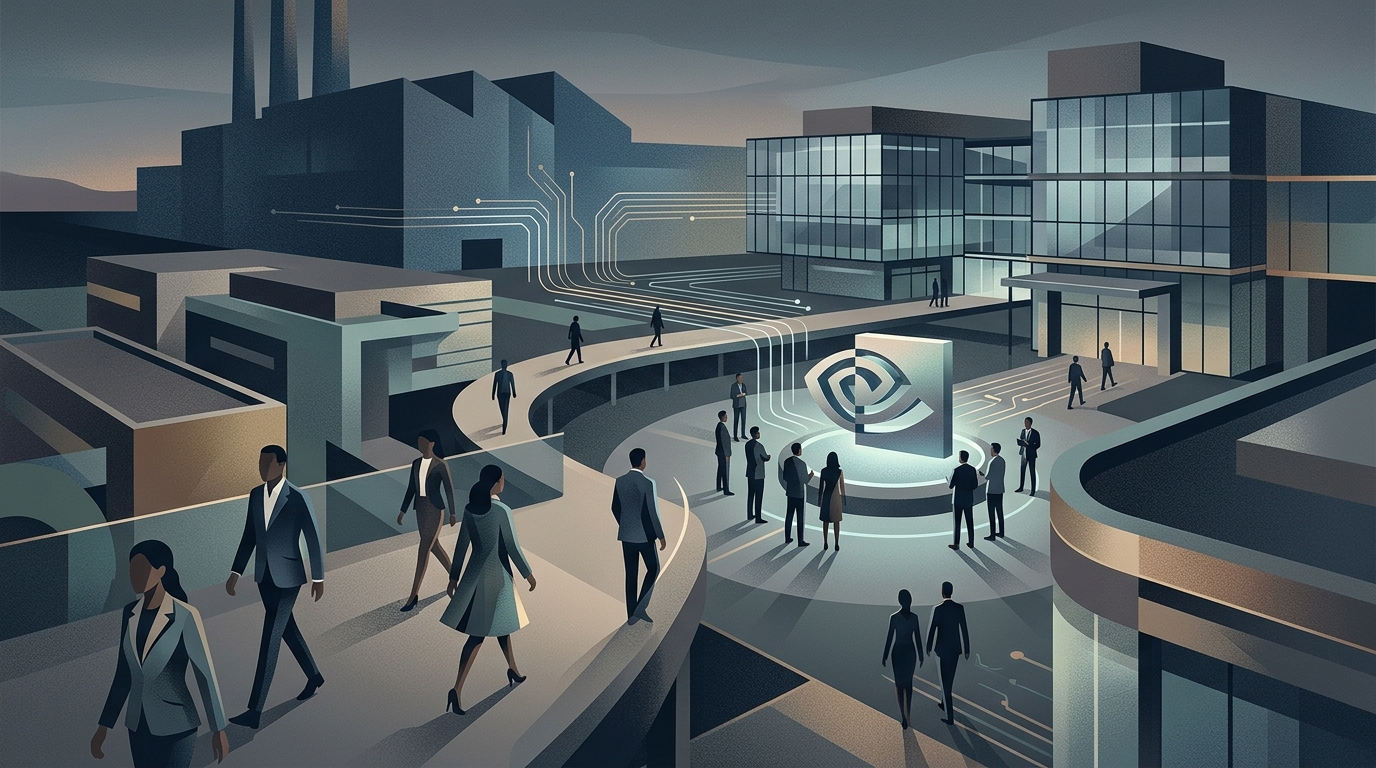
Hon Hai Precision Industry Co., globally recognized as Foxconn, is no longer just the world’s largest contract manufacturer for consumer electronics. In a strategic pivot that is redrawing the global technological landscape, the Taiwanese giant has recently issued a series of bullish forecasts, anchored almost exclusively by the insatiable market demand for Artificial Intelligence (AI) infrastructure. Its deepening partnership with Nvidia, the undisputed leader in AI silicon, places Hon Hai at the very epicenter of the Fourth Industrial Revolution.
From Smartphones to AI Servers
For decades, Hon Hai’s fortunes were inextricably linked to the lifecycle of consumer electronics, most notably the iPhone. However, as the smartphone market matures and profit margins face pressure, Chairman Young Liu has aggressively steered the company toward the data center market. Foxconn now commands approximately 40% of the global server market, and demand for new systems incorporating Nvidia’s Blackwell architecture is expected to propel this share even further.
This transition is not merely quantitative; it is a qualitative leap. AI servers are significantly more complex to manufacture than traditional enterprise servers, requiring advanced liquid cooling systems and sophisticated power management. Hon Hai is investing billions into developing these liquid-cooling solutions, which are essential for operating Nvidia’s next-generation chips that generate immense thermal output. This technological edge allows the company to command higher margins, effectively escaping the "low-cost assembler" trap that has historically defined the EMS (Electronic Manufacturing Services) sector.
The Strategic Alliance with Nvidia
The relationship between Hon Hai and Nvidia is described by industry analysts as "symbiotic." While Nvidia designs the most advanced processors in the world, it requires a partner with Foxconn’s scale and precision to translate those designs into functional rack-scale systems that can be deployed in data centers globally. The recent announcement of a massive AI computing center in Taiwan, utilizing Nvidia’s full hardware and software stack, serves as a testament to this deep integration.
"Artificial Intelligence is the most significant growth driver for us in the coming years," a company executive recently stated. "We are not just building boxes; we are building the brains of tomorrow's global economy."
This optimism is reflected in the company's financial metrics. Revenue from the AI server segment is projected to account for 40% of total server revenue by 2025, a dramatic increase from the single digits seen just a few years ago. The market has reacted favorably, with the company’s stock hitting record highs as investors view Hon Hai as a reliable "picks and shovels" play in the AI gold rush, offering exposure to the boom without the volatility associated with pure-play software firms.
Geopolitics and Supply Chain Resilience
Despite the economic euphoria, Hon Hai must navigate a minefield of geopolitical tensions. Its heavy reliance on manufacturing facilities in mainland China remains a point of friction in its relationship with the U.S. government, particularly regarding sensitive AI technology. In response, the company is executing a rigorous "China + 1" strategy, rapidly expanding its footprint in India, Vietnam, and Mexico.
In Mexico specifically, Foxconn is constructing the world’s largest production facility for Nvidia’s GB200 chips. This move is strategic; proximity to the North American market and the mitigation of tariffs on Chinese-origin goods make Mexico an ideal hub for high-end server assembly. Simultaneously, India is becoming a cornerstone for consumer device manufacturing, allowing the company to reallocate its specialized engineering resources in Taiwan and China toward high-complexity AI hardware.
Conclusion: Hon Hai’s Future in the Intelligence Age
Hon Hai Precision Industry stands at a historic crossroads. Its ability to adapt to the rigorous demands of the AI era will determine whether it remains a manufacturing titan or becomes a relic of the mobile age. With Nvidia as a strategic anchor and an aggressive diversification plan in place, the company appears to have secured its role as the "blacksmith" of the digital future. The challenge now lies not just in manufacturing at scale, but in innovating at the speed of AI, in a world where hardware and software are becoming increasingly inseparable.





