

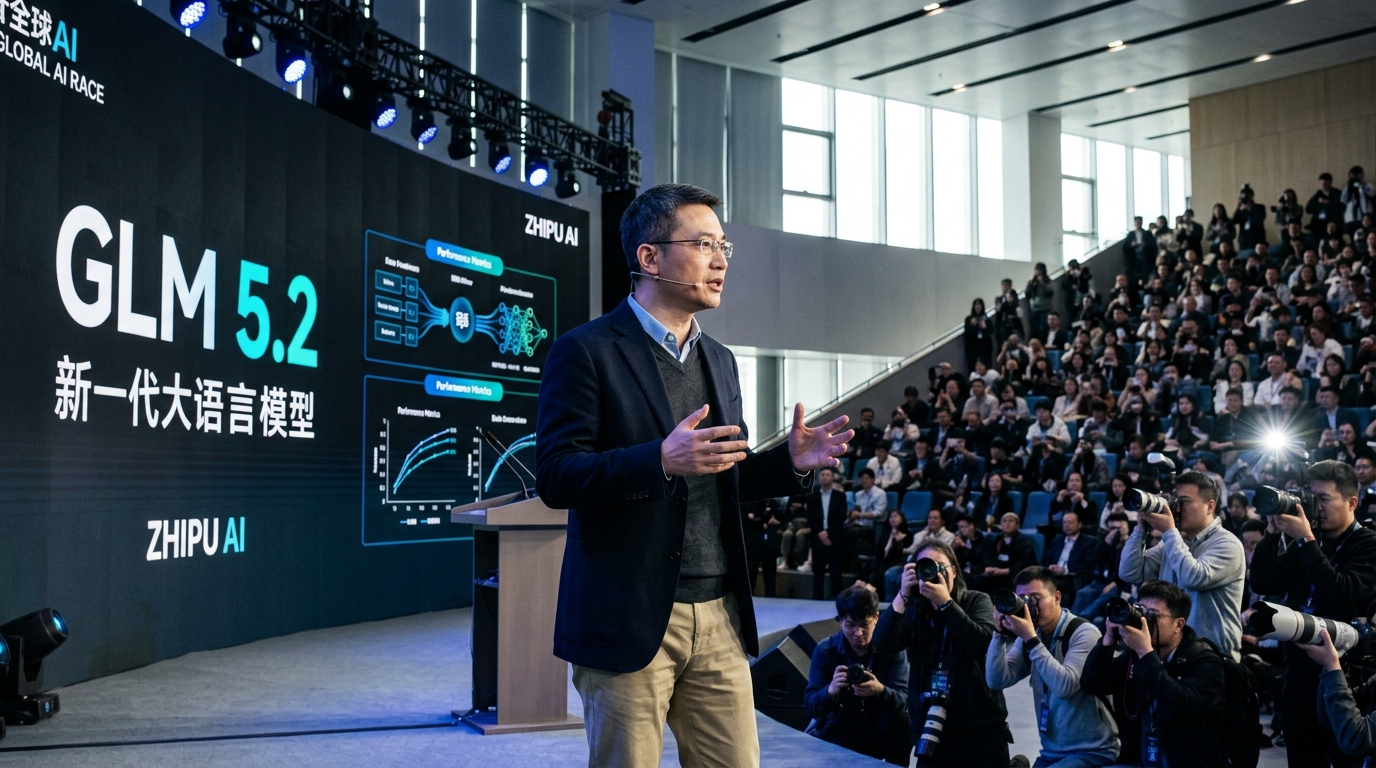
In the ever-shifting landscape of global artificial intelligence, China is no longer content with being a follower. The recent unveiling of GLM 5.2 by Zhipu AI, one of the country's most valuable 'unicorns,' is a resounding statement of power echoing from Beijing to Silicon Valley. This new model doesn't just promise incremental improvements; it aims directly for the summit, challenging established Western rivals like Anthropic's Claude 3.5 Sonnet and OpenAI's GPT-4o.
Technical Prowess and Benchmarking Success
GLM 5.2 (General Language Model) represents the pinnacle of research from Zhipu AI, a company born from the prestigious laboratories of Tsinghua University. The model's architecture has been meticulously optimized to deliver exceptional reasoning, coding proficiency, and long-context handling. According to initial benchmarks, GLM 5.2 shows impressive results across standard evaluations like MMLU (Massive Multitask Language Understanding) and HumanEval for programming tasks.
A significant focus has been placed on multimodality. The model can simultaneously process text, images, and audio with a fluidity that approaches human perception. Zhipu AI claims that the model's response to complex queries requiring logical sequencing is now on par with, if not superior to, Anthropic's Claude 3.5—a model widely regarded as the 'gold standard' for ethical and logical reasoning.
The Geopolitical Chessboard and Bypassing Sanctions
The development of GLM 5.2 is not just a technological feat but a strategic political victory for China. Amidst strict US export controls on advanced semiconductors (such as Nvidia's H100 chips), Zhipu AI has managed to train a world-class model using domestic resources and innovative algorithmic optimization methods. This demonstrates that the AI gap between East and West is closing much faster than analysts previously anticipated.
- Resource Efficiency: GLM 5.2 is designed to run at high speeds even on less powerful hardware, making it highly attractive for enterprise applications.
- Cultural Adaptation: Unlike its Western counterparts, GLM 5.2 possesses a deep understanding of Chinese idioms, culture, and the country's specific legal framework.
- Open Source Strategy: Zhipu AI continues its strategy of offering open-source versions, drawing thousands of developers into its ecosystem and fostering rapid innovation.
Challenges and the Future of AI Dominance
Despite its technical triumphs, GLM 5.2 faces significant hurdles. The primary challenge remains global trust. Concerns regarding data privacy and potential state-mandated censorship of the model's output act as a deterrent for adoption in Western markets. Furthermore, Anthropic and OpenAI are not standing still, with rumors of their 'next-generation' models already circulating in the tech community.
"Artificial intelligence is no longer a two-speed race. GLM 5.2 proves that innovation can flourish even under the pressure of restrictions," notes a Beijing-based industry analyst.
In conclusion, the arrival of GLM 5.2 reshapes the technological map. Zhipu AI is not merely competing with Anthropic; it is redefining what Chinese innovation looks like in the 21st century, turning the competition into a multipolar battle for the future of intelligence.





