

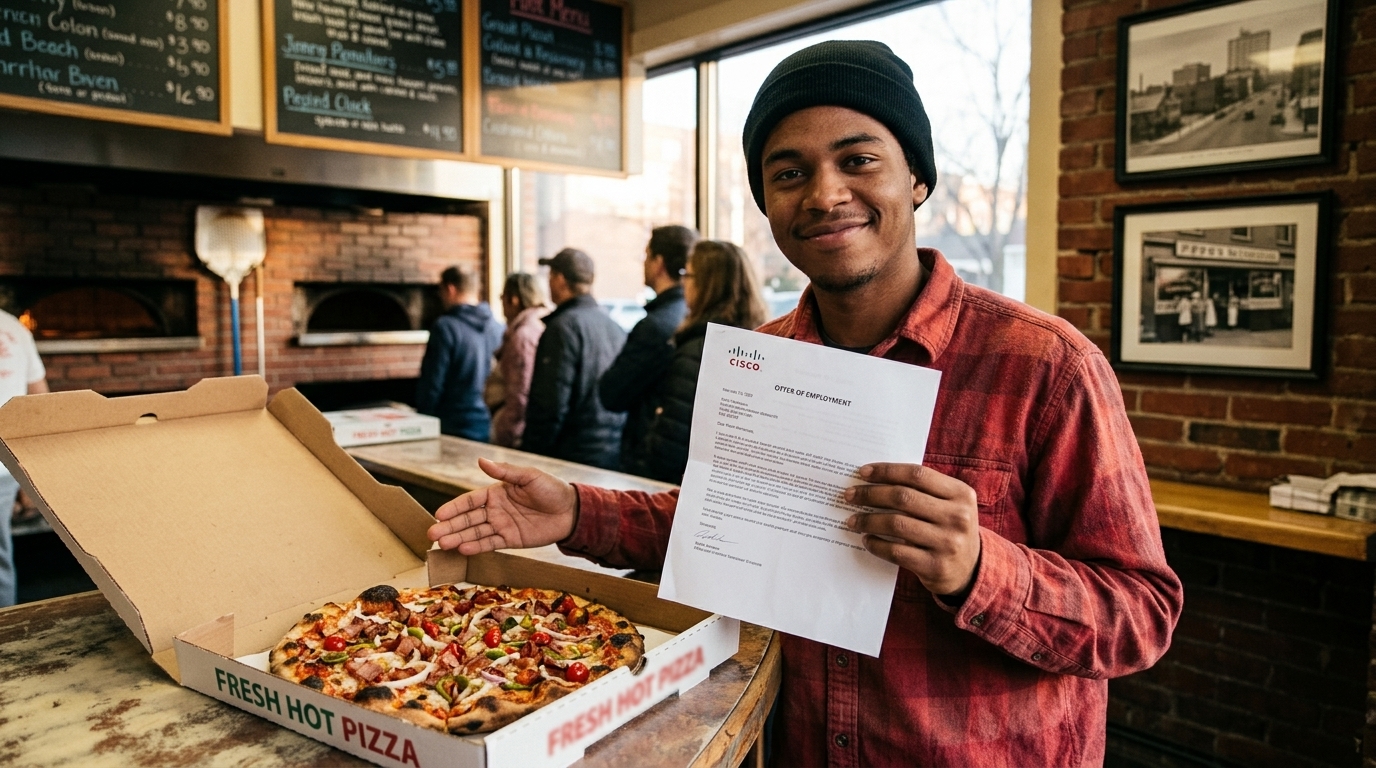
In an era where job hunting has devolved into a grueling war against Applicant Tracking Systems (ATS) and AI-driven gatekeepers, Ayala Ossowski’s story feels almost like a relic from a different age. The University of Florida graduate didn’t secure her breakthrough role through LinkedIn or an automated portal; instead, she found it while wearing her university baseball cap behind the counter of a pizza joint. Her decision to turn her service-industry job into a venue for "unusual networking" highlights a growing trend among Gen Z: a strategic return to physical, serendipitous interactions as an antidote to digital fatigue.
The Strategy of 'Unusual Networking'
Realizing that the hundreds of resumes she sent into the digital void were vanishing without a trace, Ossowski decided to leverage the one advantage she had: direct human access. By wearing her university cap, she invited conversations with customers who shared an alma mater or simply recognized the logo. When a customer would ask about her studies, she was ready with a polished elevator pitch—a concise summary of her skills, her degree, and her professional ambitions.
This approach wasn’t merely a move of desperation; it was a sophisticated market analysis. In today’s environment, where generative AI can produce thousands of "perfect" resumes in seconds, authenticity and face-to-face rapport have accrued a significant premium. For Ossowski, the pizza restaurant wasn’t just a way to pay the bills; it was a stage where she could demonstrate her communication skills in real-time, proving her value far more effectively than a PDF ever could.
The Pivot to Cisco and the Corporate Perspective
Fortune, as the saying goes, favors the prepared. One of those conversations over a pepperoni slice led to a connection with an executive who saw in Ossowski something missing from many digital profiles: grit and the ability to navigate unpredictable social dynamics. This chance encounter opened the door to an internship at Cisco, which rapidly evolved into a full-time role within the company's sales and strategy division.
From a corporate standpoint, cases like Ossowski’s underscore a critical shift in hiring philosophies for 2026. While AI is excellent at filtering for hard skills, "soft skills" such as empathy, persuasion, and initiative remain notoriously difficult to assess through a screen. Cisco, like many tech giants, is increasingly looking for candidates who can break the mold and demonstrate creative problem-solving—even when the problem is the hiring process itself.
Gen Z and the Authenticity Revolution
Ossowski’s story has resonated globally, not just because of its success, but because it voices the frustration of a generation tired of being treated like data points. Young professionals in 2026 are finding that an over-reliance on data has dehumanized the workforce. Returning to "old school" methods—personal referrals, cold introductions, and physical presence—is becoming a form of resistance against the algorithmic determination of their careers.
- Digital networking has reached a saturation point, making physical presence a rare commodity.
- Employers are increasingly valuing an "entrepreneurial mindset" regardless of the current job title.
- The ability to bridge disparate worlds (e.g., service industry and high-tech) indicates high adaptability.
"It wasn't the pizza that sold me; it was my ability to connect with the person across the counter in less than two minutes," Ossowski noted in a recent reflection on her journey.
Conclusion: The Future of Work is Hybrid
As we move further into the age of automation, Ossowski’s example serves as a reminder that technology should be the tool, not the destination. Her success doesn't negate the need for a strong resume or technical proficiency, but it adds a necessary layer of human agency. For the Class of 2026, the message is clear: do not wait for the algorithm to discover you. Create your own opportunities in the spaces where others see only a mundane routine. In a world of bots, being undeniably human is the ultimate competitive advantage.





