

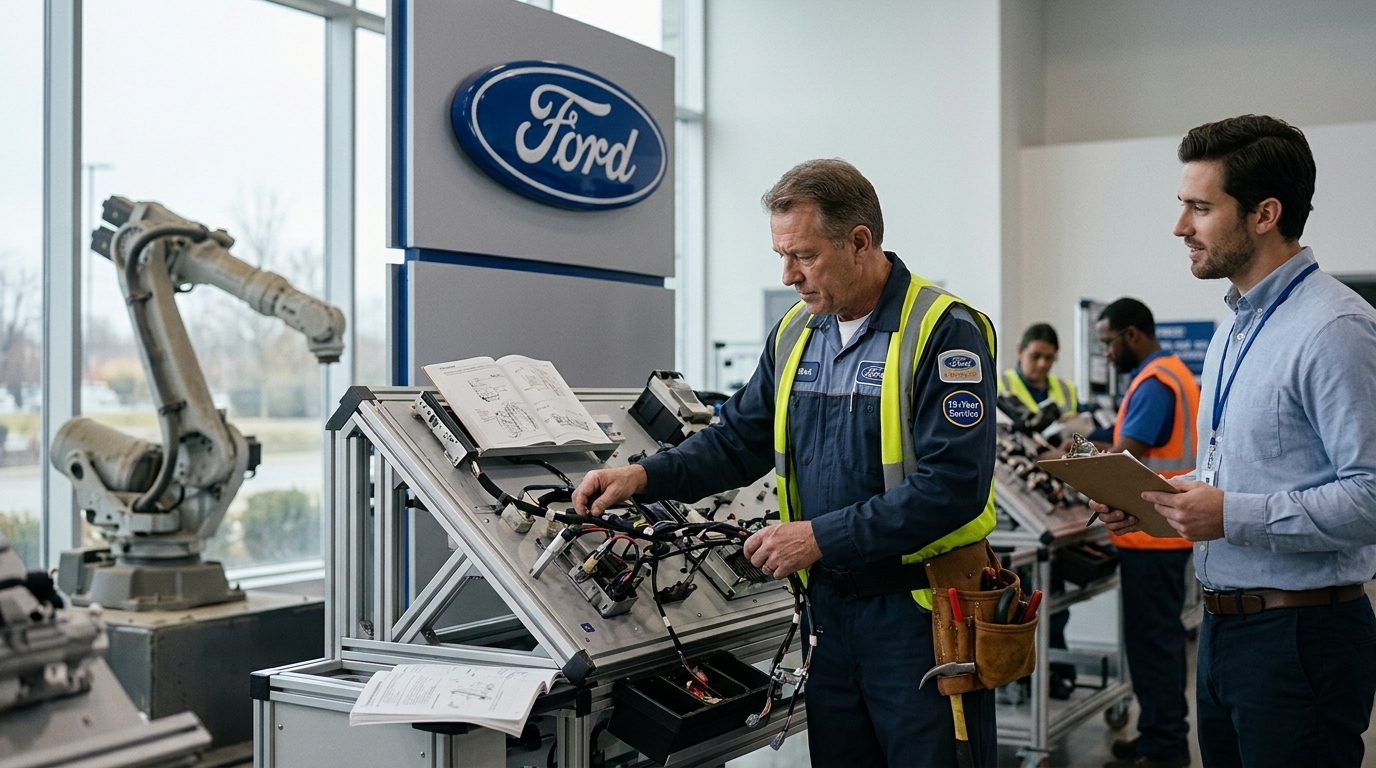
In the dawn of the Fourth Industrial Revolution, the narrative seemed almost predestined: Artificial Intelligence (AI) would replace human labor, slashing costs and eliminating errors. However, Ford Motor Company’s recent move to recall and rehire dozens of experienced engineers and specialized staff, following a failed attempt at full automation in specific design and control departments, serves as a resounding reminder that technology is not yet ready to substitute human intuition and decades of experience.
The news, which surfaced via Fortune, reveals a deep identity crisis within the automotive sector. Ford, under pressure from competitors like Tesla and Chinese EV manufacturers, invested billions in generative AI systems to accelerate the development of new models. Yet, the reality of the assembly line proved far more complex than simulation models suggested.
The Gap Between Algorithm and Reality
The trouble began when the AI systems, trained to optimize component design and predict material failures, started producing results that, while theoretically sound, failed miserably in real-world testing. The engineers who were let go during "efficiency" cuts possessed something AI lacks: the ability to perceive context. An algorithm can calculate a metal's tensile strength, but a veteran engineer with 30 years of experience "feels" how a vehicle will behave in extreme weather or on rugged terrain, based on thousands of hours of observation that haven't been digitized.
According to internal sources, Ford discovered that the time required to fix errors generated by the AI was longer than the time it would take a human to complete the task from scratch. This led to production delays and, more importantly, concerns regarding vehicle safety. The decision to reach back out to former employees was not just a move of necessity, but an admission that a company's "institutional memory" is its most valuable asset.
The Return of "Human Intelligence"
Ford's case is not an isolated incident; it represents the tip of the iceberg in a broader trend known as "AI Disillusionment." Many Fortune 500 companies are discovering that AI is an excellent support tool but a poor replacement. The rehiring of engineers at Ford occurred under terms that reflect a shift in power: higher salaries, advisory roles, and a commitment that technology will henceforth be used to augment human judgment, not bypass it.
- AI struggles to handle "edge cases" that require creative problem-solving.
- The lack of transparency in algorithmic decisions (Black Box AI) makes it difficult to identify the root cause of a failure.
- The loss of empirical knowledge leads to a degradation of the final product's quality.
"Technology can process data, but humans process meaning. In the automotive industry, a mistake in meaning can cost lives," stated a Ford executive who wished to remain anonymous.
Lessons for the Future of Work
Ford’s experience should serve as a lesson for any board of directors viewing AI as a silver bullet for reducing labor costs. Industrial production, especially in high-precision sectors, requires a combination of digital speed and human wisdom. The return of the "veterans" to Ford’s offices marks the end of the period of uncritical AI adoption and the beginning of a more mature approach, where humans remain at the center of decision-making. Technology is here to serve us, not to displace us before it has even learned to walk the difficult paths of real-world production.





