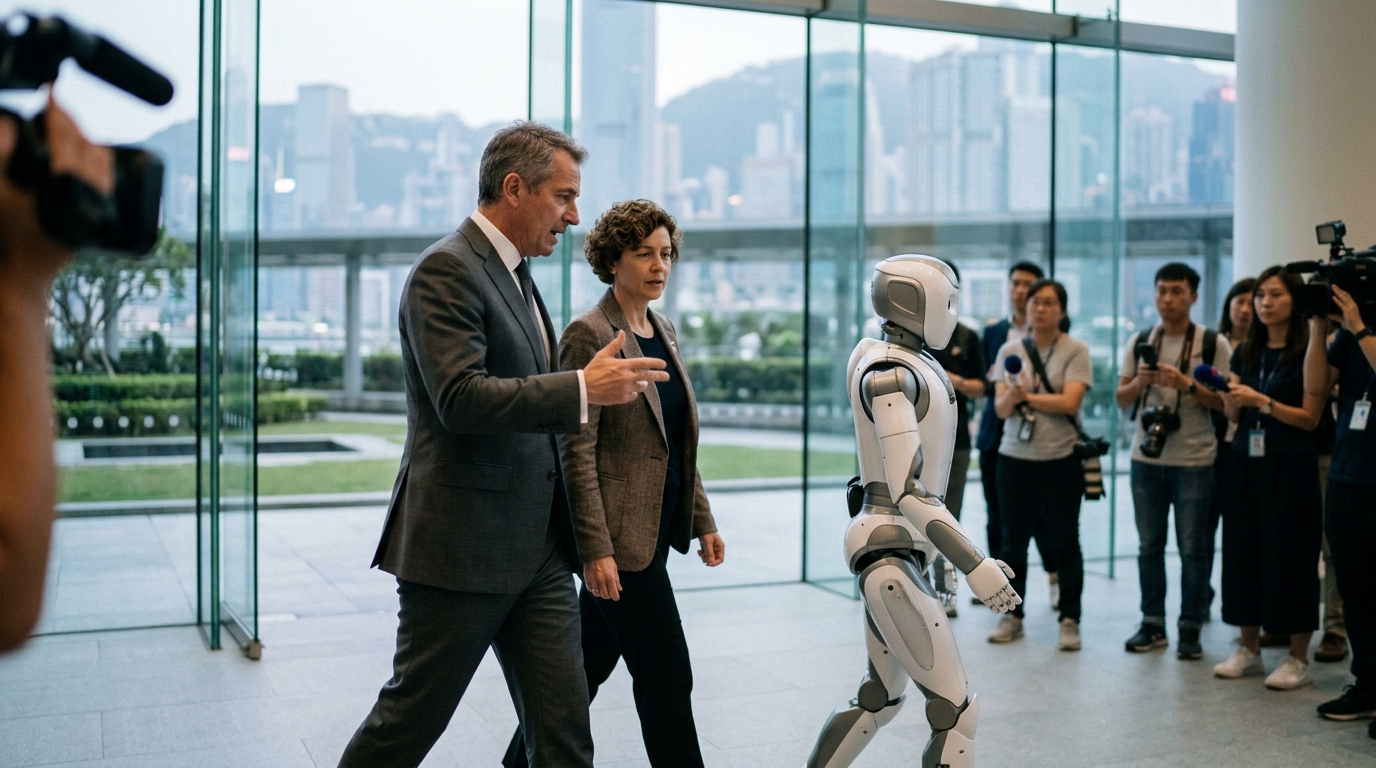
In a period where technological supremacy is shifting from digital language models to the physical embodiment of machines, the news of EngineAI's application for an Initial Public Offering (IPO) on the Hong Kong Stock Exchange (HKEX) is not merely a business move, but a geopolitical milestone. According to Bloomberg sources, the Chinese startup, which has emerged as a major player in the humanoid robotics sector, seeks to raise capital that will allow it to transition from prototyping to mass industrial production.
The Strategic Significance of Hong Kong
The choice of Hong Kong for the IPO reflects the need for China's tech elite to balance domestic state oversight with access to international capital. At a time when US markets remain hostile to Chinese high-tech firms due to semiconductor export restrictions and national security concerns, Hong Kong provides a necessary "window" to the world. EngineAI, following in the footsteps of UBTECH Robotics which listed on the same exchange in 2023, aims to capitalize on investor interest in "Embodied AI."
This move comes at a time when Beijing has designated robotics as one of the central pillars of its "New Productive Forces." The Chinese government aims for the mass production of humanoid robots by 2025-2027, viewing them as the next "disruptive" technology after smartphones and electric vehicles. EngineAI, with its advanced models demonstrating exceptional balance and learning capabilities through reinforcement learning, is at the forefront of this endeavor.
Technological Edge and Industrial Application
What sets EngineAI apart from competitors like Tesla's Optimus or Figure AI is its focus on movement speed and adaptability to uneven terrain. The company's robots have demonstrated running and navigation capabilities in environments simulating construction sites or logistics warehouses. The integration of Large Language Models (LLMs) allows these machines not only to execute commands but to understand the context of their tasks, making them true collaborators in the workplace.
- Dynamic Motion: Utilization of advanced actuators allowing high-precision movements.
- Decision Autonomy: Embedded AI processing visual data in real-time.
- Production Scaling: Design focused on reducing manufacturing costs for wide adoption.
However, the transition from lab to factory remains the greatest challenge. EngineAI must prove to investors that it can produce thousands of units with consistent quality and, crucially, that a market exists ready to absorb the cost. The current price of a humanoid robot remains prohibitive for most small and medium-sized enterprises, limiting the clientele to industrial giants.
Global Competition and the Geopolitical Chessboard
EngineAI's move does not happen in a vacuum. Silicon Valley is responding with billions of dollars in funding for companies like Figure and Agility Robotics, while Boston Dynamics (owned by Hyundai) recently transitioned to fully electric models. The competition for robotics dominance resembles the 20th-century space race. Whichever power manages to automate its workforce with humanoid robots first will gain a massive advantage in productivity and labor costs.
"It is no longer about who has the best code, but about who can give that code the best hands and feet," notes an industry analyst.
EngineAI also faces the specter of Western sanctions. If its robots are deemed dual-use (civilian and military), its access to critical components, such as NVIDIA processors, could be abruptly severed. The Hong Kong IPO is an attempt to fortify itself financially before geopolitical tensions escalate further.
The Future of Work and Social Implications
Beyond numbers and shares, the rise of EngineAI brings the question of human replacement to the fore. In China, with its aging population and shrinking workforce, robots are seen as economic saviors. In the West, the reception is more skeptical, with unions warning of mass unemployment. EngineAI promises that its robots will take over the "3D" jobs (Dirty, Dangerous, Dull), leaving humans in supervisory roles. The reality, however, will depend on how quickly production costs drop and how "smart" these machines become in their interaction with the physical world.