

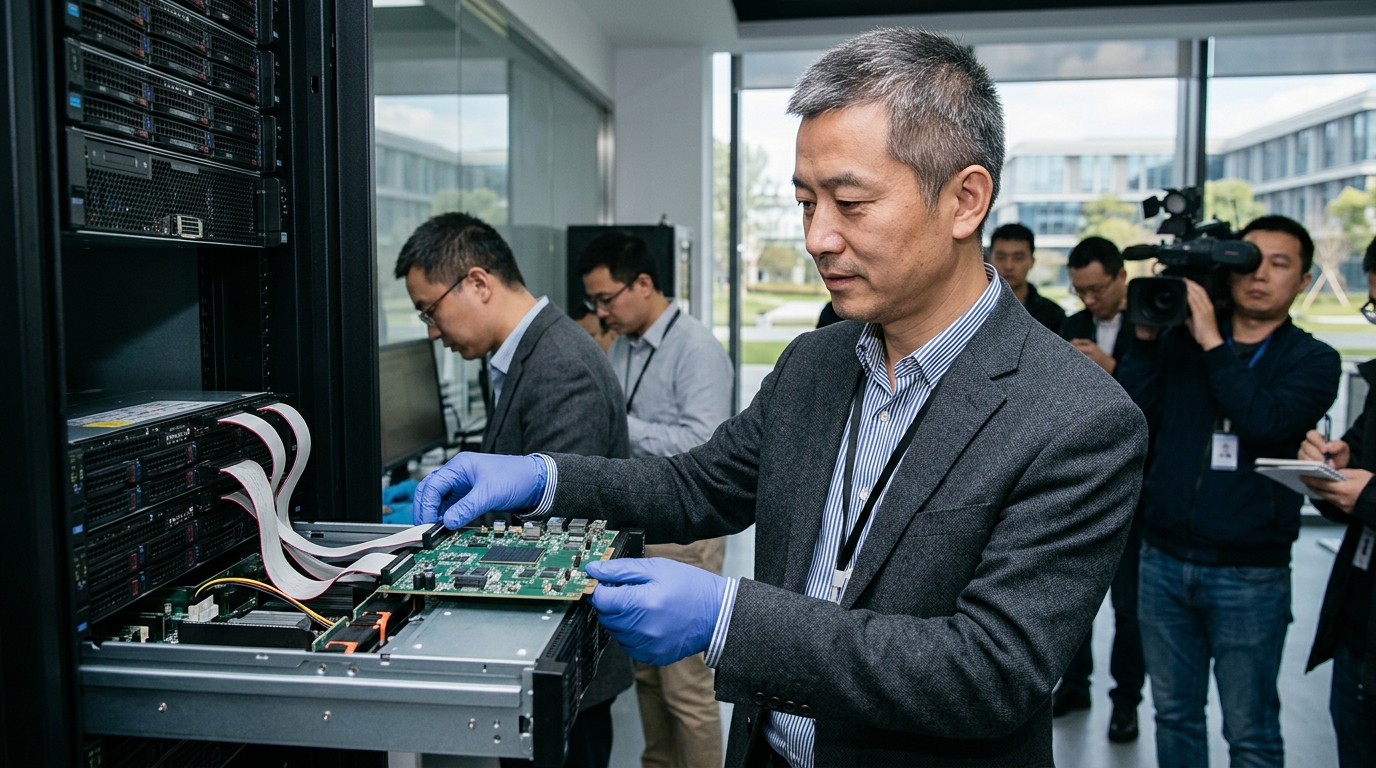
In a move that is redrawing the global map of artificial intelligence, DeepSeek, the Chinese AI lab that disrupted the industry with its hyper-efficient models, is reportedly developing its own specialized AI chips. This decision is not merely a business expansion; it is a strategic necessity for survival and dominance in a geopolitical environment increasingly hostile to Chinese tech firms. As US export controls on Nvidia’s flagship chips tighten, DeepSeek is moving toward full-stack sovereignty—controlling everything from the code to the silicon.
The Necessity of Autonomy Amidst Sanctions
For DeepSeek, dependence on external suppliers has become its primary bottleneck. Despite the global acclaim for its DeepSeek-V3 and R1 models, the company faces a looming compute crisis. Current US sanctions block access to Nvidia’s top-tier H100 and B200 processors, forcing Chinese firms to rely on downgraded versions or navigate the complexities of the secondary market. Even domestic alternatives, such as Huawei’s Ascend series, struggle with production yields and software optimization hurdles.
Building a proprietary chip allows DeepSeek to bypass these constraints. According to industry sources, the company is aiming to create an ASIC (Application-Specific Integrated Circuit) meticulously optimized for its Mixture-of-Experts (MoE) architecture. Unlike Nvidia’s general-purpose GPUs, which are designed for a broad range of workloads, DeepSeek’s custom silicon will be a precision tool designed exclusively to run its specific algorithms with maximum throughput and minimum power consumption.
MoE Architecture and Silicon Specialization
DeepSeek’s competitive edge has always been its algorithmic ingenuity. By utilizing MoE architecture, which activates only a fraction of a model's parameters for any given request, the company has drastically reduced inference costs. However, generic GPUs are not perfectly suited for the sparse computation patterns of MoE. A DeepSeek-designed chip could feature specialized memory management units and data routing fabrics that align perfectly with how MoE distributes tasks among its specialized "experts."
"Vertical integration is no longer a luxury; it is a prerequisite for AI leadership. DeepSeek recognizes that software has reached the limits of what existing hardware can efficiently support," noted a senior semiconductor analyst.
This approach mirrors the strategies of global tech giants like Google with its TPUs or Apple with its M-series silicon. The critical difference is that DeepSeek is executing this pivot under extreme pressure, with limited access to the most advanced lithography processes (like those from TSMC), forcing the company to be even more innovative in its architectural design to compensate for manufacturing limitations.
Challenges and Geopolitical Ripple Effects
The path to functional AI silicon is fraught with obstacles. First is the manufacturing hurdle. While DeepSeek can design the chip, fabricating it requires advanced facilities. With TSMC facing intense pressure from US regulators, DeepSeek may have to rely on China’s SMIC, which currently lags behind in cutting-edge 7nm and 5nm production capacity. Second, the software ecosystem is as vital as the hardware. Nvidia’s dominance is anchored by CUDA; DeepSeek will need to develop a robust, developer-friendly software stack from scratch.
On a broader scale, this move signals a definitive decoupling of the Chinese tech ecosystem from the West. If DeepSeek successfully produces a chip that rivals Nvidia in specific AI tasks, it will prove that US sanctions have not only failed to halt Chinese progress but have acted as a catalyst for domestic innovation. This could lead to a bifurcated AI world: a Western ecosystem built on Nvidia and a Chinese ecosystem powered by proprietary solutions from firms like DeepSeek and Huawei.
The Future of AI Sovereignty
DeepSeek’s investment in hardware is a high-stakes gamble. If successful, the company will lower its operational costs to a point where it can offer AI services at prices no Western firm can match. DeepSeek-V3 is already significantly cheaper to run than GPT-4o. With custom hardware, this price gap could widen into a chasm, potentially making DeepSeek the default provider for cost-sensitive AI applications globally.
In conclusion, DeepSeek is not just building a chip; it is building a fortress. In an era where compute is the new oil, controlling the "refineries"—the chips—is the only guarantee of independence. This move will be closely watched by Washington and Silicon Valley alike, as its outcome will determine who holds the reins of the next industrial revolution.





