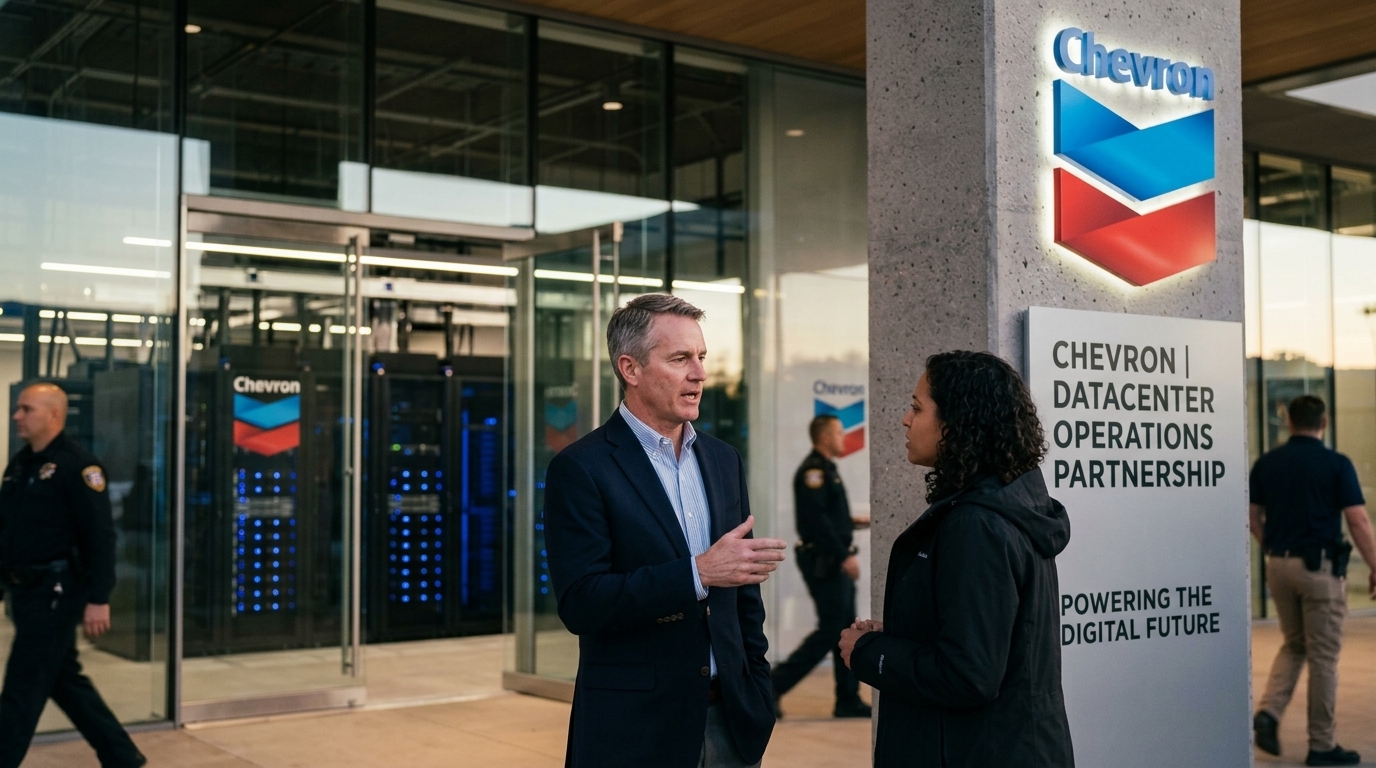
In an era where the digital economy and heavy energy industry are converging at an unprecedented pace, Chevron, one of the traditional "Seven Sisters" of the oil industry, is emerging as an unexpected yet pivotal player in the infrastructure of Artificial Intelligence. The company's recent announcement regarding the pursuit of new data center deals across the Midwest, the Rocky Mountains, and the Gulf Coast signals a strategic shift that goes far beyond simple hydrocarbon extraction.
This move is not a bolt from the blue. As tech giants like Microsoft, Google, and Amazon race to secure the power necessary for training and operating their large language models, the U.S. electrical grid is under immense strain. Chevron, possessing vast tracts of land, access to abundant natural gas, and power generation expertise, is positioning itself as the ideal partner for an industry that requires power 24/7, 365 days a year.
The Strategic Geography of Energy
Chevron's choice of regions is calculated. The Midwest and the Gulf Coast offer a combination of low land costs and proximity to existing natural gas infrastructure. While Northern Virginia remains the world's data center capital, grid saturation there is forcing investors to seek new "virgin" territories. Chevron can offer "behind-the-meter" solutions—generating power directly on the data center site—thereby bypassing the years-long delays associated with public utility grid connections.
The Rocky Mountain region is of particular interest, where climatic conditions favor natural cooling for servers, significantly reducing energy overhead. Chevron is exploring how to utilize the natural gas it extracts in the region to power low-emission turbines, providing a reliable alternative to intermittent renewable sources like wind and solar.
The Sustainability Paradox and Natural Gas
This raises a critical question: How do fossil fuels align with Big Tech’s net-zero carbon commitments? The answer lies in the concept of "baseload power." Artificial Intelligence cannot wait for the wind to blow or the sun to shine. Chevron is promoting natural gas as the essential "bridge fuel," arguing that with the implementation of Carbon Capture and Storage (CCS) technologies, it can provide cleaner energy than coal while maintaining the required stability for high-performance computing.
These agreements, often spanning two decades, provide Chevron with a steady revenue stream that is not directly tied to the volatility of global oil prices. It is a form of "digital insurance" for the energy giant, allowing it to remain relevant in a world attempting to transition away from gasoline but remaining hungry for data processing.
Economic Implications and Future Outlook
From an investment perspective, Chevron is transforming from a traditional oil major into an integrated energy solutions provider. Wall Street views these moves favorably, as data centers are considered high-credit-quality tenants with long-term contracts. Furthermore, Chevron's ability to utilize its own gas feedstock reduces supply chain costs, enhancing profit margins in a way few other companies can match.
In conclusion, Chevron's expansion into data centers is not just a business maneuver; it is an acknowledgement of a new reality: power in the 21st century is measured not just in barrels, but in the gigawatts that fuel intelligence. The alliance between the oil fields of Texas and the server farms of Silicon Valley is becoming the new backbone of the global economy.