

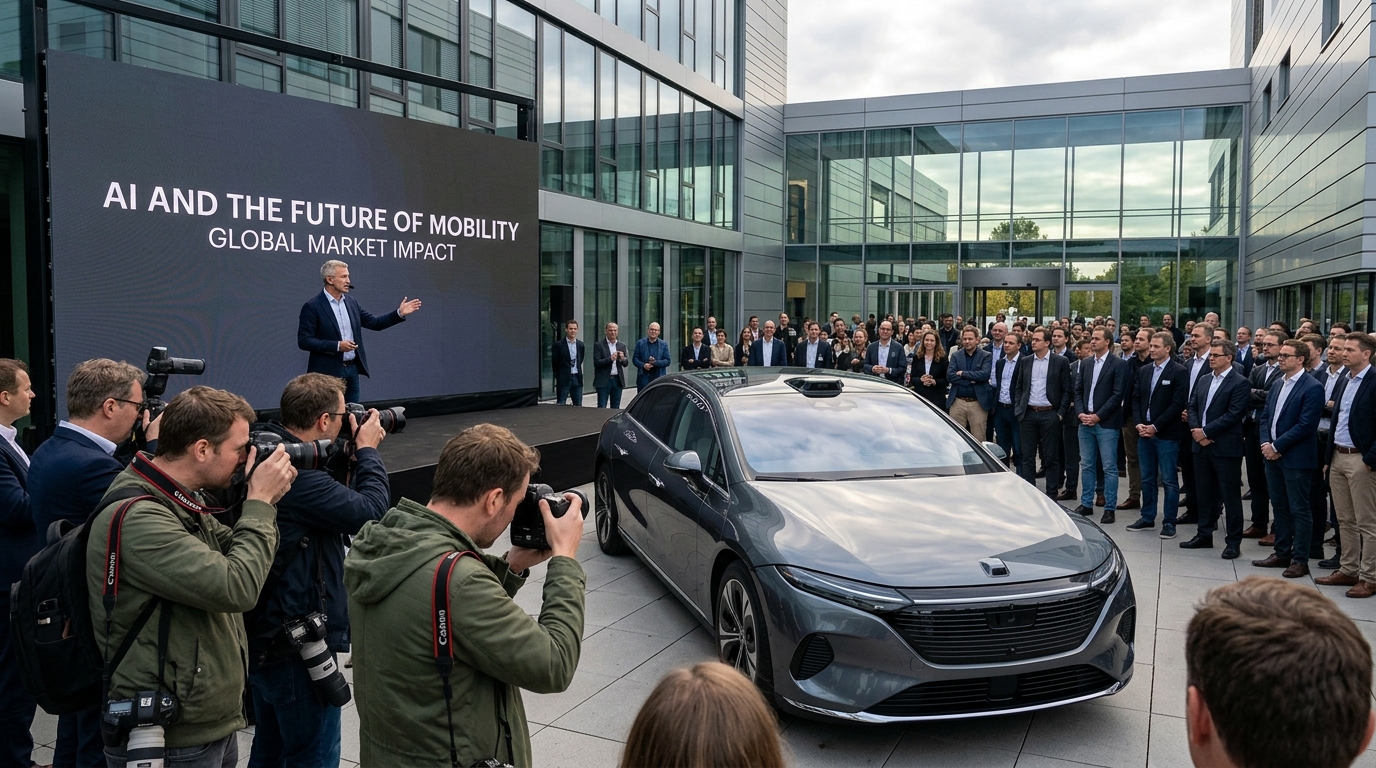
The automotive industry is not just undergoing a period of change; it is experiencing a total metamorphosis. As we move through 2026, the car has ceased to be viewed merely as a mechanical assembly transporting passengers from point A to point B. Instead, it has evolved into a sophisticated "computer on wheels," where value is shifting from horsepower and chassis to algorithms and processing power. A recent report via openPR highlights a market in a state of explosion, with Artificial Intelligence (AI) serving as the central pillar of this new era.
The Dominance of NVIDIA and the Semiconductor Race
At the heart of this revolution lies NVIDIA Corporation. Once known primarily for its graphics cards, it is now the backbone of autonomous driving. The NVIDIA DRIVE Orin platform has become the gold standard for manufacturers looking to integrate Level 3 and 4 capabilities into their vehicles. The ability of these chips to process vast amounts of data from sensors, radar, and cameras in real-time is what allows vehicles to "understand" their environment.
However, NVIDIA is not playing alone. Competition from Qualcomm and Intel (via Mobileye) is intensifying as these companies strive to offer more energy-efficient solutions. For legacy manufacturers like Audi AG, the challenge is twofold: they must integrate this technology without losing their driving experience identity, while simultaneously facing the need for massive software investments.
Tesla: The Paradigm of Vertical Integration
Tesla Inc remains the industry benchmark, not necessarily for its build quality, but for its approach to AI. Tesla's strategy is built on vertical integration: it designs its own processors (FSD chips), collects billions of miles of real-world data, and trains its neural networks on proprietary supercomputers like Dojo. This ecosystem creates a "moat" that competitors find difficult to bridge.
In 2026, the conversation has shifted from "if" autonomous driving is possible to "how fast" it can be made safe and regulatory-compliant. Tesla is pushing boundaries with Full Self-Driving (FSD), which now utilizes end-to-end neural network technology, reducing lines of code and letting AI "learn" to drive by observing human drivers. This approach, while controversial, has accelerated development across the entire industry.
From Ownership to Subscription: The New Economic Model
The rise of AI brings with it a radical shift in the business model of automotive companies. Manufacturers are discovering that selling a car is only the beginning. The future lies in Software-as-a-Service (SaaS). The ability to upgrade a vehicle's capabilities via Over-the-Air (OTA) updates allows companies to generate recurring revenue. Whether it’s improved driver assistance systems or personalized in-car entertainment experiences, AI is the key to unlocking these profits.
In Europe, Audi and the Volkswagen Group are attempting to recover from previous software delays through their Cariad unit, focusing on safety and data privacy—areas where the EU maintains strict standards. The battle for AI market dominance is no longer about who has the fastest engine, but who possesses the smartest and most reliable software ecosystem.
Ethical Dilemmas and the Regulatory Landscape
Despite the technological euphoria, challenges remain. The ethical dilemmas of AI—such as how a vehicle should react in an unavoidable accident—continue to occupy legislators. Furthermore, cybersecurity is becoming critical. An AI-controlled car is a potential target for hackers, forcing companies to invest billions in system hardening.
In conclusion, the automotive AI market is not a passing trend but the new norm. As NVIDIA provides the "brain," Tesla the "experience," and Audi the "luxury," the consumer stands before a new reality where driving may soon be considered an optional leisure activity rather than a daily necessity.





