

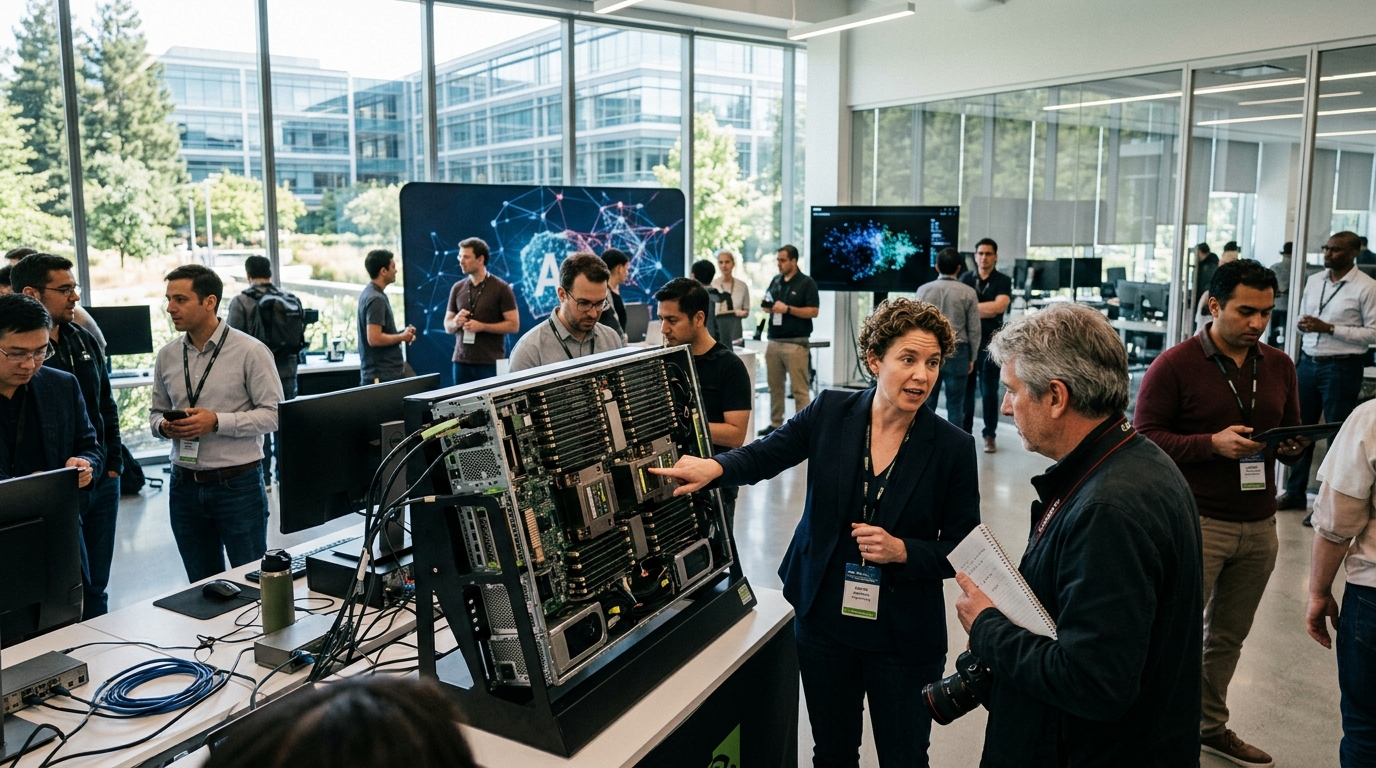
At the heart of the global technological stage, where artificial intelligence is no longer a promise of the future but the driving force of the current economy, Victory Giant Technology Huizhou Co. is emerging as one of the most critical players. The recent announcement of its financial results for the first quarter of 2026 left no room for doubt: the company recorded a 28% surge in sales, a performance attributed almost entirely to the explosive demand for high-end printed circuit boards (PCBs), which form the "backbone" of Nvidia's AI servers.
The Silent Dominance of Physical Infrastructure
While the general public focuses on large language models and generative AI applications, investors and analysts are turning their gaze to the physical components that make this computational power possible. Victory Giant, based in Huizhou, China, has managed to establish itself as a leading supplier to Nvidia, providing the essential components for the Blackwell architecture and subsequent generations of processors. The PCBs manufactured by the company are not simple boards; they are complex, high-density interconnect (HDI) multilayer structures that must manage massive data loads and heat.
The 28% increase in sales reflects a broader market trend: the transition from traditional servers to AI servers requires radically different hardware. A typical AI server can require circuit boards with a value up to ten times higher than a conventional server, due to the need for faster signal transmission and increased durability. Victory Giant is capitalizing on this market premium, simultaneously improving its profit margins.
The Nvidia Factor and the Geopolitical Chessboard
Victory Giant's close relationship with Nvidia is a double-edged sword, but for now, the profit far outweighs the risk. Despite Washington's efforts to limit China's access to advanced semiconductor technology, the supply chain for peripheral components remains deeply rooted in Chinese soil. Victory Giant has invested billions in automated production lines, making it nearly impossible to replace in the short term by competitors in Southeast Asia or the West.
"The demand for AI infrastructure is so intense that it transcends geopolitical constraints. Companies are looking for quality and scale of production wherever it may be found," say technology market analysts.
Furthermore, the company has begun to diversify its client base, targeting the so-called "Hyperscalers" — Google, Amazon, and Microsoft — who are now developing their own internal AI chips. This strategic move ensures that Victory Giant will not depend exclusively on Nvidia's orders, shielding its revenue against potential fluctuations in the semiconductor market.
Technological Challenges and Future Prospects
Victory Giant's future depends on its ability to innovate in the fields of thermal management and miniaturization. As graphics processing units (GPUs) become increasingly powerful, the heat they generate is the greatest enemy of performance. Victory Giant is developing new substrate materials that allow for better heat dissipation, a critical advantage for data centers struggling with energy costs and cooling.
The market expects growth to continue at double-digit rates for the remainder of 2026. Moving into 2027, the focus will likely shift toward "Edge AI" — artificial intelligence running locally on devices — and Victory Giant is already preparing for this transition, designing smaller but equally powerful circuits for the next generation of smartphones and autonomous vehicles. Its current success is merely the prelude to a long period of dominance in the hardware infrastructure sector.





