

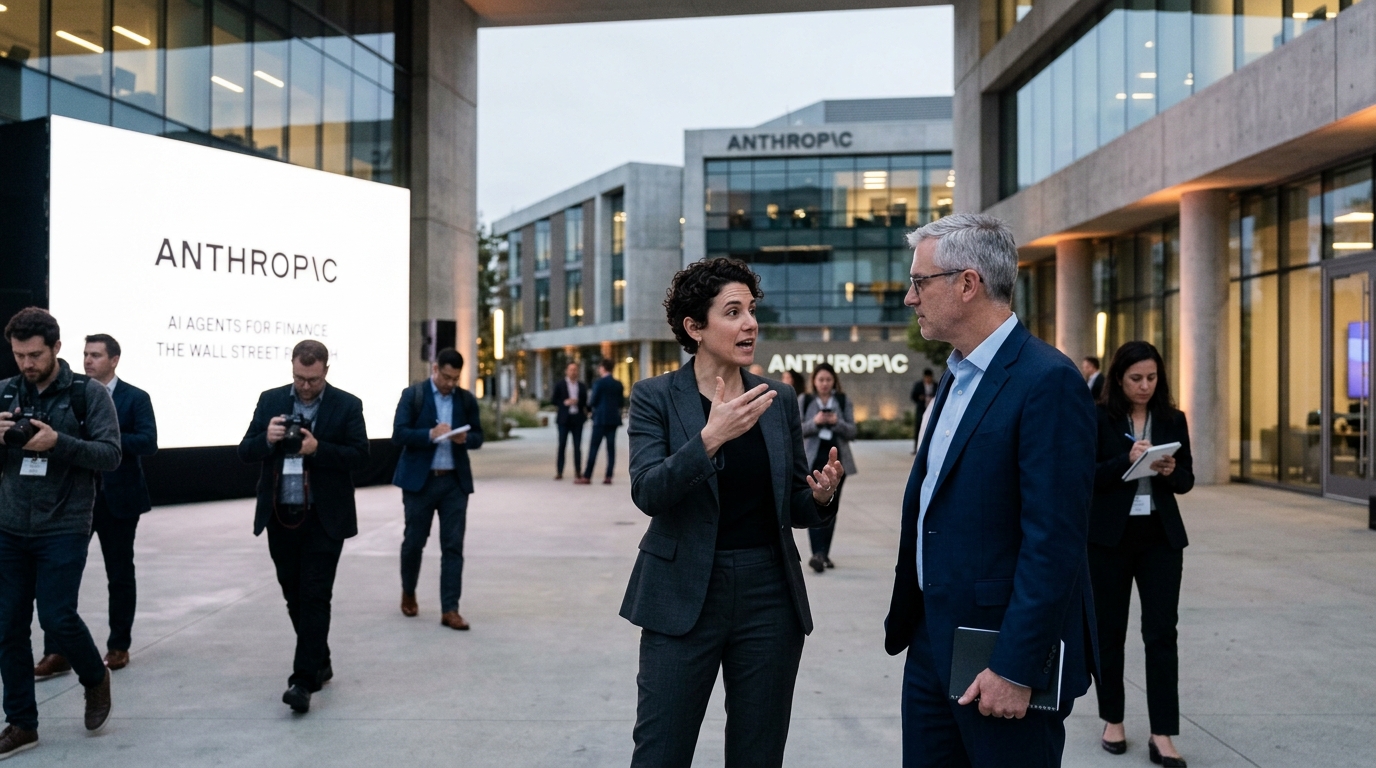
In a move that signals the dawn of a new era for the global financial sector, Anthropic announced today the release of a suite of specialized AI agents designed exclusively for the demanding needs of Wall Street. This development is not merely an upgrade to the existing Claude models but a fundamental strategic shift: moving from providing general answers to undertaking autonomous, complex tasks in high-stakes environments.
The Transition from Chatbots to Autonomous Agents
Until recently, the use of AI in banking was largely confined to drafting documents or basic customer service. Anthropic's new agents, however, possess the capability to navigate third-party software, analyze massive datasets from terminals like Bloomberg, and execute processes that traditionally required hundreds of man-hours from junior-level analysts. The ability of these systems to "reason" through multiple steps and self-correct in real-time is what sets them apart from standard Large Language Models (LLMs).
According to the company's presentation, these agents can handle Know Your Customer (KYC) procedures, Anti-Money Laundering (AML) checks, and the drafting of detailed corporate credit ratings. The key to their potential success lies in the integration of Anthropic's "Constitutional AI," which ensures that the agents' decisions remain within the strict regulatory frameworks that govern the banking industry.
A Strategic Alliance with Wall Street
Anthropic, backed by giants such as Amazon and Google, appears to be betting on the banking sector's need for security and predictability. While OpenAI focuses on mass consumer adoption, Anthropic is positioning itself as the "mature adult" in the room, offering models that are less prone to hallucinations and more transparent in their decision-making processes. Major investment banks are already reportedly piloting these agents, aiming to reduce operational costs and accelerate transaction speeds.
Wall Street has long struggled with the sheer volume of unstructured data. These new agents can scan thousands of pages of financial statements in seconds, identifying anomalies that would escape the human eye and suggesting complex hedging strategies. This doesn't just change how analysts work; it redefines the very concept of financial intelligence.
Challenges and Ethical Dilemmas
Despite the excitement, the introduction of autonomous agents into the heart of global capitalism raises serious questions. What happens if an AI agent makes a flawed investment decision that leads to systemic risk? Who bears the liability? Anthropic maintains that the agents always operate with a "human-in-the-loop," but the speed at which these systems function often renders human intervention more of a formality than a meaningful check.
- Automation: Significant risks to thousands of back-office and junior analyst positions.
- Regulatory Compliance: The urgent need for new legislation covering autonomous financial actions.
- Cybersecurity: The potential for agents to be exploited for sophisticated market manipulation.
In conclusion, Anthropic's move is a clear statement of intent. Artificial intelligence is no longer a support tool but an active player on the global economic chessboard. The success of these agents will be judged not just by their efficiency, but by their ability to earn the trust of an industry that traditionally abhors uncertainty and prizes stability above all else.





