

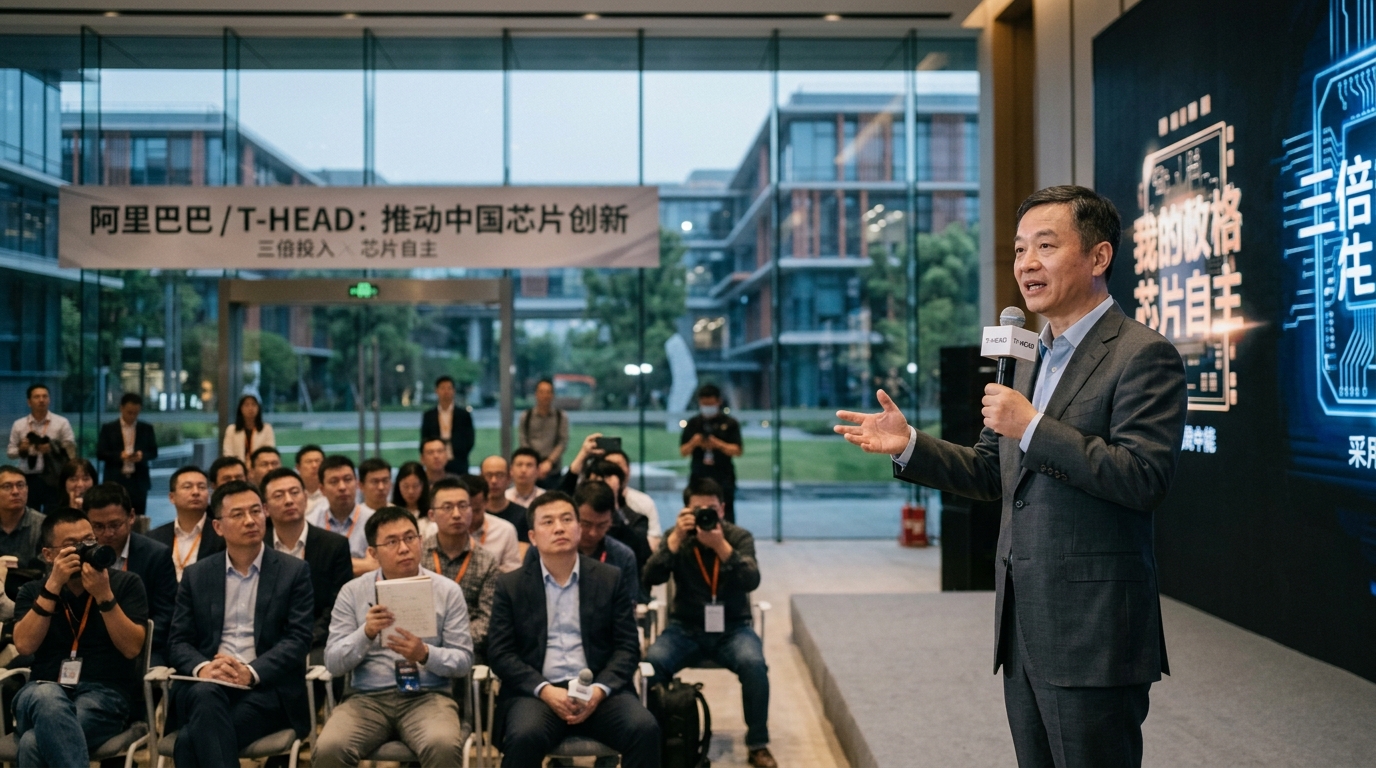
In an era where the global geopolitical chessboard is increasingly defined by access to advanced computing power, Alibaba Group Holding has executed a high-stakes move of immense strategic significance. The Chinese e-commerce and cloud giant has tripled the registered capital of its chip design unit, T-Head (also known as Pingtouge), signaling a new phase in China's quest for technological autonomy. This move is not merely an accounting adjustment but a clear declaration of intent in the face of mounting pressure from the United States and its allies.
The Strategic Weight of T-Head in Alibaba’s Ecosystem
T-Head was established in 2018 following the acquisition of C-Sky Microsystems, with the explicit goal of making Alibaba self-sufficient in the semiconductor domain. Since then, the unit has developed impressive products, such as the Yitian 710 processor, which is based on the ARM architecture and powers Alibaba Cloud’s data centers. The decision to triple its capital comes at a time when access to top-tier chips from Nvidia and AMD is becoming increasingly difficult for Chinese firms due to Washington’s expanding export restrictions.
This capital injection allows T-Head to expand its research and development (R&D) in critical areas such as AI accelerators and ultra-low-power processors. For Alibaba, owning its own intellectual property in the chip sector is no longer a luxury—it is a survival necessity. By controlling the hardware, the company can optimize its software at levels that competitors relying on off-the-shelf solutions simply cannot match. It creates a vertical integration that mirrors the strategies of global leaders like Apple and Google.
RISC-V: China’s Open-Source Weapon
One of the most compelling aspects of T-Head’s strategy is its pivot toward the RISC-V architecture. Unlike the x86 (Intel/AMD) and ARM architectures, which are subject to licensing agreements that can be revoked or restricted by Western governments, RISC-V is open-source. This makes it effectively "sanction-proof," as no single nation holds exclusive rights to the architecture's core design.
Alibaba has emerged as a global leader in promoting RISC-V, developing the XuanTie series of processors. With the increased capital, T-Head is expected to accelerate the adoption of RISC-V not only in servers but also in Internet of Things (IoT) devices and autonomous vehicles. This strategy aims to create a parallel technological ecosystem that operates independently of Western standards, ensuring that the Chinese digital economy remains resilient even in scenarios of total decoupling. The goal is to make RISC-V a viable third pillar alongside x86 and ARM.
Challenges and the Geopolitical Backdrop
Despite the massive influx of capital, the path forward for T-Head is fraught with obstacles. Chip design is only half of the equation; the other half is manufacturing. China still lags significantly in lithography technology, with the Dutch firm ASML holding a monopoly on the EUV (Extreme Ultraviolet) machines required to manufacture the most advanced chips. While T-Head can design 5nm or 3nm chips, finding a foundry that can manufacture them without violating U.S. sanctions remains a formidable challenge.
Furthermore, internal competition within China is intensifying. Huawei, through HiSilicon, and Baidu, with its Kunlun chips, are also vying for a share of the domestic semiconductor market. Alibaba’s move indicates it is prepared for a war of attrition, investing billions over a decade-long horizon. The success of T-Head will largely determine whether Alibaba remains a global player in artificial intelligence or is relegated to being a service provider strictly within Chinese borders.
Conclusion: The New Architecture of Power
The tripling of T-Head’s capital marks a milestone in Alibaba’s history. It represents a transition from a company built on consumption and software to an entity that controls the foundations of computing power. In a world where data is the new oil, chips are the engines that refine it. Alibaba, through T-Head, is not just building components; it is fortifying the walls of its future empire against an uncertain global order. The "Silicon Curtain" is falling, and Alibaba is ensuring it stands on solid ground.
- The move bolsters Alibaba's resilience against US-led semiconductor sanctions.
- Investment focuses on RISC-V to bypass Western intellectual property traps.
- T-Head is now the cornerstone of Alibaba's long-term AI and Cloud strategy.
- Manufacturing (foundry) bottlenecks remain the primary hurdle to total independence.





