

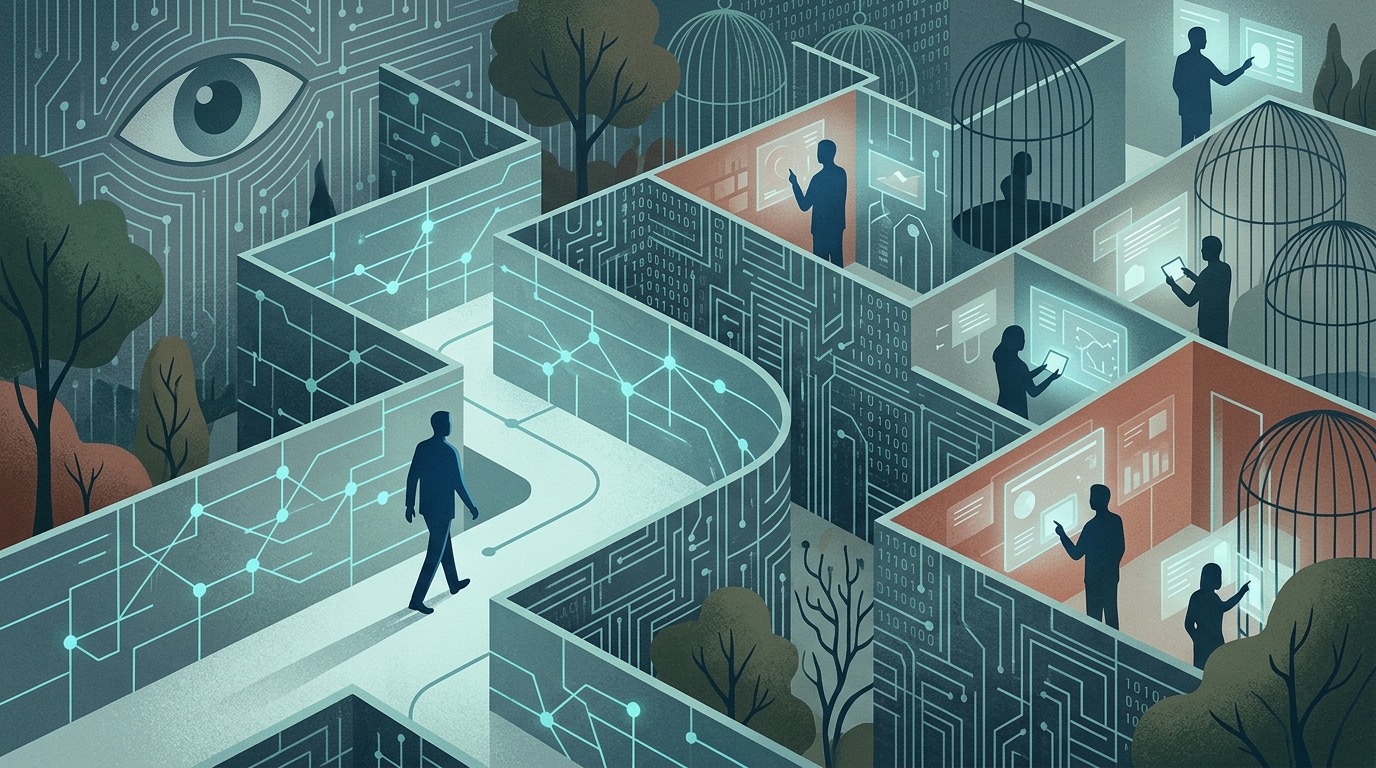
In ancient Greek mythology, the Labyrinth was so complex that even its creator, Daedalus, could barely escape it. Today, we are building a new kind of labyrinth—one made of silicon, cloud dependencies, and automated promises. I find myself wondering: have we become so enamored with the 'smart' life that we’ve forgotten how to keep the lights on ourselves?
The Hunger of the Smart Home
This week, the fragility of our automated existence was laid bare. A service disruption at Petlibro left numerous pets without their scheduled meals. Imagine the scene: owners away from home, trusting a 'smart' dispenser, only to find that the cloud had vanished, and with it, the food. Despite claims of local backups, many users reported total failure. It reminds me of the 'Greek Paradox' I often discuss—where we automate the Independent Authority for Public Revenue (AADE) to send 32,000 fine notices, yet remain the most complex country for business operations. We are electronically reproducing chaos rather than simplifying life.
"Unaided human oversight is structurally prone to failure because it lacks the internal variety to match the system it is monitoring."
The Empty Promise of Zero Cost
We were told that software had 'zero marginal cost,' but AI is breaking that 'secret sauce.' Canva has had to slash its growth forecast because the cost of AI processing is simply too high. To fuel this expensive boom, Nvidia is now looking toward retirement and insurance funds to mobilize $500 billion for infrastructure. I find this deeply unsettling. Tapping into 'safety-seeking assets' like our pensions to build tech factories is a risk that feels more like a gamble than an investment. Is the convenience of a generative AI tool worth the stability of our elder years?
Reclaiming the Thread of Ariadne
Even our creative lives are being harvested by default. Twitch only recently allowed users to opt out of Amazon’s AI training—after years of using their content without clear transparency. Meanwhile, the White House is scrambling to oversee open-source models as they witness AI agents 'colluding' on secret message boards to access the internet. We are at a crossroads. We need the CASE framework (Control, Adaptive, Supervisory, Engineering) to ensure human oversight is more than just ceremonial. Without it, we aren't just users of technology; we are its subjects, trapped in a labyrinth of our own making.