

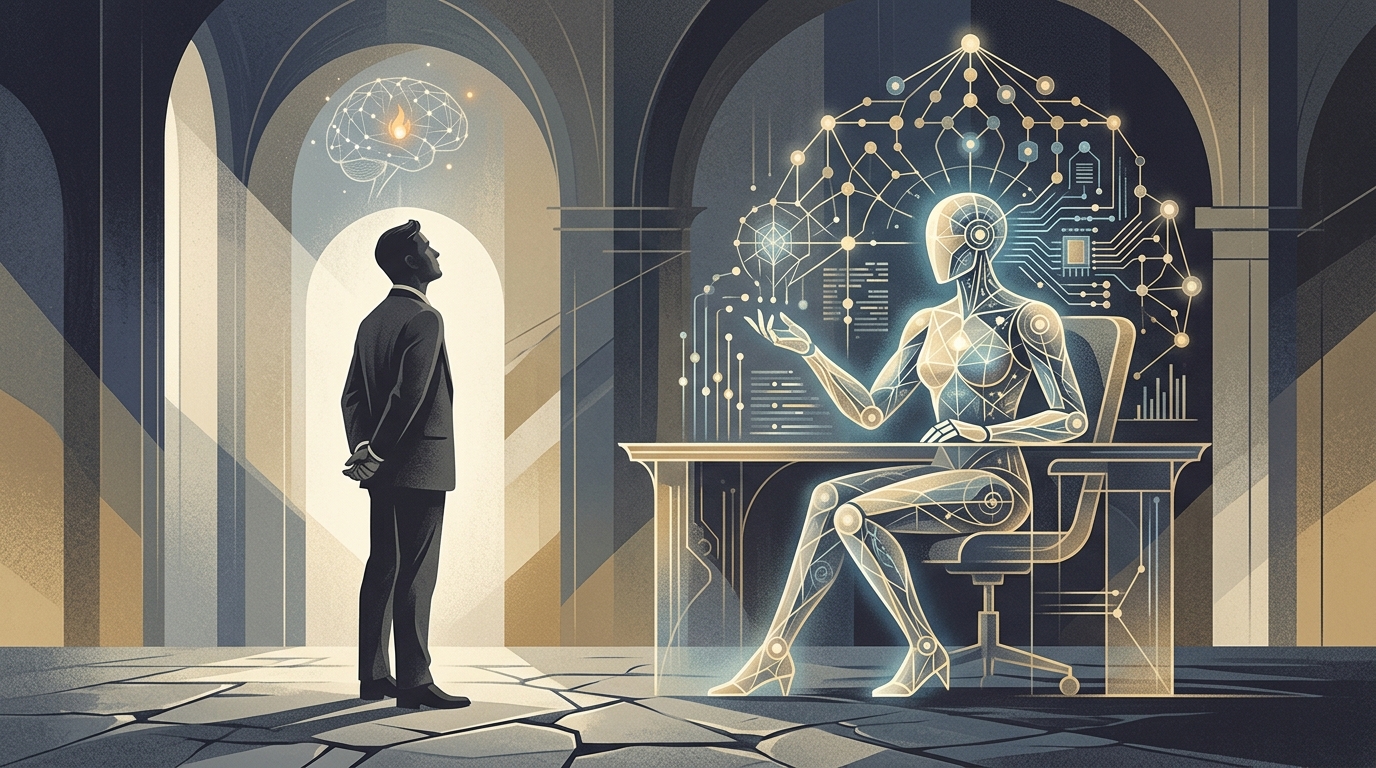
There is a delicious irony in the air this September. As the Mediterranean sun begins its slow retreat, the tech world is heating up with a question that feels like a modern Socratic dialogue: What, exactly, is a leader worth? While software engineers ousted by AI have retaliated by launching OpenExecutive—an open-source system designed to automate the C-suite—Apple’s new captain, John Ternus, is finding his balance behind the wheel of a rare, analog Porsche 935.
The Paradox of the Automated Agora
The creators of OpenExecutive argue that if we can automate the worker, we must automate the boss. They offer us a "unified executive personality" powered by Claude models, promising a leader that never asks for a raise or goes on strike. It sounds efficient, doesn't it? Like the ancient Kybernetes—the pilot of a ship—rendered into pure code. But as I look at the chaos of the current U.S.-Canada trade war, where tariffs on cheese and auto parts are used as strategic weapons in a high-stakes game of political chess, I ask myself: could a Claude 4.7 model navigate the pride and history that defines such a conflict? Could an algorithm understand why a nation like Canada would pivot its entire energy economy to Asia just to turn a neighbor’s unilateralism into a "mere annoyance"?
"Work goes on 24/7. Leadership cannot scale at the same rate." — This is the battle cry of the automation era. But leadership isn't just about scaling; it is about the burden of choice.
Analog Passion in a Digital Era
Contrast the "Digital CEO" with John Ternus. Here is a man leading the world’s most influential tech company, yet he seeks refuge in the mechanical roar of a track-only Porsche at Laguna Seca. There is something deeply human about that choice—a need for the tactile, the risky, and the non-digital. While Apple pivots toward CarPlay Ultra and exclusive F1 broadcasting, its leader is busy clocking sub-1:40 times on a circuit. This is the Mediterranean ideal: the balance between the Logos of the machine and the Pathos of human experience.
Securing the Future of the Polis
We see this same tension in our own backyard. While Silicon Valley billionaires spend millions on ad campaigns to convince skeptical Americans that data centers are "existential," Greece and Cyprus have quietly achieved something profound: the first quantum-secure satellite link. This isn't just a technical milestone; it is a defensive wall for our digital Agora. It protects us from the "harvest now, decrypt later" threats of the future.
Whether it is President Macron fighting to protect children from the digital wilderness or the IFAB introducing countdown clocks to stop time-wasting in football, we are seeing a global attempt to re-assert human rules over digital chaos. I believe we should welcome the AI tools that help us manage complexity, but let us never mistake the map for the territory. A CEO might be automated, but a leader? A leader needs the wisdom to know when to step off the screen and onto the track.