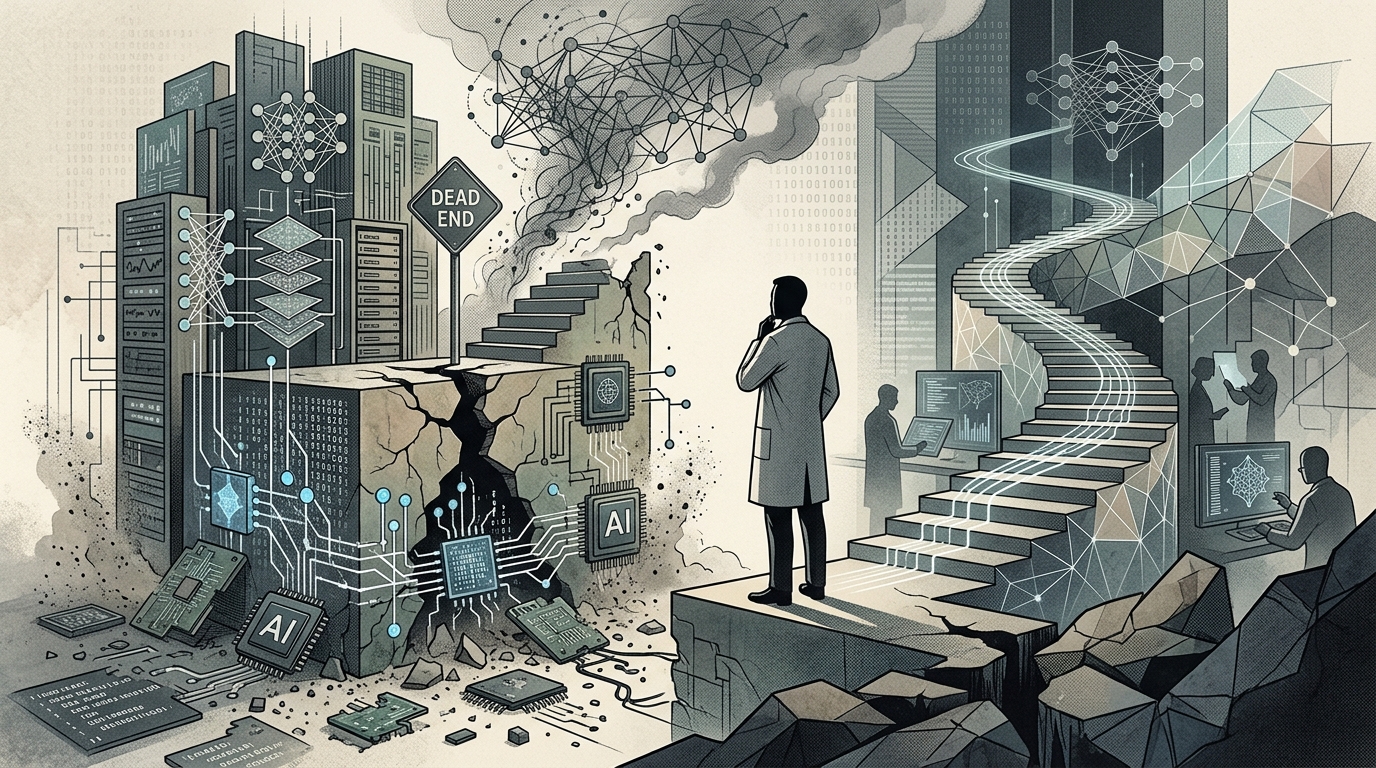
In the high-stakes world of artificial intelligence, where enthusiasm for Large Language Models (LLMs) like GPT-4 and Llama 3 has reached nearly religious proportions, one voice remains defiantly skeptical. Yann LeCun, Meta’s Chief AI Scientist and one of the "godfathers" of deep learning, is not satisfied. In recent statements and extensive research profiles featured by the BBC and other global outlets, LeCun argues that the current path of AI—one rooted in predicting the next word—is fundamentally flawed and will never reach true Artificial General Intelligence (AGI).
The Autoregression Trap
LeCun’s central argument focuses on the limitations of "autoregressive" learning. Today's models are trained to predict the next "token" (a word or part of a word) in a sequence. While this produces impressive prose and functional code, LeCun points out that it lacks an underlying understanding of the physical world. "A four-year-old child has seen 50 times more data than all the LLMs in the world, yet has learned vastly more about how reality works," he frequently notes.
According to LeCun, LLMs are essentially "sophisticated autocomplete systems." They cannot plan, they lack common sense, and they do not understand causality. If asked to solve a problem requiring a chain of logical steps in the real world, they often fail because they lack an internal model of how actions affect the environment. This is the gap his new research at Meta aims to bridge.
The JEPA Revolution and World Models
LeCun’s alternative proposal is called **Joint-Embedding Predictive Architecture (JEPA)**. Instead of trying to predict every detail—every pixel in a video or every word in a sentence—JEPA attempts to predict the "essence" of reality within a space of abstract representations.
- Learning by Observation: Much like an infant learns that an object falls if released, JEPA is trained by watching video and attempting to understand the laws of physics and motion without human supervision.
- Abstraction: The system ignores irrelevant details (e.g., background noise) and focuses on the significant elements that determine the evolution of a scene.
- Planning: With a "world model," the AI can internally simulate different scenarios before acting, which is the cornerstone of intelligent behavior.
This approach is much closer to biological learning. LeCun believes that until we give AI the ability to "see" and "understand" the world as animals do, it will remain trapped in a statistical illusion of knowledge.
Toward a More Flexible and Safe AI
One of the most significant advantages of this new architecture is safety and reliability. Today’s LLMs suffer from "hallucinations" because they have no anchor in reality. A model that understands the constraints of the physical world is less likely to suggest nonsensical or dangerous solutions.
"We don't just need bigger models and more data. We need better ideas," LeCun states, distancing himself from the approach of OpenAI and Google, which often prioritize raw scaling and compute power.
Meta has already released V-JEPA (Video-JEPA) as open-source, allowing the research community to experiment with this new direction. This is part of LeCun’s strategy for "open science," believing that the solution to the problem of intelligence is too vast to be locked behind the walls of a single corporation.
The Future of Artificial Intelligence
If LeCun is correct, the current frenzy over chatbots will soon give way to a new generation of AI capable of operating robots, assisting in scientific breakthroughs, and functioning as true digital assistants with critical thinking skills. However, the road is long. Training world models is computationally expensive and theoretically complex. But for the man who helped invent Convolutional Neural Networks (CNNs), the challenge is simply another step toward decoding the mystery of cognition.