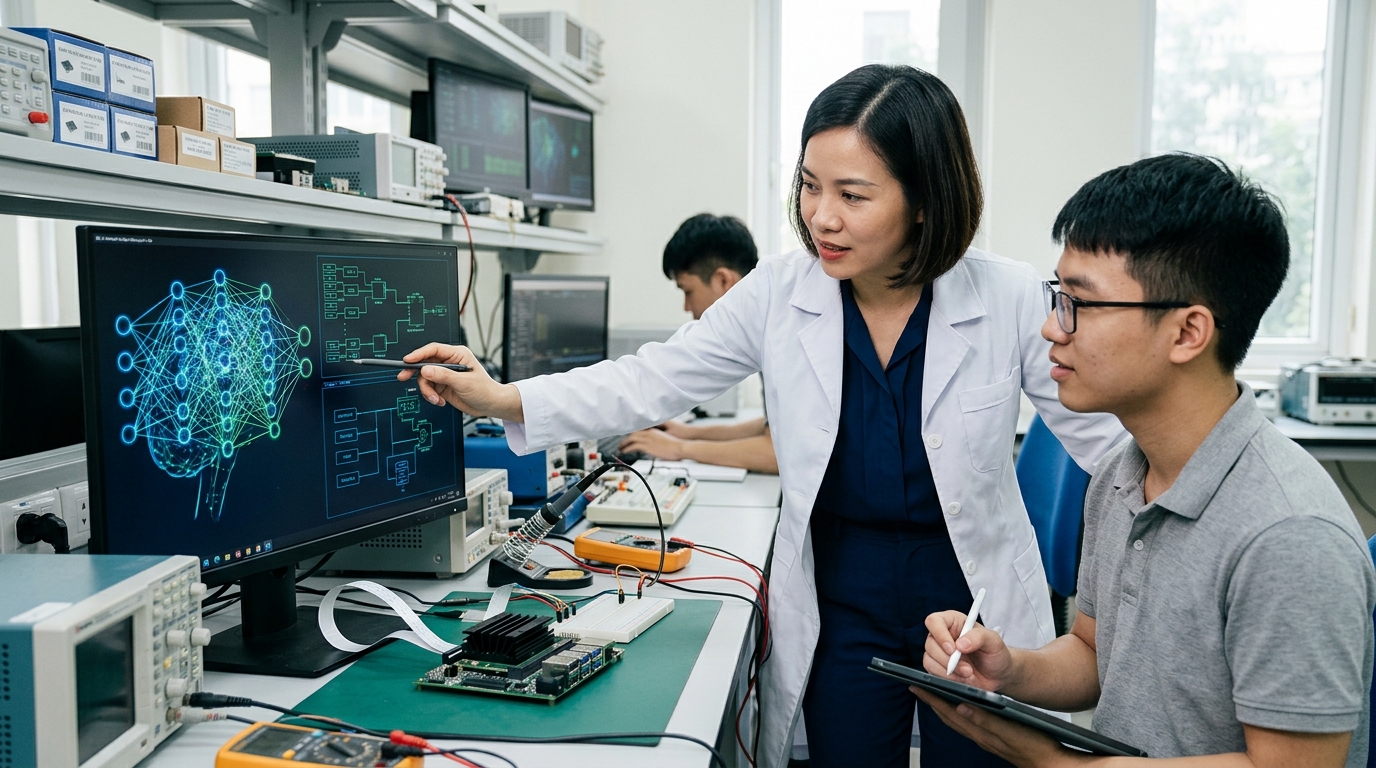
In an era where the boundaries between traditional academic disciplines are increasingly blurred, Vietnam's National Economics University (NEU) is undertaking a bold restructuring of its educational model. The integration of Artificial Intelligence (AI) and Big Data is no longer a mere addition to the curriculum, but the central pillar of a strategy aimed at transforming the institution into a "Digital University."
The Convergence of Economics and Technology
NEU's initiative reflects a broader global trend where economic science is moving away from purely theoretical models and turning towards the empirical analysis of vast amounts of real-time data. The interdisciplinary approach promoted by the university seeks to equip students with tools that were previously considered the exclusive domain of computer scientists. Understanding machine learning algorithms and the ability to manage Big Data are now seen as essential assets for the modern economist, market analyst, and business executive.
According to the university's leadership, the integration of these technologies is not just about teaching new software. It is about a profound change in mindset. Students are called upon to solve complex economic problems using computational thinking, recognizing patterns in chaotic data, and predicting trends with a precision that was impossible a decade ago. This shift is crucial for Vietnam, a country striving to become a regional technology hub in Southeast Asia.
The university's leadership emphasizes that this transition is not merely cosmetic. It involves a fundamental re-evaluation of how knowledge is produced and disseminated. By breaking down the silos between the IT department and the School of Economics, NEU is fostering a collaborative environment where data scientists and economists work side-by-side to tackle issues ranging from macroeconomic stability to consumer behavior.
Strategic Importance for Vietnam and the Region
Vietnam is at a critical juncture in its economic development. Aiming to become a high-income country by 2045, the government is investing heavily in the digital economy. NEU, as the country's leading institution for economic studies, bears the weight of preparing the workforce for "Industry 4.0." The introduction of programs combining finance with technology (FinTech), digital marketing, and business data analytics is a direct response to immediate labor market needs.
- Modernization of infrastructure with state-of-the-art data analysis laboratories.
- Partnerships with international tech giants for student skill certification.
- Encouragement of research that combines sociology, economics, and data science.
- Development of lifelong learning programs for executives looking to upgrade their digital skills.
This movement is not without its challenges. The lack of specialized teaching staff who possess both economic theory and advanced technological skills is a global phenomenon, which NEU is attempting to address through international partnerships and exchange programs. Furthermore, the cost of technological infrastructure and the need for continuous updates to curricula require significant resources and agility. However, the university's commitment to this path signals a long-term vision that prioritizes relevance and impact over tradition.
Ethics and Social Implications
Another significant dimension of NEU's new direction is the emphasis on AI ethics. In a world where algorithms make decisions about credit, hiring, and investments, the economists of the future must be able to recognize the biases of these systems. The university is integrating courses on ethics and critical thinking, ensuring that technological progress is not detached from humanistic values and social justice.
"Technology is the means, not the end. Our goal remains the prosperity of society through scientific knowledge," a university representative stated.
In conclusion, the initiative of the National Economics University of Vietnam serves as a roadmap for how educational institutions can adapt to the digital storm. The success of this venture will be judged by the ability of its graduates to navigate an environment that requires continuous adaptation, critical analysis, and a deep understanding of the interaction between humans and machines. As Vietnam positions itself as a digital leader in Asia, NEU’s transformation may well become the blueprint for other institutions in developing economies.