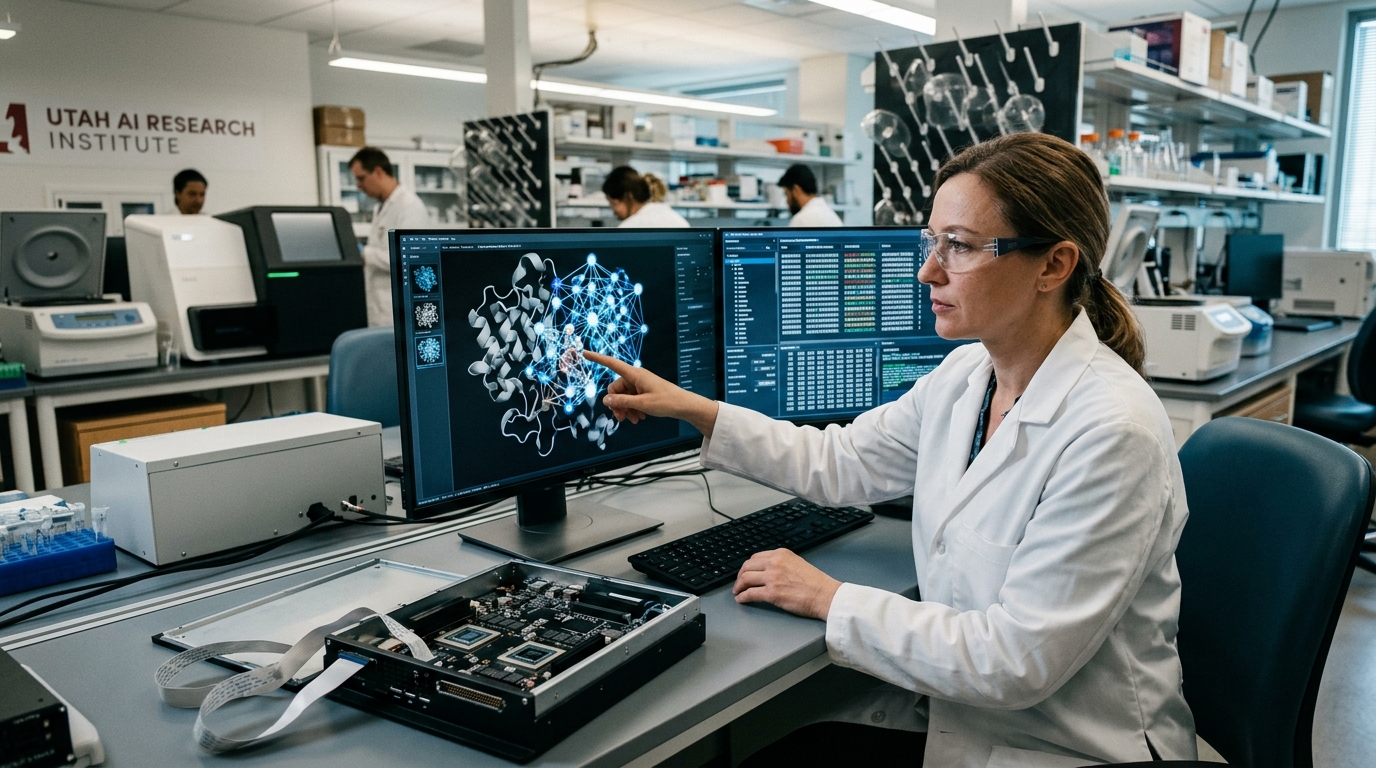
In the heart of the Rocky Mountains, where the burgeoning "Silicon Slopes" tech scene meets academic rigor, the State of Utah is making a monumental stride into the future. The recent announcement of a $100 million investment in the University of Utah is not merely a financial injection; it is a strategic pivot designed to anchor the region as a global epicenter for Artificial Intelligence (AI) and computational discovery.
This initiative, bolstered by state legislative support and private philanthropy via the Utah Impact Partnership, aims to weave AI into the fabric of scientific inquiry, with a primary focus on healthcare. In an era where AI is disrupting every industry, Utah is distinguishing itself by championing "Responsible AI," establishing a framework for ethical, human-centric technological evolution.
The Convergence of Big Data and Biomedicine
The University of Utah holds a distinct advantage: the Utah Population Database (UPDB), one of the world’s most comprehensive repositories of genetic and public health records. With this new investment, the deployment of Large Language Models (LLMs) and advanced machine learning algorithms will allow researchers to parse through decades of data with unprecedented speed and precision.
University President Taylor Randall emphasized that the funding will secure top-tier faculty and acquire state-of-the-art computational infrastructure. "We aren’t just buying hardware; we are building an ecosystem where AI assists clinicians in predicting diseases long before the first symptoms manifest," Randall noted. The focus on precision medicine is expected to drastically lower healthcare costs by providing personalized treatments tailored to an individual’s unique genetic blueprint.
The Ethical Frontier: Responsible AI
Perhaps the most compelling aspect of this initiative is the launch of the Responsible AI Initiative. Unlike many tech investments that prioritize raw output and speed, Utah is placing transparency and safety at the forefront. Concerns regarding algorithmic bias and patient data privacy are central to the project’s mission.
Researchers will focus on developing "Explainable AI" (XAI) models, ensuring that machine-led decisions are auditable and understandable by human practitioners. This is vital in a clinical setting, where a diagnosis can be a matter of life or death. By embedding ethics into the development phase, Utah seeks to establish a governance standard that could influence federal policy and international regulations.
Economic Implications and the Future of Silicon Slopes
This $100 million commitment is expected to act as a catalyst for the regional economy, attracting biotech and health-tech startups. Utah already hosts a vibrant tech community, but the specialized focus on AI-driven health research creates a high-value niche. Graduates of the University will have hands-on experience with cutting-edge tools, making the region a formidable competitor to traditional hubs like Silicon Valley and Boston.
- Stimulating the local economy through high-skill job creation in AI and bioinformatics.
- Attracting venture capital specifically targeted at ethical AI development.
- Accelerating the discovery of new drugs and patents through computational chemistry.
Ultimately, Utah is not just chasing a trend; it is preparing for a fundamental shift in how human knowledge is synthesized. As Governor Spencer Cox stated, "Artificial Intelligence is the next great frontier, and Utah will be the force that explores it with both innovation and integrity."
"Technology without ethics is blind, but ethics without technology in our age is ineffective. Here, we aim to unify them."
The stakes are high, but the foundation being laid today in Salt Lake City promises to redefine the future of medical science for generations to come. As we move deeper into 2026, the success of this initiative will be measured not just in dollars, but in the lives saved through the intelligent application of data.