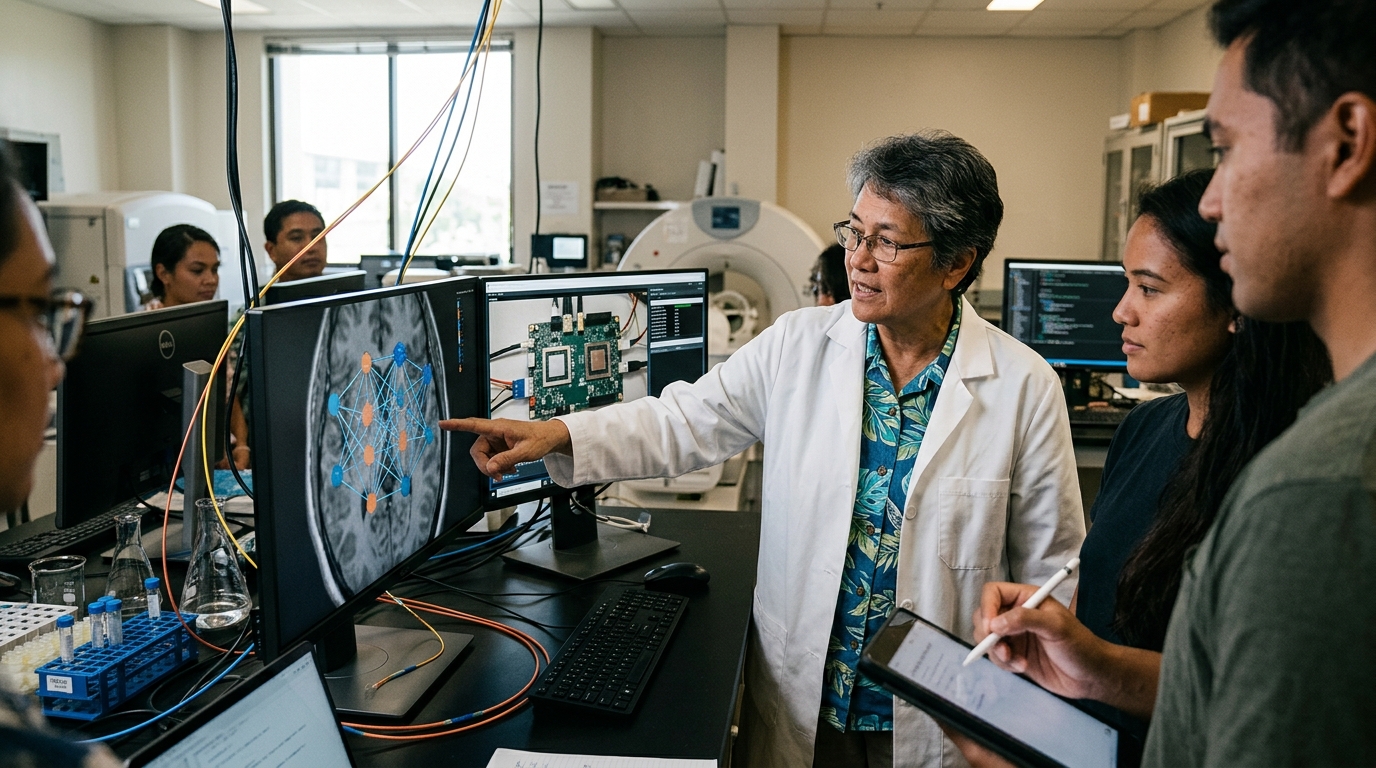
The announcement of a $12 million grant awarded to the University of Hawaii (UH) to establish a state-of-the-art AI medical research center is more than just financial news; it is a watershed moment for the Pacific scientific community. The new center, which will focus on applying machine learning to improve health outcomes in underrepresented communities, promises to revolutionize how we perceive preventive medicine and diagnostics in geographically isolated regions.
The Strategic Importance of AI in Healthcare
Artificial Intelligence (AI) has the potential to analyze vast amounts of data much faster than humans, identifying patterns that often escape the naked eye. For Hawaii, a state with a unique demographic composition and significant geographic challenges, AI offers life-saving solutions. The new center will focus on developing algorithms that account for the social determinants of health—such as access to clean water, nutrition, and housing location—factors traditionally ignored by generic medical models.
Researchers at UH intend to use these funds to build an infrastructure that allows for the safe and ethical use of patient data. One of the biggest hurdles in medical AI today is data bias. Most AI models are trained on datasets from mainland European or American populations, leaving indigenous populations and minorities behind. The Hawaii center aims to correct this imbalance by creating models that are "culturally aware" and medically accurate for Pacific Island residents.
Bridging the Disparity Gap
Healthcare in Hawaii often faces the problem of distance. Residents of smaller islands frequently have to travel to Oahu for specialized testing. AI can serve as a digital bridge, enabling remote diagnostics with accuracy levels approaching those of a physical specialist. For instance, computer vision algorithms can analyze X-rays or dermatological lesions in real-time, sending alerts to physicians for urgent cases.
- Development of low-cost diagnostic tools for rural areas.
- Training a new generation of data scientists with biomedical expertise.
- Collaborating with local communities to protect indigenous data privacy.
- Enhancing telehealth through smart monitoring systems.
Furthermore, the grant will support the creation of high-skilled jobs, boosting the local economy and preventing "brain drain" to the mainland. Hawaii is now positioning itself on the global biotechnology map, not just as a tourist destination, but as a hub for innovation.
Challenges and Ethical Dilemmas
Despite the excitement, the use of AI in medicine is not without challenges. Managing sensitive personal data requires strict cybersecurity protocols. UH has committed to making transparency the cornerstone of the center's operations. There is also the issue of trust: how will patients be convinced to trust a diagnosis coming from an algorithm? The answer lies in "Explainable AI" (XAI), where the system's decisions can be interpreted and verified by human physicians.
"AI is not going to replace doctors, but doctors who use AI will replace those who don't," industry experts often note, and UH seems to fully embrace this perspective.
In conclusion, the $12 million investment represents a vote of confidence in Hawaii's potential to lead in the digital health sector. It is an opportunity to prove that technology, when used with a human-centric orientation, can eliminate centuries of social and geographic exclusion in healthcare access. The success of this center could serve as a blueprint for other remote regions globally, demonstrating that innovation knows no borders.