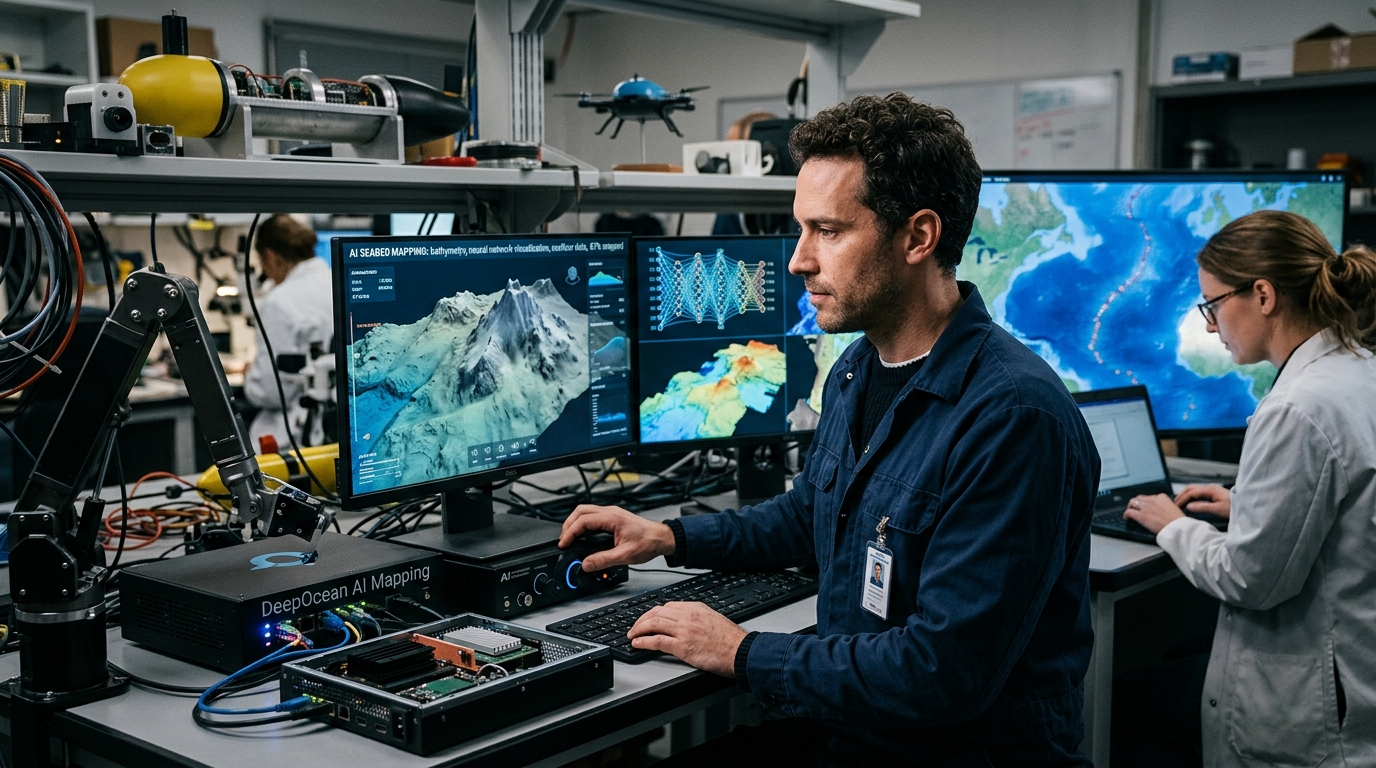
For decades, humanity has gazed at the stars with more curiosity than at the depths of its own oceans. It is a cliché that remains disturbingly true: we know more about the surface of the Moon and Mars than about the ocean floor, which covers over 70% of the planet. However, the advent of Artificial Intelligence (AI) is radically shifting this balance, transforming oceanography from a slow, costly, and dangerous science into a field of rapid digital innovation.
Autonomous Underwater Vehicles: The Robotic Explorers
Traditional deep-sea exploration relied on manned submersibles or Remotely Operated Vehicles (ROVs) tethered to surface ships via kilometers of umbilical cords. Today, AI enables Autonomous Underwater Vehicles (AUVs) to operate and make real-time decisions without human intervention. These robots don't just follow a pre-programmed path; they use machine learning algorithms to recognize obstacles, map unknown territories with high-definition sonar, and decide which samples hold the highest scientific value.
The challenges of the deep are immense: there is no GPS signal, the pressure is crushing, and light does not penetrate beyond the first two hundred meters. AI solves the navigation problem through 'Simultaneous Localization and Mapping' (SLAM), allowing vehicles to create maps of their surroundings while simultaneously determining their position within them. This paves the way for the complete mapping of the Earth's seabed by 2030, a goal that until recently seemed impossible.
Decoding Marine Life
Beyond geology, AI is revolutionizing marine biology. Analyzing video footage from the deep used to require thousands of hours of human labor. Now, computer vision models are trained to identify species of fish, coral, and plankton with accuracy that exceeds human capability. This allows scientists to monitor ecosystem health in real-time, identifying the impacts of climate change and ocean acidification.
- Bioacoustics: AI algorithms analyze sounds from the deep to track whale migrations and protect species from ship collisions.
- Environmental DNA (eDNA): AI helps correlate genetic traces in the water with specific species, creating a "digital census" of marine life.
- Predictive Modeling: Deep learning models analyze ocean currents to predict the spread of plastics and oil spills.
Geopolitics and Ethical Dilemmas
However, this technological progress is not without risks. AI's ability to pinpoint rare minerals on the seabed—such as cobalt, nickel, and manganese—has sparked a new "gold rush" for deep-sea mining. While these metals are critical for the green transition and electric vehicle batteries, mining them threatens to destroy ecosystems we haven't even had time to study.
"Artificial Intelligence is the lens that allows us to see into the darkness of the abyss, but the question remains: will we use this light to protect or to plunder?"
The international community is now called upon to establish rules. AI can serve as the ultimate "guardian," detecting illegal fishing activities through satellite data and autonomous drones, but it can also become the tool of a new colonialism of seabed resources. The balance between economic development (the Blue Economy) and environmental conservation will be determined by how we program these algorithms.
Conclusion: A New Ocean of Data
The AI revolution in the ocean is not just about robots. It's about turning the ocean into a "transparent" data environment. As sensors proliferate and processing power increases, our ability to understand the ocean's role in climate regulation will improve dramatically. AI is not just an exploration tool; it is the bridge connecting us to the last great mystery of our planet, offering a final chance to rectify our relationship with the sea before it is too late.