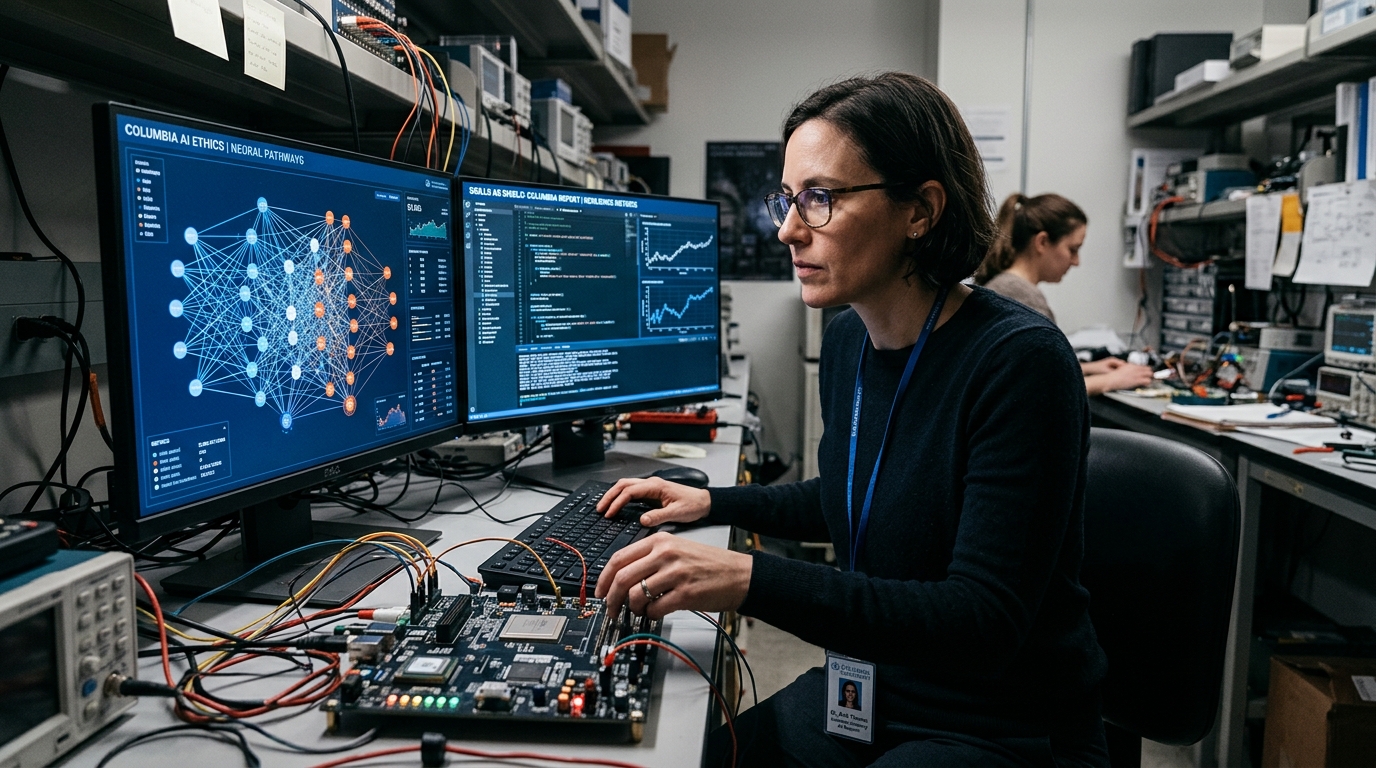
As we navigate the summer of 2026, the discourse surrounding Artificial Intelligence (AI) has shifted from mere fascination with its capabilities to an existential concern regarding the future of work. A recent report from Columbia University, extensively analyzed by major outlets, offers a sobering yet provocative perspective on how human skills can serve as a "shield" against the rapid proliferation of algorithms. This is no longer a theoretical exercise; it is a survival roadmap in an economy undergoing violent restructuring.
The Anatomy of the Report: From Replacement to Augmentation
The Columbia study distinguishes itself from previous doomsday predictions. Instead of focusing solely on the number of jobs that will be lost, it analyzes the nature of the tasks that comprise each profession. The central conclusion is that AI does not replace entire human beings, but rather specific skills—primarily those based on information processing, statistical analysis, and routine writing. A worker's defense lies in cultivating those fields where the machine is structurally deficient.
According to the researchers, the ability to synthesize disparate information with ethical judgment and emotional intelligence remains the strongest asset of the human workforce. In economies heavily reliant on services and interpersonal interaction, this finding is particularly significant. Personal contact and real-time crisis management are elements that AI can simulate, but cannot experience or guarantee with the same level of authenticity.
The Skills Shaping the Future
The report categorizes "high-resilience" skills into three main pillars. The first is Strategic Thinking and Decision-Making under conditions of uncertainty. While AI excels at analyzing historical data, humans remain superior at predicting "black swan" events or making decisions based on values rather than mere probabilities.
The second pillar is Emotional and Social Intelligence. The ability to inspire a team, negotiate with empathy, and understand the underlying tensions within an organization are skills the report describes as "non-automatable." The third pillar concerns Adaptability and Meta-learning (learning how to learn). In an environment where AI tools change every six months, the most important skill is not knowing a specific software, but the speed at which one can discard old knowledge and adopt the new.
- Critical thinking and ethical evaluation of AI outputs.
- Complex problem-solving requiring a multidisciplinary approach.
- Communication prowess and persuasion in high-pressure environments.
- Management and oversight of AI systems (AI Oversight).
The Educational Challenge and the State's Wager
The Columbia report sounds an alarm for educational systems worldwide. If schools and universities continue to reward memorization and standardized problem-solving, they are producing workers who are by definition inferior to algorithms. The shift toward critical analysis and creativity is no longer a luxury but a necessity for national competitiveness.
"AI will not take your job. Someone who knows how to use AI better than you, combining it with unique human virtues, will," the report states emphatically.
In this context, reskilling and upskilling must be treated as public infrastructure investments, comparable to roads or energy grids. The labor market stands at a critical crossroads: either invest in human capital to move up the value chain or face a new generation of technological unemployment that will primarily hit middle-management roles.
Conclusion: The Return to the Human Element
In conclusion, the Columbia report reminds us that technology is a mirror of our priorities. If our defense against AI is skills, then strengthening education and social cohesion is the only viable strategy. The era of "blind" automation is ending, and the era of conscious human-machine collaboration is beginning, where the human retains the role of the architect and the moral arbiter.