In a move that recalibrates the landscape of global technological competition, Chinese giant Alibaba has announced the launch of a new suite of AI models specifically engineered to power robotic systems. The announcement, made as part of the company's strategic pivot toward "Embodied AI," marks a transition from language models that merely "chat" to systems capable of "perceiving" and "acting" within the physical world. As we navigate June 2026, this move by Alibaba Cloud is not just a technical upgrade but a bold response to the supply chain challenges and demographic shifts facing China.
The Technological Edge of VLA Models
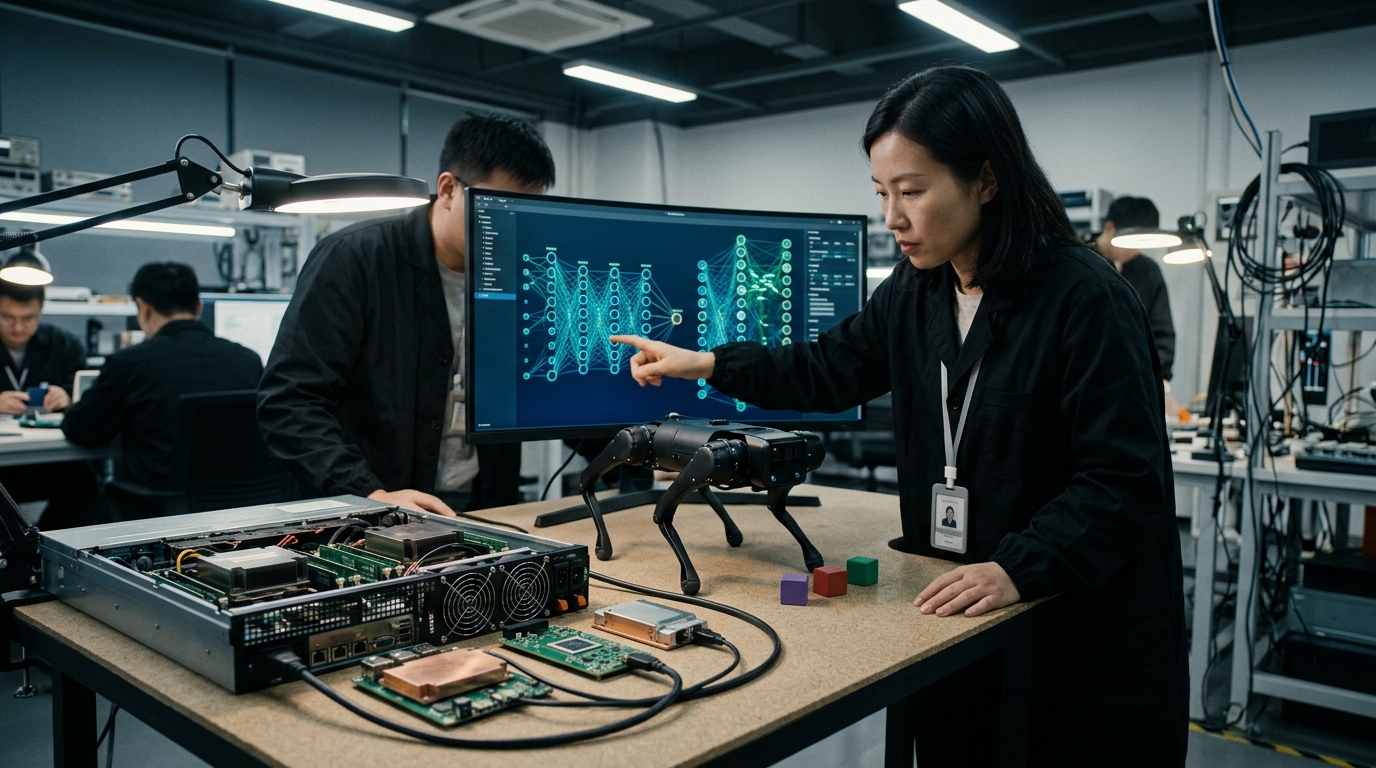
The new models, an evolution of the Qwen series, belong to the Vision-Language-Action (VLA) category. Unlike traditional models that process only text or images, Alibaba's VLA models have the capacity to translate visual stimuli and voice commands into specific motor instructions for robotic arms and autonomous vehicles. This is achieved through a unified architecture that allows the robot to understand the context of its environment. For instance, if a worker asks a robot to "pick up the fragile object on the left," the model doesn't just identify the object; it adjusts its grip pressure based on a visual analysis of the material's properties.
Alibaba claims these models have been trained on massive datasets including videos of human activities and physics simulations. This enables robots to learn through observation, drastically reducing the time required to program new tasks. In demonstrations, robots powered by Alibaba's software showcased precision in tasks such as electronic component assembly and waste sorting in complex environments, surpassing previous iterations in response speed and accuracy.
Strategic Significance and Geopolitical Context
Alibaba’s move does not occur in a vacuum. China is in a high-stakes race with the United States for dominance in next-generation productive infrastructure. With rising labor costs and a shrinking working-age population, automation is no longer a luxury but a necessity for the Chinese economy. The government in Beijing has prioritized "New Quality Productive Forces," and Alibaba Cloud is positioning itself as the central provider of the "intelligence" that will drive the factories of the future.
Furthermore, the release of these models represents Alibaba's attempt to differentiate itself from competitors like OpenAI and Google. While American firms focus heavily on digital productivity and content creation, Alibaba is targeting the heart of industrial manufacturing. Integrating AI into robotics offers a direct path to monopolizing the "Robot-as-a-Service" (RaaS) market, where businesses will not just buy machines but lease intelligence on a subscription basis.
Challenges and the Future of Labor
Despite the excitement, significant challenges remain. The transition from digital simulation (sim) to the real world (real) remains the "holy grail" of robotics. Alibaba's models must prove they can operate safely alongside humans without the risk of accidents stemming from a misinterpretation of visual data. Data security is also a critical issue, as these robots will continuously record audiovisual material from workplaces.
Finally, the social dimension of automation cannot be ignored. As Alibaba makes robots more capable and easier to deploy, the debate over job displacement gains new intensity. The company argues that its technology will liberate humans from dangerous and repetitive tasks, yet the speed of this transition may exceed the capacity of social structures to adapt. What is certain is that with Alibaba’s entry into robotic intelligence, the path toward a fully autonomous industry appears shorter than ever before.
- New VLA models allow robots to understand complex human commands in real-time.
- Alibaba Cloud aims for leadership in the "Embodied AI" market.
- The technology addresses labor shortages and the need for industrial upgrading in China.
- Safety and the ethics of automation remain primary points of contention for analysts.