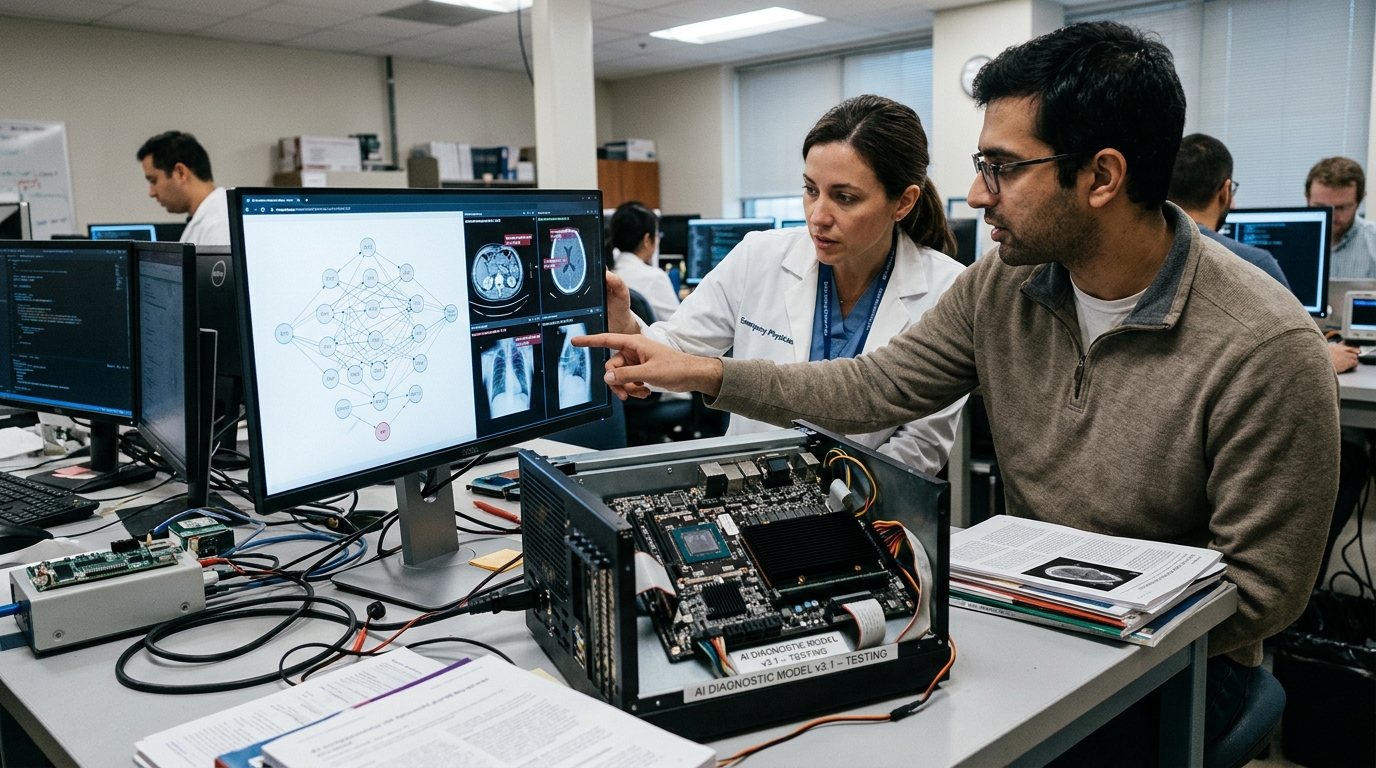
The Emergency Room (ER) is a high-stakes environment where every second counts and the margin for error is razor-thin. In recent years, healthcare systems globally have faced a dual crisis: a surge in patient volume and a critical shortage of medical personnel. Amidst this pressure, Artificial Intelligence (AI) is emerging as a potential game-changer. Recent reports, including insights from CBC and various clinical trials, suggest that AI diagnostics are showing significant promise in the chaotic frontlines of emergency medicine.
The Diagnostic Co-pilot: Enhancing Clinical Accuracy
Diagnosis in the ER is a complex puzzle. Physicians must synthesize symptoms, medical history, and diagnostic tests while managing multiple patients simultaneously. Human cognition, however, is susceptible to fatigue, stress, and cognitive biases. AI models, particularly those trained on vast datasets of medical records and imaging, offer a different approach. They can identify patterns that might be too subtle for the human eye or too rare for a general practitioner to recall instantly.
Research indicates that AI tools can assist in interpreting X-rays, CT scans, and EKGs with a level of precision that matches senior radiologists and cardiologists. By acting as a 'co-pilot,' AI can flag urgent cases, such as a subtle stroke or a pulmonary embolism, ensuring that the most critical patients receive immediate attention. This triage capability is perhaps the most immediate benefit of AI integration in the ER, directly addressing the bottleneck of long wait times.
The Hurdles: Hallucinations and the 'Black Box'
Despite the optimism, the path to fully autonomous AI diagnosis is fraught with challenges. One of the most significant concerns is the 'black box' nature of deep learning models. While an AI might provide a correct diagnosis, it often cannot explain the underlying reasoning in a way that a human doctor can verify. In medicine, understanding the 'why' is just as important as the 'what.'
- The risk of AI 'hallucinations' where the system generates plausible but incorrect medical facts.
- Liability issues: Who is responsible when an AI-assisted diagnosis leads to a medical error?
- Data privacy: Ensuring that sensitive patient data used to train and run these models remains secure.
- The risk of 'automation bias,' where clinicians might stop questioning the machine's output.
Furthermore, the ER is not just about data; it’s about the human condition. A machine can analyze a blood test, but it cannot hold a patient's hand or navigate the complex emotional landscape of a family receiving bad news. The consensus among medical ethicists is that AI should remain a tool for augmentation, not a replacement for human judgment and empathy.
Systemic Impact and the Future of Healthcare
From a systemic perspective, AI could be the key to making healthcare more sustainable. By streamlining the diagnostic process, hospitals can reduce costs and improve patient throughput. For overworked ER staff, AI could handle the heavy lifting of data entry and preliminary analysis, allowing them to spend more quality time with patients.
"AI in the emergency room is not about replacing the doctor; it's about providing them with a superpower—the ability to see through the noise of a thousand data points to find the one that matters most for the patient's survival," says a leading expert in medical informatics.
As we look toward 2026 and beyond, the integration of AI into the ER will likely become standard practice. However, this requires robust regulatory frameworks and a commitment to transparency from tech developers. The goal is a hybrid model of care where the analytical prowess of the machine and the clinical wisdom of the human work in tandem to save lives. The 'Dr. AI' of the future won't be a robot in a white coat, but a sophisticated layer of intelligence woven into the very fabric of the hospital.