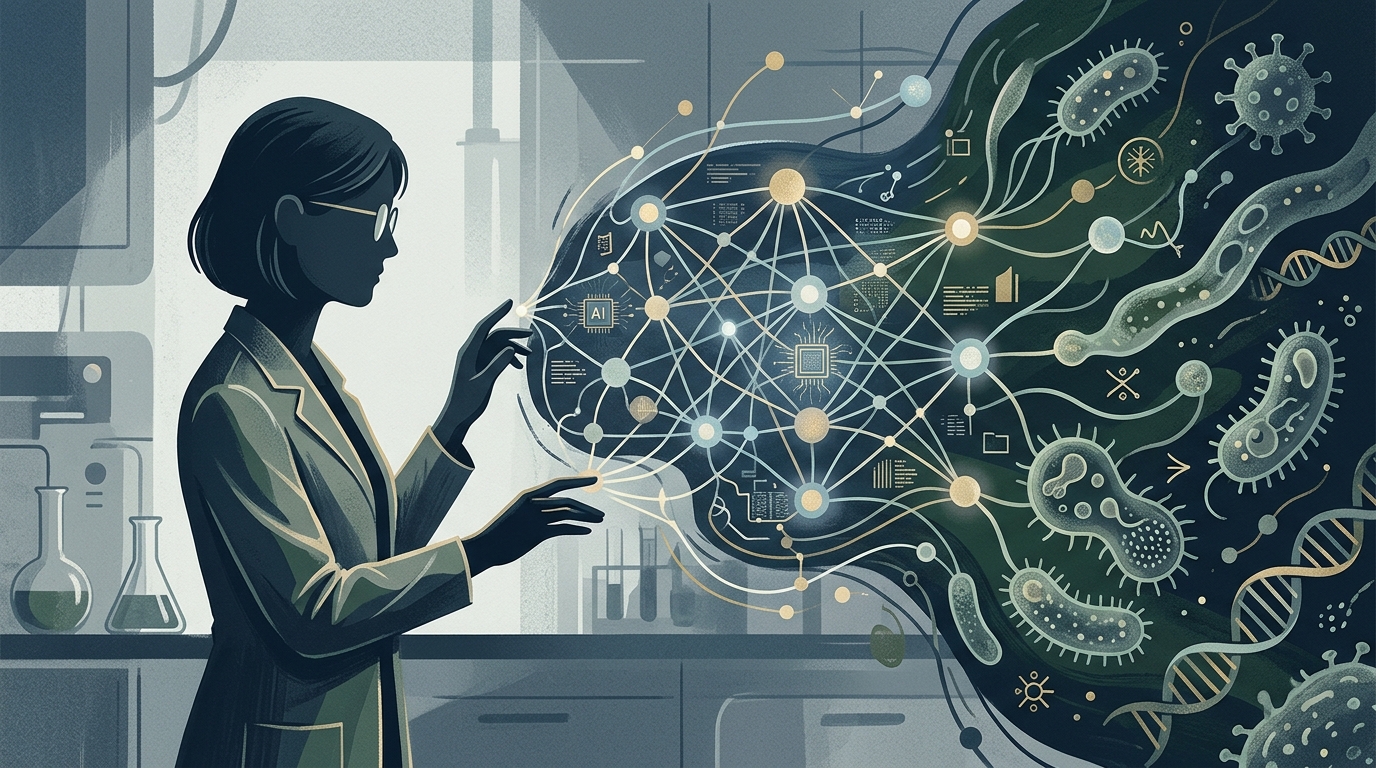
Humanity is facing a "silent pandemic." Antimicrobial resistance (AMR) threatens to return us to a pre-antibiotic era, where even a minor infection could prove fatal. At this critical crossroads, Artificial Intelligence (AI) is emerging not merely as an automation tool, but as the catalyst for a new era in pharmacology. Maria Gazouli, Professor of Biology and Genetics at the NKUA School of Medicine, speaking to "Parapolitika," outlined this technological revolution, explaining how AI can accelerate processes that once required decades and billions of dollars.
The End of the "Discovery Void"
For more than thirty years, the antibiotic industry has been in a state of stagnation. The so-called "discovery void" meant that no new class of antibiotics had reached the market since the 1980s. Traditional methods, based on trial and error in soil or plant samples, had been exhausted. Artificial Intelligence is changing this paradigm, transforming biological research into a problem of data management and predictive modeling.
As Professor Gazouli points out, AI allows scientists to digitally "scan" millions of chemical compounds in a fraction of the time. Instead of laboratory experiments lasting years, deep learning algorithms can predict which compounds have the ability to kill specific bacteria without being toxic to humans. This digital pre-selection dramatically reduces costs and time, allowing researchers to focus only on the most promising candidates.
From Halicin to Personalized Therapy
One of the most iconic examples often cited in this field is the discovery of Halicin by MIT researchers. Using an AI model, scientists identified a molecule that was structurally different from all known antibiotics and effective against multi-drug resistant strains, such as Acinetobacter baumannii. Maria Gazouli emphasizes that this ability of AI to recognize patterns that escape the human eye is the "key" to the future.
Furthermore, AI is not limited to finding new molecules. It helps in understanding the mechanisms by which bacteria develop resistance. By analyzing the genome of pathogens, algorithms can predict the bacterium's next "move," allowing scientists to design antibiotics that are "armored" against mutations. This proactive approach is essential for maintaining the efficacy of new drugs over time.
Challenges and the Greek Reality
Despite the optimism, Professor Gazouli remains a realist. The use of AI in pharmacology is not a magic bullet that will eliminate the problem overnight. There are significant challenges, most notably data quality. An AI model is only as good as the data it is trained on. If data from clinical trials or laboratories are incomplete or biased, the results will be inaccurate.
In Greece, research in this field is at a promising level, despite limited resources. Collaboration between biologists, geneticists, and computer scientists is now imperative. The professor emphasizes the need for investment in supercomputing infrastructure and the creation of large, open databases to fuel research. Our country has the human potential but needs the institutional framework and funding to play a leading role in this global effort.
The Future of Medicine
The integration of AI into antibiotic discovery is part of a broader shift toward precision medicine. In the future, antibiotics may not be "broad-spectrum" but targeted to the specific organism and the specific infection of each patient. Maria Gazouli concludes that this technology gives us the advantage in a race against time. Bacteria are constantly evolving; now, for the first time, we have a tool that can evolve faster than they do.