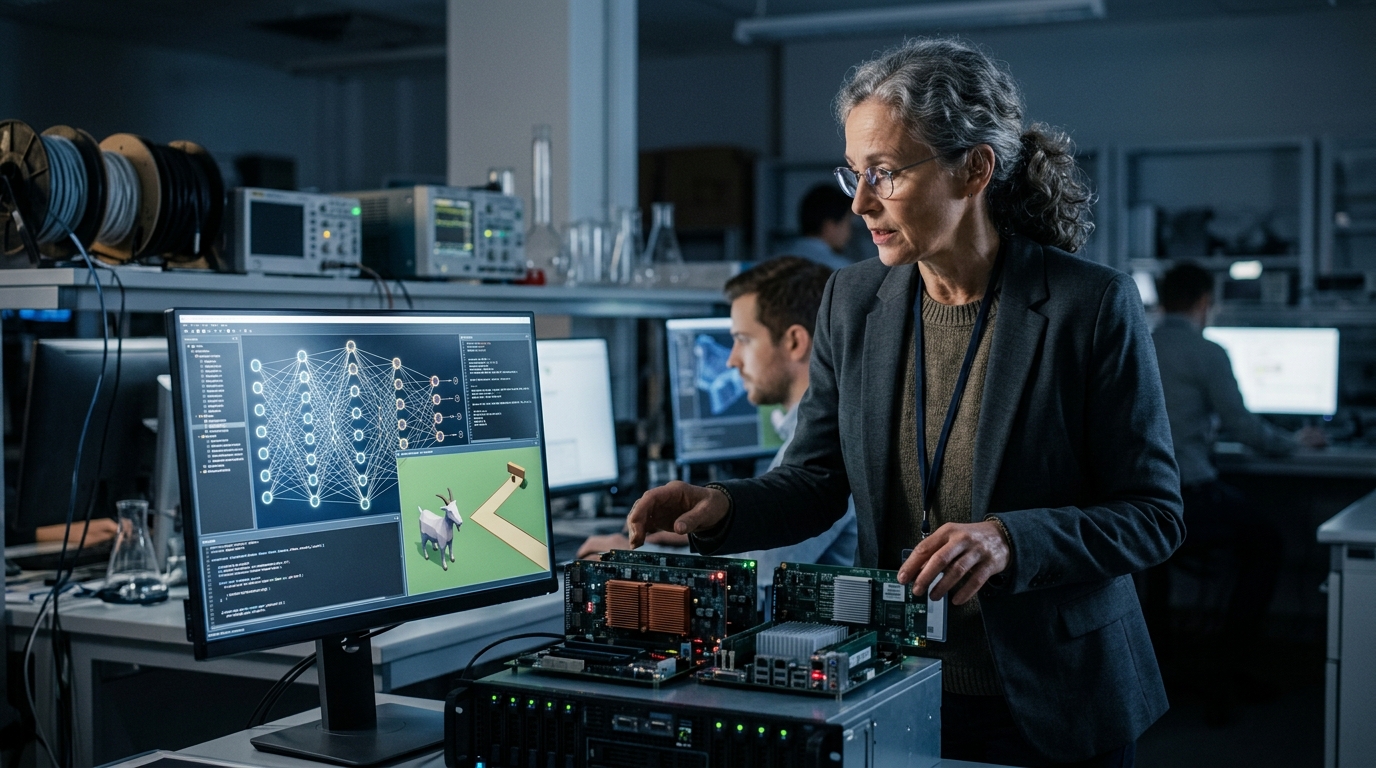
In a tech landscape dominated by hyperbolic claims of "digital life" and "machine consciousness," an unconventional experiment has emerged to ground the public discourse in cold, hard logic. Ali Alvi, a Principal Software Engineer at Microsoft, chose an unlikely laboratory for his latest research into the nature of AI: the 1999 real-time strategy classic, Age of Empires II. By utilizing the game’s digital goats as fundamental building blocks, Alvi constructed a fully functional neural network, demonstrating with absurd clarity that computational complexity does not equate to sentience.
The Mechanics of the Absurd: Goats as Logic Gates
Alvi’s project is far more than a nostalgic stunt for gamers; it is a profound demonstration of "computational universality." Within the Age of Empires II Scenario Editor, players can set up "triggers"—conditional statements that execute actions when specific criteria are met. Alvi leveraged the movement and pathfinding of goats to create the digital equivalent of logic gates (AND, OR, and NOT). These gates are the atomic components of every computer processor on the planet.
By networking hundreds of these "goat-gates" together, Alvi built a two-layer neural network capable of performing MNIST digit recognition—a standard benchmark in machine learning where an AI identifies handwritten numbers. The process is painstakingly slow and visually chaotic: goats move into specific zones to trigger sensors that represent mathematical weights and biases. When the system "recognizes" a digit, it is merely the result of a chain reaction of animal movements. The fact that a herd of pixelated ruminants can execute deep learning algorithms highlights a fundamental truth: AI is, at its core, an incredibly complex mechanism for moving data, not an emergent spirit.
The Chinese Room Revisited in the Digital Age
This experiment serves as a 21st-century iteration of philosopher John Searle’s "Chinese Room" thought experiment. Searle argued that if a person in a room follows a rulebook to respond to Chinese characters without actually knowing the language, they might convince those outside that they understand Chinese, while in reality, they are simply executing a mindless process. In Alvi’s case, the goats are the participants in the room. They perform the labor of intelligence, yet no rational observer would claim the herd possesses consciousness or an understanding of the mathematics they are facilitating.
This deconstruction is vital in an era where Large Language Models (LLMs) like GPT-4 are frequently anthropomorphized. When a chatbot expresses "feelings" or claims to fear being turned off, it is doing nothing fundamentally different from Alvi’s goats: it is following statistical pathways carved out of massive datasets. The difference lies in the scale, speed, and sophistication of the interface, not in the essence of its existence. The "ghost in the machine" is often just a reflection of our own desire to find life in the tools we build.
Corporate Irony and the Responsibility of Researchers
The fact that a senior researcher at Microsoft—the primary benefactor of OpenAI—is the one behind this project is particularly noteworthy. It suggests a growing internal push for scientific sobriety within an industry often intoxicated by its own marketing narratives of "existential risk" and "Artificial General Intelligence" (AGI). If we can simulate intelligence with goats, the "magic" of AI begins to dissipate, replaced by a more sober analysis of architecture and algorithmic efficiency.
Key Takeaways from the Goaty Experiment
- Complexity is not a proxy for consciousness: A system can be highly capable without being aware.
- Computational Indifference: Digital systems do not "care" about or understand the data they process.
- The Eliza Effect: Humans are predisposed to project human traits onto complex systems, a tendency this experiment mocks.
In conclusion, the "Goaty AI" reminds us that intelligence, as defined in computer science, is a function, not a state of being. As machines become more adept at mimicking us, the need to distinguish between processing and experience becomes more urgent. The goats of Age of Empires II, in their simple movements across a digital battlefield, have provided one of the most serious lessons of the decade: do not mistake the map for the territory, nor the algorithm for the soul. The path to true understanding begins with recognizing that even the most brilliant AI is, in a sense, just a very large herd of goats.