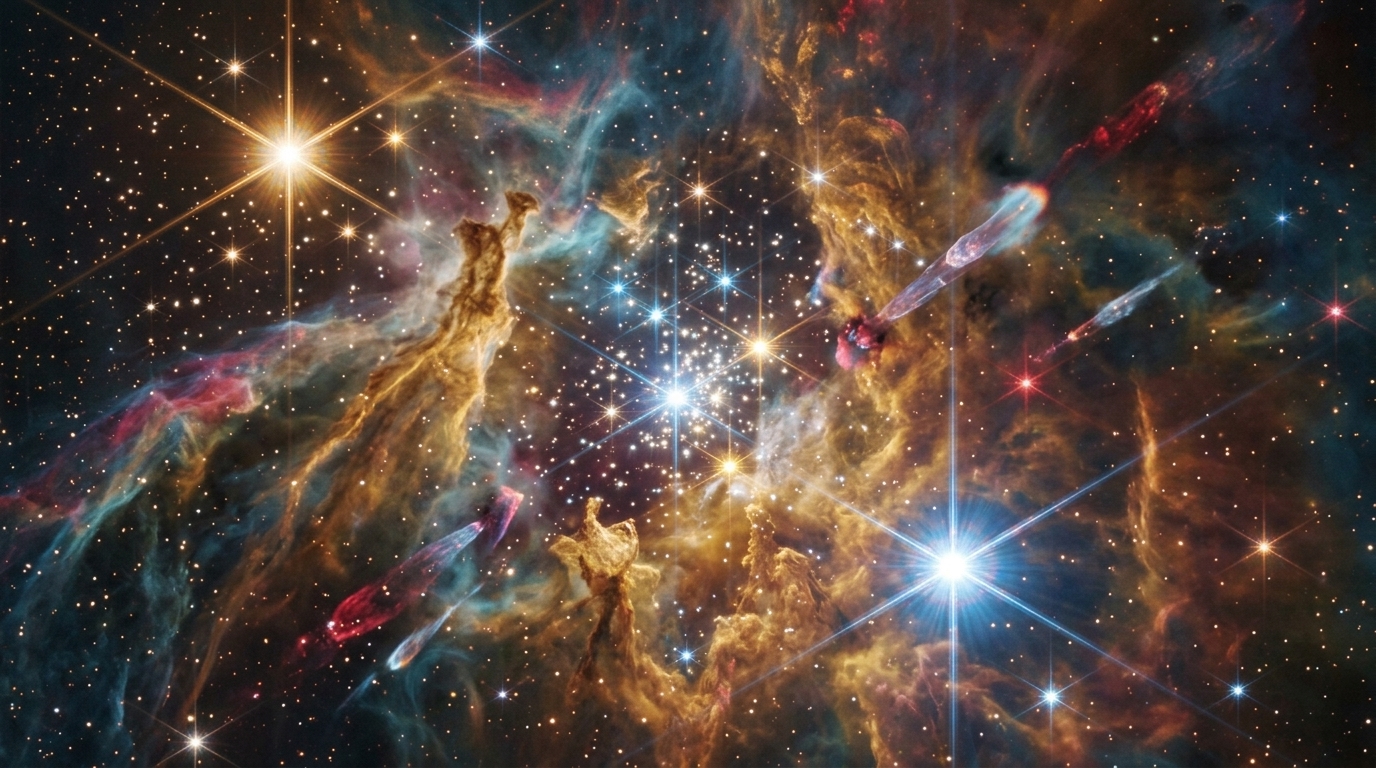
In the vast darkness of space, where human vision fails to penetrate, the James Webb Space Telescope (JWST) continues to serve as a state-of-the-art lens that transforms the invisible into the visible. The latest image released by NASA, in collaboration with ESA and CSA, is not merely an aesthetic achievement; it is a living chronicle of creation, a detailed record of the first moments of a star's existence. What at first glance resembles an epic clash from a science fiction movie is, in reality, the "cry" of a newborn sun struggling to emerge from the protective yet dense veil of cosmic dust.
The Anatomy of Stellar Birth
The central theme of this new observation is Herbig-Haro objects, specifically the jets of matter ejected from a protostar. When a star is in the early stages of its formation, it accumulates mass from the surrounding nebula of gas and dust. However, this process is far from calm. Part of this material is ejected along the star's poles at speeds of hundreds of kilometers per second. These supersonic jets collide with the surrounding gas, creating luminous nebulae that astronomers call Herbig-Haro objects.
The James Webb's ability to observe in the near and mid-infrared spectrum is the key to this discovery. Cosmic dust, which blocks visible light (such as that detected by the Hubble telescope), becomes almost transparent at infrared frequencies. Thus, the JWST can look "inside" the star's womb, revealing the structure of the jets and the dynamics of their interaction with the interstellar medium. The details are staggering: shock ripples, knots of matter, and the subtle hues of chemical elements excited by the energy of the collision are clearly visible.
Technological Superiority and the Light of the Unseen
For decades, astronomers relied on theoretical models to understand how protostars affect their environment. Webb's images are a game-changer. The NIRCam (Near-Infrared Camera) captured light from hydrogen molecules, carbon monoxide, and silicon dioxide, which emit at specific wavelengths when heated by collisions. This "chemical signature" allows scientists to map the velocity and temperature of the ejected matter with a precision that was unthinkable five years ago.
Analysis of the image shows that the jets are not continuous but are ejected in episodes. This suggests that the feeding of the star with material from the surrounding accretion disk occurs in an intermittent manner, like "bites" of matter that the star swallows before venting excess energy. This dynamic is critical for the final mass the star will acquire and, by extension, for whether it will evolve into a sun capable of hosting planetary systems.
From Dust to Life: Broader Implications
The study of these regions is not just about high-energy astrophysics. It is about our very origins. Every carbon atom in our bodies and every drop of water on Earth originates from similar processes that took place 4.6 billion years ago. By observing the birth of stars in distant nebulae, scientists are effectively observing the past of our own solar system.
Furthermore, Webb's sensitivity allows for the identification of organic molecules within these jets. The presence of water and complex chemical compounds in star-forming regions suggests that the building blocks of life are scattered throughout the universe, waiting for the right conditions to "take root" on a future planet. This image, therefore, beyond its artistic beauty, serves as a roadmap for understanding cosmic evolution.
Conclusion: A New Window into Existence
The James Webb continues to justify the massive investment and the expectations of the scientific community. Every new photograph is a chapter in a book we have only just begun to read. The "living portrait" of cosmic creation reminds us that the universe is not a static space, but a living organism in constant transformation. As we move into the second half of the 2020s, these discoveries lay the groundwork for the next great challenge: the direct imaging of Earth-like exoplanets and the search for biosignatures in deep space.