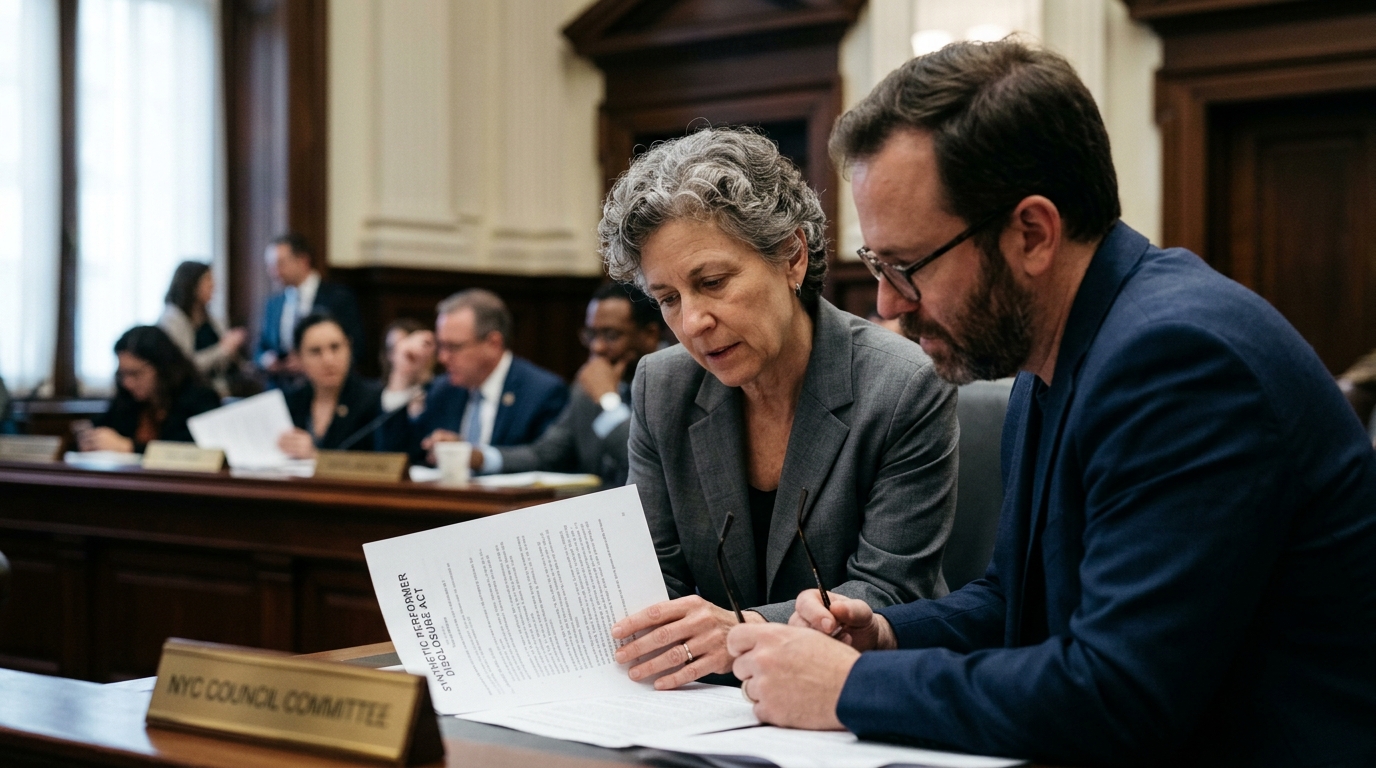
In a move poised to reshape the global advertising landscape, New York State has enacted groundbreaking legislation requiring explicit labeling of any 'synthetic performer' generated via Artificial Intelligence. Signed into law by Governor Kathy Hochul, this measure aims to safeguard the rights of professional actors and prevent consumer deception by digital replicas that are increasingly indistinguishable from reality.
Legal Safeguards for the Human Element
The new law defines a 'synthetic performer' as any digital representation of a human being—whether based on a real person or entirely fictional—that appears in audiovisual content in a manner likely to be perceived as a real human presence. Under these provisions, advertising agencies and content producers are now mandated to include a clear and conspicuous disclosure stating that the 'performer' viewed by the audience is not a human but an algorithmic creation.
The impetus for this legislation followed intense lobbying from talent unions, most notably SAG-AFTRA. During recent Hollywood strikes, the union placed AI protections at the forefront of their agenda. Artists expressed legitimate fears that AI’s ability to generate convincing digital twins could lead to the wholesale replacement of humans by cheaper, 'compliant' digital models that do not require insurance, meal breaks, or residual payments.
Economic and Ethical Implications on Madison Avenue
For the advertising industry in New York, the historic home of Madison Avenue, this change presents a significant operational challenge. On one hand, AI offers massive reductions in production costs. Instead of expensive shoots involving dozens of crew members, companies can now generate entire campaigns from a desktop. However, mandatory disclosure may interfere with the consumer's 'immersion' in the marketing message.
Analysts suggest that transparency is a double-edged sword. While it protects the truth, it simultaneously reminds the viewer of the artificial nature of the product being pitched. As a global commercial hub, New York is setting a precedent likely to be emulated by other U.S. states and potentially integrated into broader international frameworks like the EU AI Act. Ethically, the issue touches the core of identity: Who owns our likeness? And how can we ensure an actor doesn't 'lend' their face to a campaign that contradicts their personal values without explicit, informed consent?
The Technological Challenge of Compliance
Implementing the law is not without technical hurdles. Advertisers must develop new protocols for integrating disclosures that are 'clear and conspicuous.' This raises questions about how labels will be handled on short-form video platforms like TikTok or Instagram, where screen real estate is limited and user attention spans are fleeting.
- Violators will face substantial fines, with penalties scaling based on the reach and duration of the campaign.
- The legislation covers both visual and auditory representations (AI voice cloning).
- Exemptions are narrowly tailored for parody, satire, or news reporting under strict conditions.
Ultimately, New York’s move is an attempt to bring 'order to the chaos' of the digital age. As the lines between physical and digital reality blur, the law serves as a reminder that human labor and consumer honesty remain values that cannot be fully automated. The success of this endeavor will be judged by whether consumers continue to trust brands utilizing synthetic media, or if they will gravitate back toward the authenticity of the human touch.