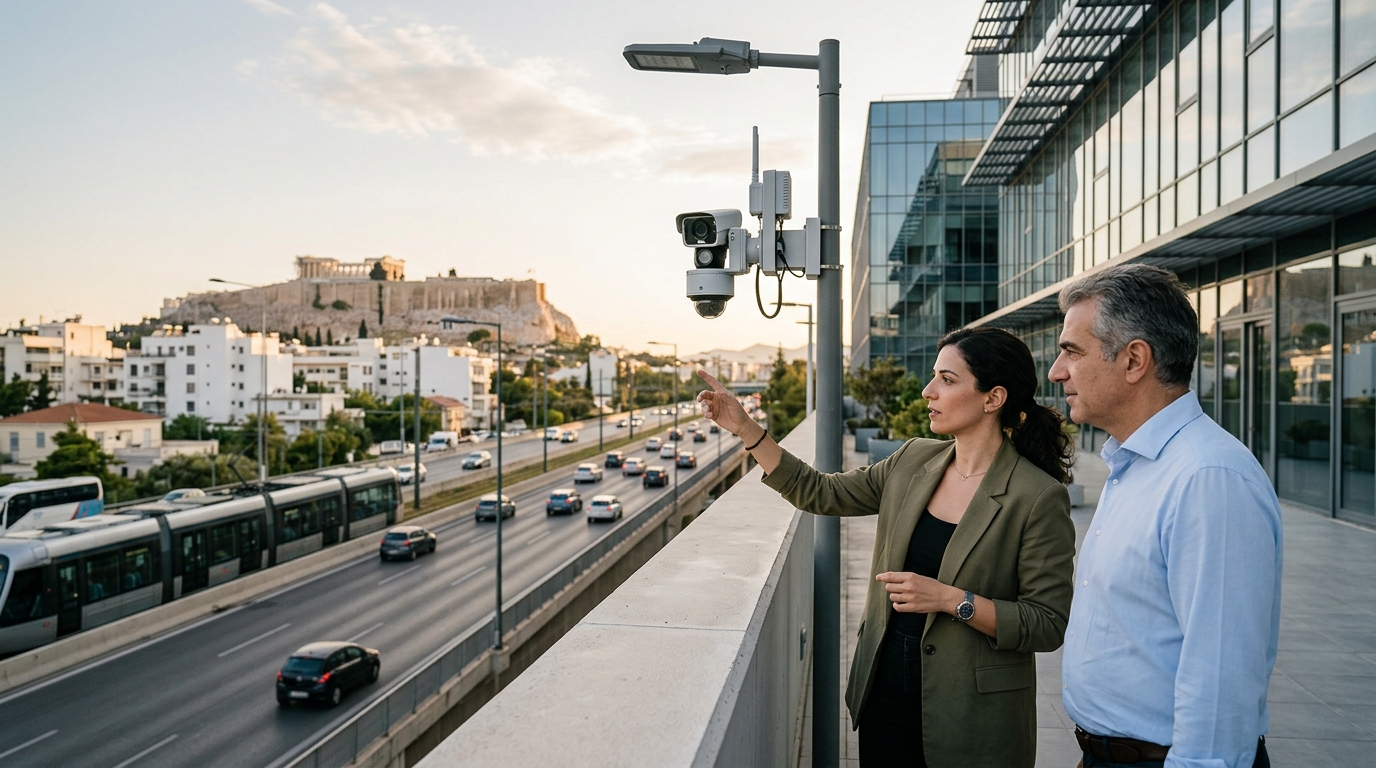
Greece, a country that has historically struggled with high rates of road accidents and a frequently problematic driving culture, is on the threshold of a technological revolution. As of mid-2026, the integration of Artificial Intelligence (AI) into traffic management and road safety is no longer a science fiction scenario, but a daily reality transforming the national road network. From the boulevards of Athens to the provincial roads of the periphery, the state's "digital eye" is becoming smarter, faster, and, most importantly, more preventive.
Smart Policing and the End of Impunity
The most visible application of AI in Greece today is the installation of new "smart" surveillance cameras. Unlike older systems limited to speed recording, the new cameras powered by neural networks can detect multiple violations simultaneously. Mobile phone use while driving, failure to wear a seatbelt or helmet, and illegal driving in Emergency Lanes (LEA) are now automatically recognized in real-time.
The system does not merely function as a fine-imposing mechanism. Data analysis allows authorities to understand driver behavior patterns. For instance, if AI detects that at a specific turn on Marathonos Avenue, 40% of drivers cross the double dividing line, the system alerts technical services to potential road defects or inadequate signage before the next fatal accident occurs. This shift from enforcement to predictive analysis is what makes the difference in protecting human life.
Accident Prediction and Traffic Management
Beyond policing, Artificial Intelligence plays a decisive role in managing traffic flow, which is directly linked to safety. AI systems installed in the traffic control centers of Attica and Thessaloniki analyze data from thousands of sensors and cameras to predict congestion before it happens. Using machine learning algorithms, traffic lights are dynamically adjusted to avoid "stop-and-go" traffic, which is responsible for a large number of low-intensity collisions.
Furthermore, AI is used to create "digital twins" of the road network. These virtual models allow engineers to simulate various scenarios—such as heavy rainfall or increased traffic due to social events—and see how road safety will be affected. Thus, infrastructure interventions are based on hard data rather than assumptions. The ability to predict "black spots"—points where accidents statistically cluster—allows for the timely placement of protective barriers or improved lighting.
Ethical Dilemmas and the Privacy Challenge
Despite the undeniable benefits, the extensive use of AI on the roads raises serious questions regarding personal data protection and digital surveillance. The Greek government, in compliance with the European Union's AI Act, must ensure that data collection is strictly limited to the purpose of road safety. Automatic facial recognition remains a "red flag," with authorities assuring that algorithms focus on the vehicle's license plate and detecting the violation, automatically blurring the faces of occupants.
Another issue is "algorithmic fairness." How infallible is an AI system when called upon to judge a violation in complex conditions? The need for human oversight (human-in-the-loop) remains imperative. Every violation detected by AI must be validated by specialized Traffic Police personnel before a fine is issued, ensuring that technology functions as a tool and not as an absolute judge. Public trust in these systems is key to their acceptance and, ultimately, to the long-term improvement of driving behavior.
Conclusions: The Road to Vision Zero
The European Union's goal of zero road deaths by 2050 (Vision Zero) seems less utopian with the help of Artificial Intelligence. For Greece, the challenge is twofold: integrating technology on one hand and upgrading infrastructure that has remained neglected for decades on the other. AI cannot fix a pothole, but it can precisely indicate where the next layer of asphalt should be laid to save lives.
At the end of the day, technology is a power multiplier. Its success in road safety will be judged not by the number of fines issued, but by the reduction of empty seats at the family table. Greece in 2026 shows that digital transformation can have a human face, protecting the most precious asset: life itself.