

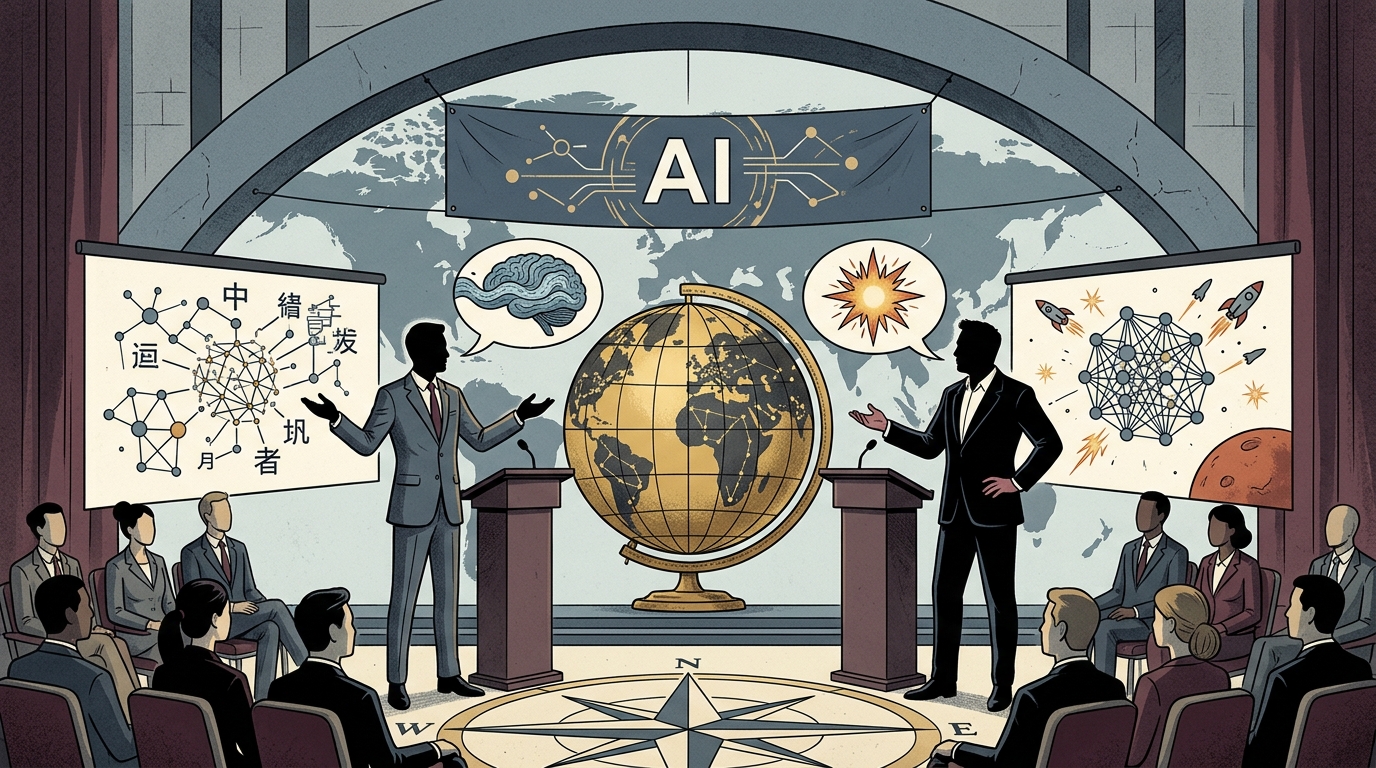
In the high-stakes theater of Artificial Intelligence (AI), words often carry as much weight as the code they describe. The recent public exchange between Elon Musk and the leadership of Zhipu AI is more than just a corporate spat; it is a profound manifestation of the geopolitical tensions defining our digital era. Musk, known for his visionary yet often polarizing commentary, found himself corrected when he attempted to frame Chinese AI progress through a Western lens, using terminology that the Chinese side deemed fundamentally inaccurate.
The Anatomy of a Dispute: 'Fable 5' vs. Chinese Innovation
The core of the controversy ignited when Musk commented on China's purported launch of models akin to 'Anthropic Fable 5.' To the uninitiated, this might sound like technical jargon, but to those in the industry, it carried a sting of dismissiveness. Musk's reference to 'Fable'—a codename associated with Anthropic's internal development cycles—implied that Chinese AI is merely chasing or mirroring Western benchmarks.
The CEO of Zhipu AI, one of China's 'AI Tigers' and a company valued at over $2.5 billion, took the opportunity to set the record straight. The 'correction' was not merely about names but about the essence of technological sovereignty. Zhipu's GLM (General Language Model) series, they argue, is built on distinct architectural foundations, optimized for a different set of constraints and goals than those of OpenAI or Anthropic. By rejecting Musk's framing, Zhipu AI signaled that the era of China being viewed as a 'copycat' is officially over.
The Compute Gap and the Efficiency Strategy
Perhaps the most significant takeaway from this clash is the underlying debate over hardware. Since the U.S. implemented strict export controls on high-end GPUs like Nvidia’s H100s, the narrative in the West has been that China’s AI ambitions would eventually hit a 'silicon ceiling.' However, companies like Zhipu AI and Kai-Fu Lee’s 01.AI have turned this constraint into a catalyst for innovation.
"Innovation is not just a matter of resources; it is a matter of adaptability. Our constraints have forced us to become more ingenious with our architectures," notes an industry analyst familiar with the Beijing tech hub.
While Musk builds massive compute clusters like the 'Colossus' for xAI, Chinese engineers are focusing on algorithmic efficiency—getting more 'intelligence' out of fewer flops. Zhipu AI’s models have consistently ranked at the top of global benchmarks for mathematical reasoning and coding, areas where structural logic is more important than sheer scale. This 'lean' approach to AI is something Musk’s comments failed to acknowledge, prompting the sharp rebuttal from the Chinese side.
Geopolitical Chess: Musk’s Multi-Front War
Elon Musk’s position is uniquely precarious. As the CEO of Tesla, he is deeply tethered to China’s manufacturing ecosystem and consumer market. As the founder of xAI, he is a direct competitor to the very companies he often comments on. This duality makes his critiques of Chinese AI a sensitive diplomatic matter. When he 'mischaracterizes' Chinese progress, it isn't just seen as a technical error; it is viewed as a strategic narrative move by a Western competitor.
The response from Zhipu AI also reflects a surge in Chinese national pride. In a climate where AI dominance is equated with national security, allowing a Western mogul to define the narrative of domestic progress is not an option. The 'correction' serves as a reminder that the global AI race is now a bipolar competition, with two distinct poles of power that no longer speak the same technical or political language.
The Future: A Bifurcated Intelligence?
As we look toward 2026, the prospect of an 'AI Splinternet' is becoming a reality. We are witnessing the emergence of two parallel tracks of intelligence: one fueled by the massive capital and hardware of Silicon Valley, and another driven by the strategic mandates and resource-optimization of Beijing. The public pushback against Musk suggests that the Chinese AI sector is no longer content with being a silent participant in this race.
Ultimately, the exchange highlights a critical shift in the global tech hierarchy. The Zhipu AI CEO's willingness to challenge Musk on the world stage demonstrates a new level of confidence. China is not just catching up; it is innovating under pressure, developing a unique technological lineage that demands recognition on its own terms, free from Western labels and comparisons.





