

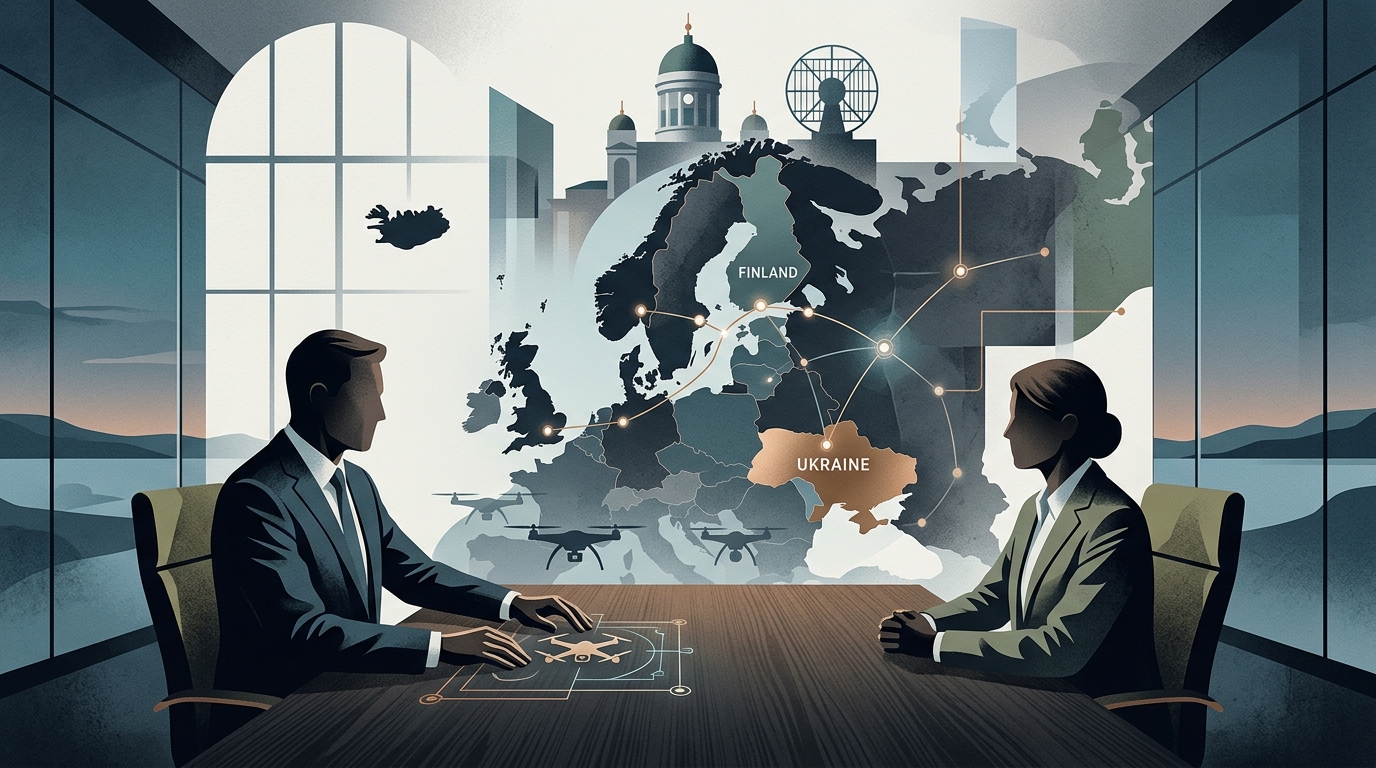
In a move that underscores the shifting geopolitical gravity of Europe toward the Northeast, Ukrainian President Volodymyr Zelenskyy has formally extended a proposal to Finland for a comprehensive agreement in the field of unmanned aerial vehicles (drones). This proposal, announced during high-level bilateral discussions, is not merely a commercial contract but a strategic partnership aimed at merging Ukraine's raw combat experience with Finnish industrial precision and technological excellence.
Ukraine as the Global Drone Laboratory
Over the past few years, Ukraine has transformed into the world's largest "living laboratory" for autonomous warfare technology. Driven by the necessity to counter a numerically superior adversary, Kyiv has developed hundreds of domestic drone models, ranging from small FPV (First Person View) units acting as loitering munitions to large long-range aircraft capable of striking strategic targets deep within enemy territory. The proposal to Finland is built on this very expertise: Ukraine offers solutions battle-tested against advanced electronic warfare (EW) environments—something no other NATO member possesses to such an extent.
Finland, for its part, as the newest member of the Alliance with the longest land border with Russia in Europe, is seeking ways to bolster its deterrent capabilities. The Nordic nation boasts a robust defense industry and a tradition of innovation but lacks the immediate, iterative experience of the rapidly evolving drone tactics seen on the fronts of Donbas and Kherson. An agreement would allow Finland to integrate Ukrainian systems into its own "total defense" doctrine while providing Ukraine with a stable production base and access to European supply chains.
Geopolitical Implications and the Northern Axis
Zelenskyy's initiative is part of a broader strategy to build "horizontal" alliances within Europe. Instead of relying solely on the central bureaucracies of Brussels or Washington, Kyiv is constructing bilateral bridges with states that share the same existential threat from Moscow. Finland, having survived the Winter War (1939-1940), understands better than most the importance of technological superiority over sheer mass.
- Joint Production: Establishing factories on Finnish soil would protect production lines from Russian missile strikes.
- Data Sharing: The transfer of telemetry and performance data under intense GPS jamming is invaluable for NATO's future readiness.
- Training: Ukrainian operators could train Finnish forces in the nuances of asymmetric, drone-centric warfare.
"We are not just offering weapons; we are offering the experience of survival in the digital age of conflict," the Ukrainian leader reportedly emphasized.
Challenges and the Path Ahead
Despite the strategic alignment, significant hurdles remain. Integrating Ukrainian systems into NATO-standard frameworks requires substantial bureaucratic and technical harmonization. Furthermore, Russia closely monitors these developments, viewing any military strengthening along its borders as a provocation. However, for Helsinki, national security outweighs diplomatic sensitivities. Finland has already committed billions in aid, and transitioning from "assistance" to "partnership" is the logical next step.
In conclusion, the drone proposal signals Ukraine's evolution from a passive recipient of aid to an active provider of security and technology. For Finland, it represents an opportunity to fortify its borders with cutting-edge technology, reaffirming that in the 21st century, power is measured not just by troop numbers, but by the intelligence of the algorithms patrolling the skies above the battlefield.





