

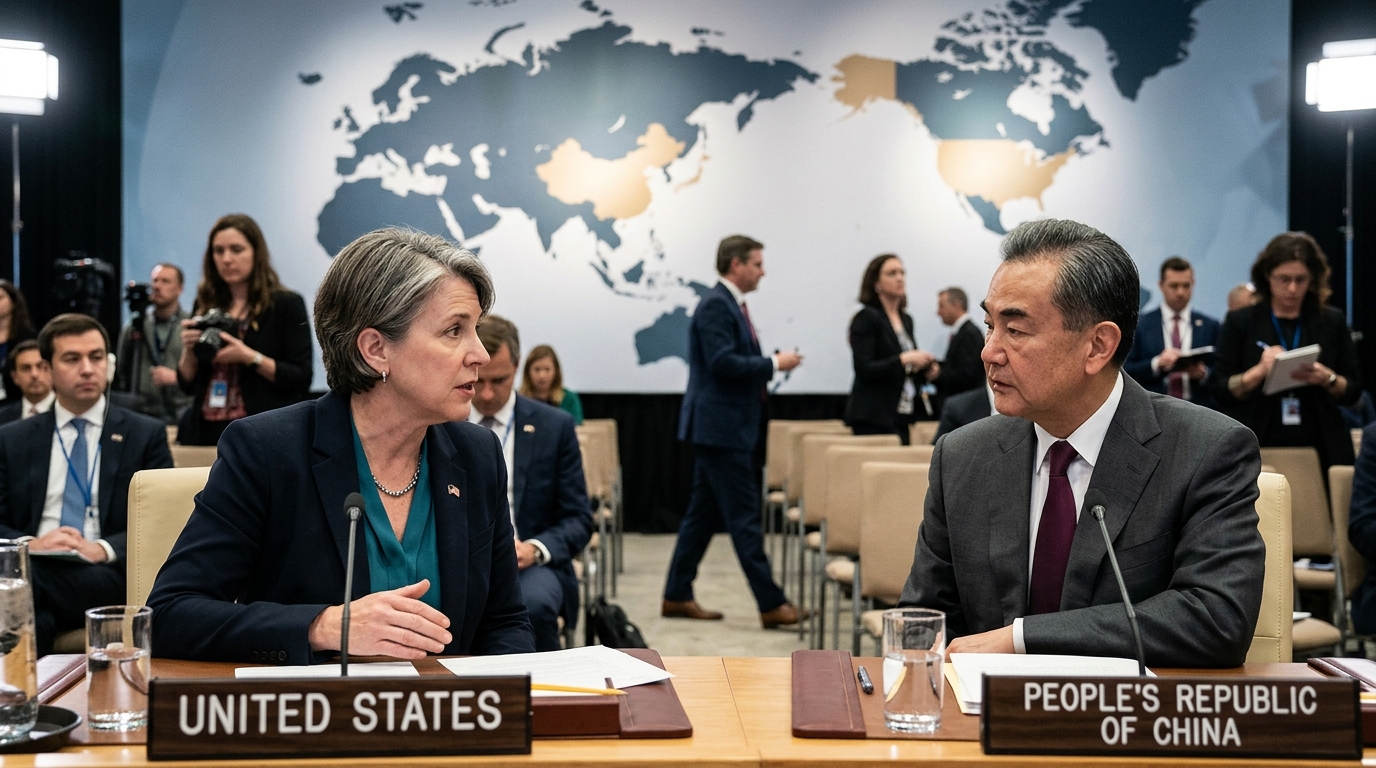
As we navigate through May 2026, the global geopolitical landscape stands at a critical juncture reminiscent of the darkest days of the Cold War, yet with a fundamental difference: the adversary is not just an ideological rival, but a technology that no one fully controls. A recent analysis by Sebastian Mallaby of the Council on Foreign Relations (CFR), published in Bloomberg, highlights a truth that many in Washington prefer to ignore: China is no longer a mere follower in AI developments, but a peer competitor closing the gap with alarming speed.
U.S. strategy, which relied heavily on strict semiconductor export controls and restrictions on knowledge transfer, appears to be reaching its limits. Despite these hurdles, Beijing has managed to develop indigenous solutions and optimize its algorithms such that Western superiority can no longer be taken for granted. In this context, the need for a coordinated approach to AI Safety becomes imperative before the situation leads to an irreversible 'Game Over' for humanity.
The Convergence of Capabilities and the Failure of Containment
For years, American foreign policy operated under the assumption that depriving China of high-end Nvidia chips would delay Chinese AI by at least a decade. However, 2026 finds us facing a different reality. China, through Huawei and other domestic giants, has developed architectures that bypass the need for the latest Western lithography, focusing instead on software efficiency and its vast pool of data.
As Mallaby points out, the attempt to 'strangle' Chinese development may have had the opposite effect: it pushed Beijing into a state of emergency that accelerated innovation. When two superpowers compete without rules in a field where mistakes can be catastrophic, the risk of an accident increases exponentially. AI safety is no longer just about whether a chatbot gives a wrong answer, but whether an autonomous military system or critical infrastructure suffers a collapse due to misaligned goals.
"AI safety is a global public good. If one party fails to control its systems, the consequences will spill over borders, affecting the entire planet."
Existential Risks and Common Ground
But why should Washington sit at the same table with a rival it considers an existential threat? The answer lies in the nature of the technology itself. Artificial Intelligence, especially as we approach levels of Artificial General Intelligence (AGI), does not recognize flags. A virus created by an uncontrolled AI or a financial crisis triggered by algorithmic panic will not discriminate between capitalism and state socialism.
- Biological Threats: The ability of AI to design new pathogens is an area where the US and China have a shared interest in imposing strict limits.
- Autonomous Weapons: The lack of protocols for the use of AI in nuclear command and control systems is perhaps the greatest risk to global peace.
- Systemic Stability: The interdependence of global markets means a failure of Chinese AI could trigger a domino effect on Wall Street and vice versa.
Cooperation does not mean trust. It means recognizing shared risks. Just as the US and the Soviet Union agreed on arms control treaties (SALT) despite mutual hostility, a framework of 'technical diplomacy' is required today. This includes sharing information on development 'red lines' and creating common standards for aligning models with human values.
Algorithmic Diplomacy: Toward an International Framework
The challenge for the US government is to balance strategic competition with the need for safety. Many hawks in Washington argue that any conversation with China is a sign of weakness. However, the reality of 2026 shows that isolation is not working. China is already actively participating in international AI forums, such as the follow-ups to the Bletchley Declaration, and appears willing to discuss risks, as it also fears internal destabilization from uncontrolled technology.
Sebastian Mallaby suggests the creation of an 'International AI Safety Institute,' where scientists from both sides can test models in simulated environments before release. This does not require revealing trade secrets or military codes, but rather establishing 'safety valves' to prevent escalation in the event of a malfunction.
The conclusion is clear: time is running out. AI development is moving at speeds that outpace the bureaucracy of diplomacy. If the world's two largest economies do not find a way to communicate on basic survival issues, 'Game Over' will not just be a headline, but the new global reality. Hegemony matters little in a world collapsed by its own ingenuity.




