

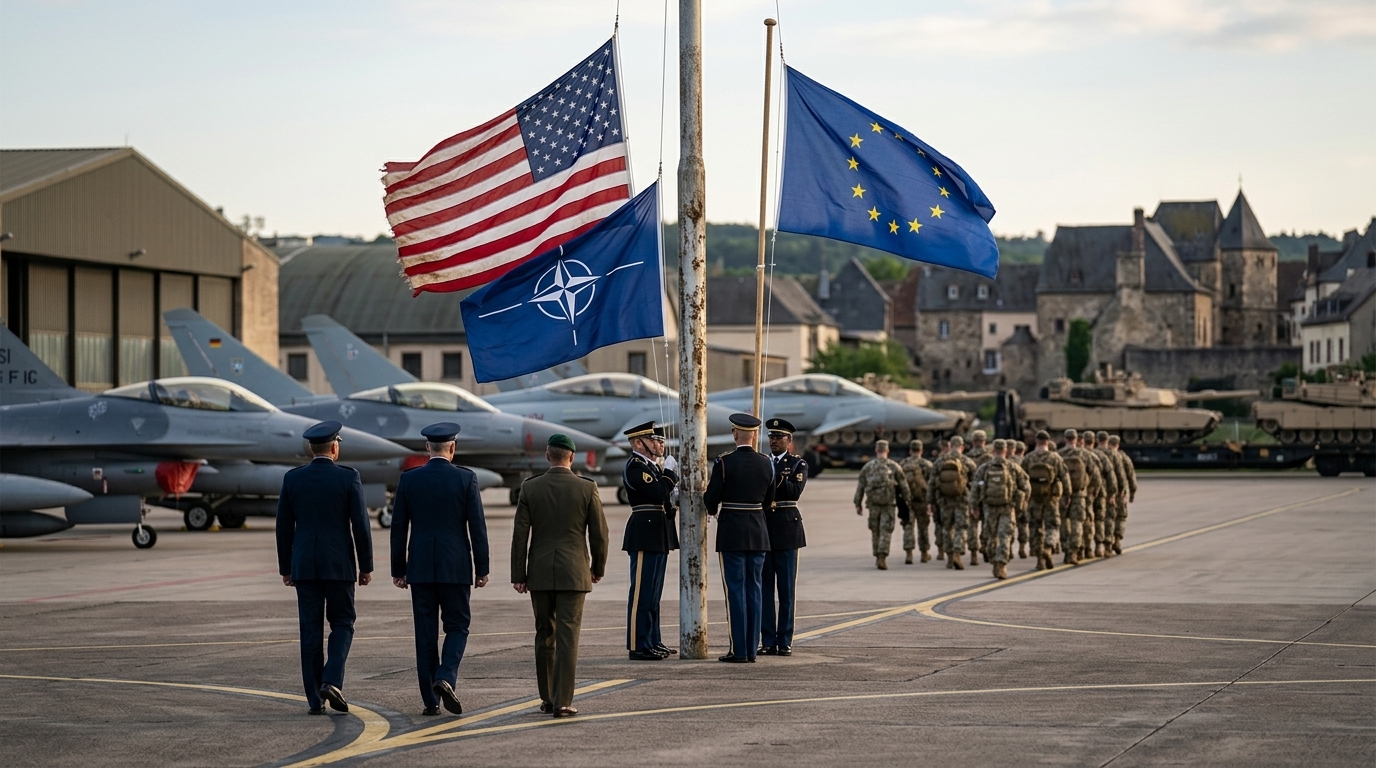
In a move that many analysts considered inevitable but few hoped to see so soon, the United States has begun a systematic process of withdrawing and realigning its military forces from the European continent. This development, occurring during a period of intense geopolitical instability, is not merely a Pentagon administrative decision, but a profound political statement about Washington's priorities in the 21st century. The shift of American interest toward the Indo-Pacific, combined with internal pressure to reduce international commitments, places NATO before its responsibilities and Europe before an existential dilemma.
The 'Pivot' Strategy and the Geopolitical Vacuum
The withdrawal of American troops does not happen in a vacuum. For over a decade, American foreign policy has been moving toward the "Pivot to Asia," recognizing China as the primary systemic competitor. Europe, which for eight decades enjoyed the security provided by American hegemony, is now called upon to fill an irreplaceable gap. The reduction of forces primarily concerns support units, armored brigades, and air squadrons stationed in Germany and Italy, sending a clear message: the era of "free security" is over.
This realignment creates immediate risks for NATO's eastern flank. Countries like Poland and the Baltic States, which base their deterrent power on the American presence, are expressing deep concerns. Despite Washington's assurances that Article 5 commitments remain ironclad, the physical absence of troops diminishes the psychological and practical deterrence against an increasingly assertive Russia. Moscow, closely monitoring developments, may interpret the American retrenchment as an opportunity to redraw spheres of influence in Eastern Europe.
Strategic Autonomy: From Slogan to Practice
For the European Union, the US withdrawal represents the ultimate "stress test." The concept of "strategic autonomy," once a favorite topic of discussion in Parisian think-tanks, is now turning into an urgent necessity. Europe is called to invest billions in defense industries, unify its military doctrines, and create command structures that do not depend on American satellite and logistical capabilities.
- Consolidation of Defense Programs: The need for joint procurement and the development of European weapon systems (such as FCAS) is becoming imperative.
- Increased Defense Spending: The 2% of GDP threshold, once considered a target, is now the minimum prerequisite for survival.
- Leadership and Political Will: The leadership vacuum left by the US must be filled by a Berlin-Paris-Warsaw axis, which remains difficult due to differing national priorities.
However, building a truly autonomous European defense will take decades. Dependence on American technology, particularly in intelligence and cybersecurity, is so deep that immediate decoupling seems impossible. The question is whether Europe can run faster than the geopolitical developments that threaten it.
The Future of NATO
NATO, as an organization, is entering a phase of transformation. From an alliance under undisputed US leadership, it must evolve into a partnership where Europeans take the lead in their continent's security. The American withdrawal does not necessarily mean the dissolution of the Alliance, but it certainly means a change in its center of gravity. Washington will remain the nuclear guarantor, but the "boots on the ground" will now be European.
"European security can no longer be outsourced. It is an internal matter that requires sacrifice and unity," stated a senior official in Brussels.
In conclusion, the withdrawal of American forces is the moment of truth for the West. If Europe manages to meet the challenge, the Alliance could emerge stronger and more balanced. However, if national egoism and inertia prevail, the continent risks finding itself in a grey zone of insecurity, exposed to the appetites of revisionist powers. The clock is already ticking for European leaders, who no longer have the luxury of waiting for the next American election to determine their fate.




