

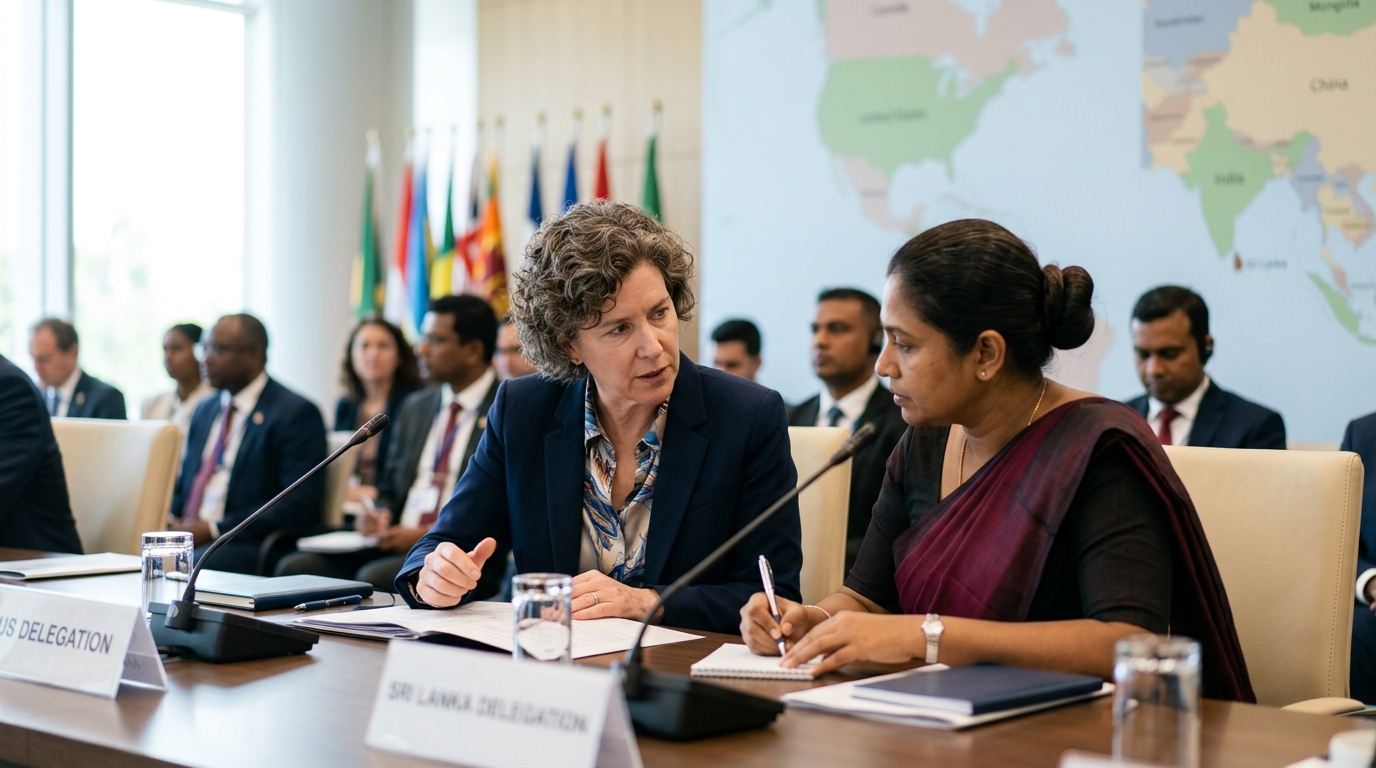
In an era where the power of nations is no longer measured solely by the size of their arsenals but by their computational capacity, the announcement of a partnership between the United States and Sri Lanka to advance American AI leadership through higher education marks a significant milestone. This is not merely an educational agreement; it is a strategic maneuver on the grand geopolitical chessboard of the Indo-Pacific, where Washington seeks to build bulwarks against Beijing's growing influence.
The initiative, announced by the U.S. Embassy in Colombo, aims to integrate American standards, technologies, and ethical frameworks into Sri Lanka's higher education system. Through academic exchanges, joint research programs, and the provision of expertise from Silicon Valley giants, the U.S. is attempting to shape the next generation of Sri Lankan scientists and leaders according to the Western model of AI development.
Education as a Tool of Soft Power
Historically, the U.S. utilized cinema, music, and democratic rhetoric as tools of soft power. Today, that tool is code. The transfer of AI expertise is not just about technical training; it is about the exportation of values. When a university in Sri Lanka adopts a curriculum designed in collaboration with American institutions, it simultaneously adopts American perspectives on data protection, intellectual property, and algorithmic transparency.
This 'educational diplomacy' is critical for maintaining American primacy. As China promotes its 'Digital Silk Road,' offering 5G infrastructure and surveillance systems to developing nations, the U.S. responds by offering the 'operating system' of knowledge. Sri Lanka, due to its strategic position in the Indian Ocean, serves as an ideal testing ground for this strategy. If the U.S. can establish American AI as the 'gold standard' in the region's education, it secures long-term economic and political dividends.
Sri Lanka at the Heart of Indo-Pacific Competition
Sri Lanka has found itself at the center of an intense tug-of-war between major powers in recent years. Following the economic crisis that shook the nation, the need for technological modernization became imperative. Partnering with the U.S. in the AI sector offers the country a path toward a digital economy while simultaneously reducing its dependence on Chinese investments, which are often accompanied by 'debt-trap diplomacy.'
For Washington, Sri Lanka is not just a partner but a critical hub. Strengthening ties through higher education creates a network of professionals who will be familiar with American ecosystems (such as Microsoft's Azure or Amazon's AWS). This creates a national-level 'vendor lock-in,' where the country's future infrastructure will inevitably rely on American technology. The geopolitical implications are clear: by training the workforce, the U.S. is ensuring that the digital architecture of the region remains compatible with Western interests.
Ethics, Standards, and the Battle for the 'Protocol'
One of the most significant aspects of this partnership is the emphasis on 'Responsible AI.' The U.S. promotes an AI model that respects human rights and individual freedoms, in contrast to the model of 'algorithmic authoritarianism' often attributed to other global players. In higher education, this translates into courses on AI ethics and regulatory frameworks.
However, the challenge remains: can academic collaboration bridge the digital divide? Sri Lanka requires not only theoretical knowledge but also access to computational resources (compute). The promise of American leadership includes access to these tools, turning the country's universities into innovation hubs that could export AI services across South Asia. In conclusion, this move by the U.S. is a clear statement: the battle for global dominance in the 21st century will not be decided on battlefields, but in the classrooms and computer labs of emerging economies.





