

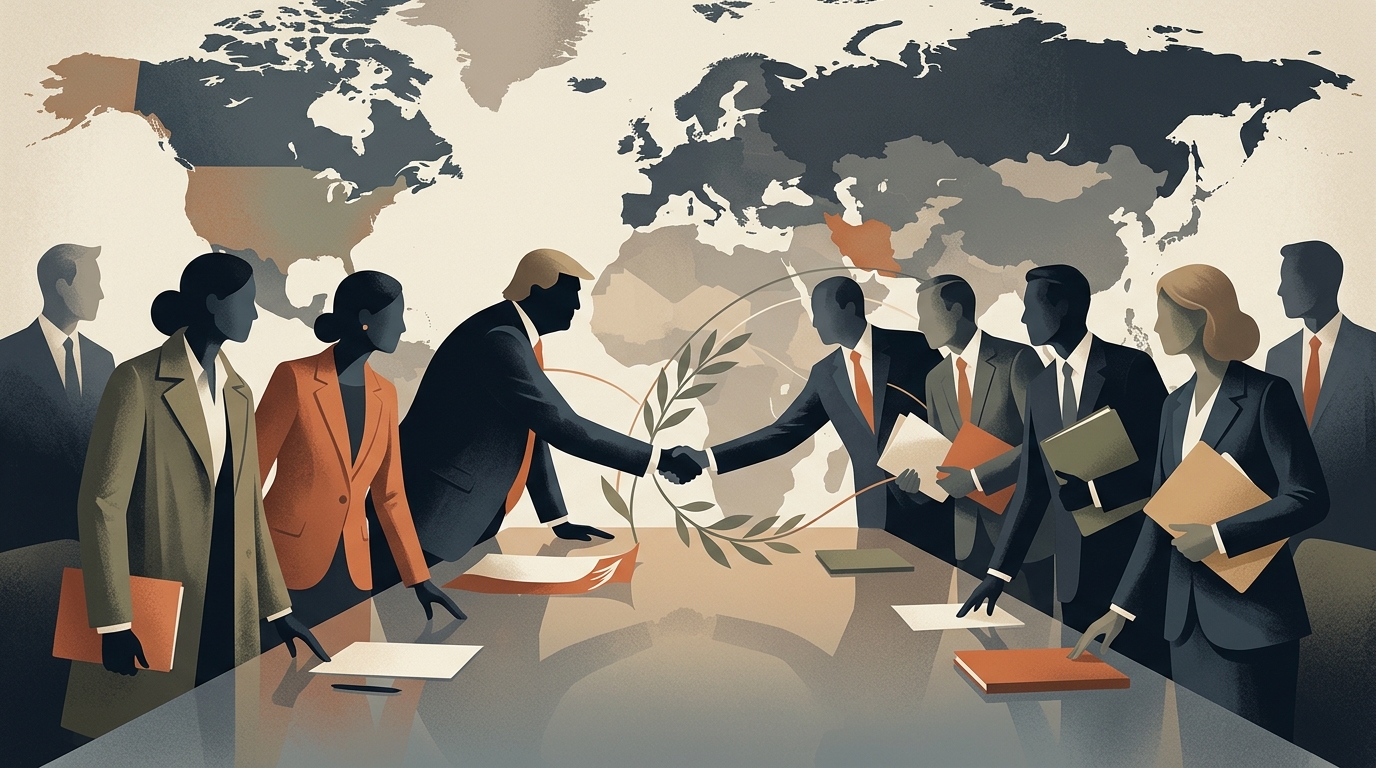
At a historical juncture where the Middle East appears to be balancing on a tightrope, the proceedings of the 11th Economic Forum (April 2026) became the stage for an unexpected diplomatic revelation. Officials closely linked to Donald Trump's inner circle and the MAGA (Make America Great Again) movement hinted that a new, comprehensive agreement between the United States and Iran is not only desirable but increasingly visible on the horizon. This rhetoric marks a significant pivot from the 'maximum pressure' policy of the past toward a more 'transactional' approach, promising to reorder the power balances in the region.
The Strategy of 'Peace Through Strength'
Trump's associates, addressing an audience of international analysts and investors, emphasized that the MAGA philosophy remains the dominant force in shaping American foreign policy, even amidst intense domestic political friction. According to their analysis, Tehran is now in a position where economic survival takes precedence over ideological rigidity. "Donald Trump understands the language of strength, but also the language of the deal," a senior staffer noted. This approach is predicated on the belief that Iran, squeezed by years of sanctions and internal unrest, is seeking an exit strategy that allows the regime to survive while conceding guarantees on its nuclear program and its role in regional proxy wars.
This strategy is not without its risks. Critics argue that any US-Iran deal under MAGA terms could potentially weaken traditional US alliances, such as those with Israel or Saudi Arabia, if absolute transparency is not maintained. However, Trump's supporters counter that traditional diplomacy has failed to curb Tehran's aggression and that only a 'Grand Bargain' can offer long-term stability. The shift suggests a move away from multilateral frameworks like the JCPOA toward a bilateral, high-stakes negotiation style.
Economic Stakes and Energy Security
It is no coincidence that these statements were made at an economic forum. The possibility of a US-Iran deal has immediate implications for global energy markets. A stabilized Middle East means secure shipping lanes in the Strait of Hormuz and the Red Sea, which would lead to a reduction in oil prices and transportation costs. For Europe, still struggling to fully decouple from Russian energy sources, the return of Iranian crude to international markets without restrictions would provide a significant economic lifeline.
- Return of Iran to international oil markets.
- Reduction of geopolitical risk premiums in commodity pricing.
- Potential lifting of banking restrictions facilitating broader regional trade.
However, the economic dimension is inextricably linked to political will. Trump's associates made it clear that any economic relief to Iran would only come in exchange for 'tangible and verifiable' results. This 'business-first' approach is the hallmark of MAGA, treating geopolitics as a series of negotiations where the profit must be mutual, but with America always in a position of leverage. The goal is to transform Iran from a regional spoiler into a predictable, albeit constrained, regional actor.
Challenges and the Future of the Agreement
Despite the optimism, the road to an agreement remains heavily mined. The internal political landscape in Iran is extremely complex, with hardliners in the Revolutionary Guard resisting any rapprochement with the 'Great Satan.' Simultaneously, in Washington, polarization makes it difficult to ratify any treaty that could be perceived as a 'concession.' Trump's associates, however, are betting on personal diplomacy and their leader's ability to bypass traditional bureaucracy.
"We don't need decades of negotiations. We need two leaders in the same room who want to do what's best for their people," one advisor stated.
The assertion that 'MAGA remains strong' serves as a warning to both allies and adversaries: America is not going back to the status quo ante. The new order in the Middle East, should this deal materialize, will bear the hallmark of a policy that prioritizes US national interests through an aggressive yet realistic diplomacy. The question remains whether Tehran is ready to accept the terms of a player who does not hesitate to flip the negotiation table if the outcome is unsatisfactory. As 2026 progresses, the world watches to see if this is a genuine breakthrough or merely another chapter in a long-standing geopolitical saga.




