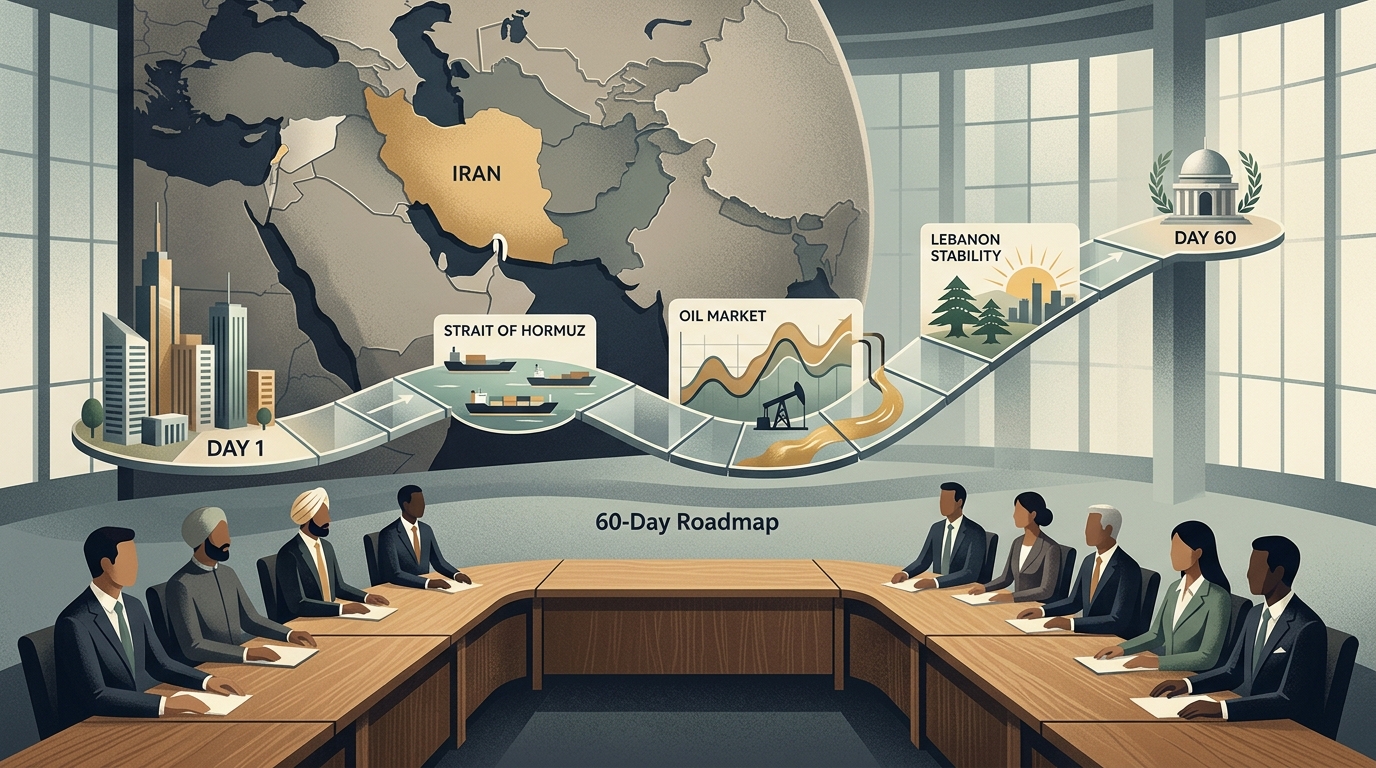
In a move that could fundamentally rearrange the geopolitical architecture of the Middle East, the United States and Iran have reached a preliminary 60-day "roadmap." The talks, conducted under strict secrecy on Swiss soil, aim to de-escalate a crisis that threatened to lead to an all-out regional war. The plan is not yet a definitive treaty but a strictly scheduled framework focusing on three critical pillars: maritime security in the Strait of Hormuz, the normalization of oil exports, and de-escalation on the Lebanese front.
The Strait of Hormuz: Guaranteeing Global Flow
The first and perhaps most urgent part of the agreement concerns the Strait of Hormuz, the "artery" through which 20% of global oil consumption passes. According to diplomatic sources, Tehran has committed to suspending all forms of harassment of commercial vessels and withdrawing Revolutionary Guard fast-attack craft from critical shipping lanes. In exchange, Washington will limit its aircraft carrier presence to a safe distance, reducing the chances of an "accident" that could trigger a conflict.
The creation of a joint communication center, involving neutral observers (possibly from Oman and Switzerland), is the core innovation of this plan. This center will function as a "red phone" for the immediate resolution of disputes at sea, preventing escalation at a tactical level. Stability in the Straits is considered a prerequisite for any discussion regarding the lifting of economic sanctions.
Oil as a Diplomatic Tool
For Iran, the motivation is clearly economic. The agreement provides for a gradual "easing" of sanctions on crude oil exports, provided Tehran adheres to the uranium enrichment limits set by the International Atomic Energy Agency (IAEA). The 60-day plan allows Iran to bring an additional 500,000 barrels per day to international markets, a move expected to push Brent prices downward, offering relief to Western economies hit by inflation.
- Gradual release of frozen Iranian funds in South Korean and Japanese banks.
- Strict oversight of revenues, which will be earmarked exclusively for humanitarian needs and food/medicine imports.
- Resumption of technical inspections at the Fordow and Natanz nuclear facilities.
This "transactional" approach shows that both sides have moved from ideological rigidity to seeking practical solutions. Washington needs cheap energy in the face of its domestic political challenges, while Tehran is struggling with social unrest due to economic desperation.
The Thorny Issue of Lebanon and Hezbollah
Perhaps the most difficult part of the roadmap is the commitment to "regional restraint." The US has demanded that Iran use its influence over Hezbollah to stop attacks on Israel's northern border. The plan calls for a 60-day "silence of weapons" period, during which consultations will begin for the full implementation of UN Resolution 1701, which stipulates the removal of armed elements south of the Litani River.
For its part, Iran is seeking guarantees that Israel will not proceed with strikes against Iranian targets in Syria. The complexity of this component is immense, as it involves third parties who are not at the negotiating table. However, the inclusion of Lebanon in the roadmap indicates that Washington no longer accepts an agreement limited only to the nuclear program but demands a comprehensive change in Iranian behavior in the region.
Conclusion: A High-Stakes Risk
The 60-day roadmap is a bold experiment. If it succeeds, it could be the foundation for a new "Grand Bargain." If it fails, the return to hostility will be violent and perhaps irreversible. The question remains: do the leaderships in Washington and Tehran have the political capital to impose this agreement on their domestic opponents?
"Diplomacy is not the art of the possible, but the art of making the necessary seem possible," said a senior European diplomat involved in the talks.
In the coming weeks, technical committees will work on the details, while satellites and intelligence assets will monitor every move on the ground. The countdown to peace—or the next crisis—has already begun.