

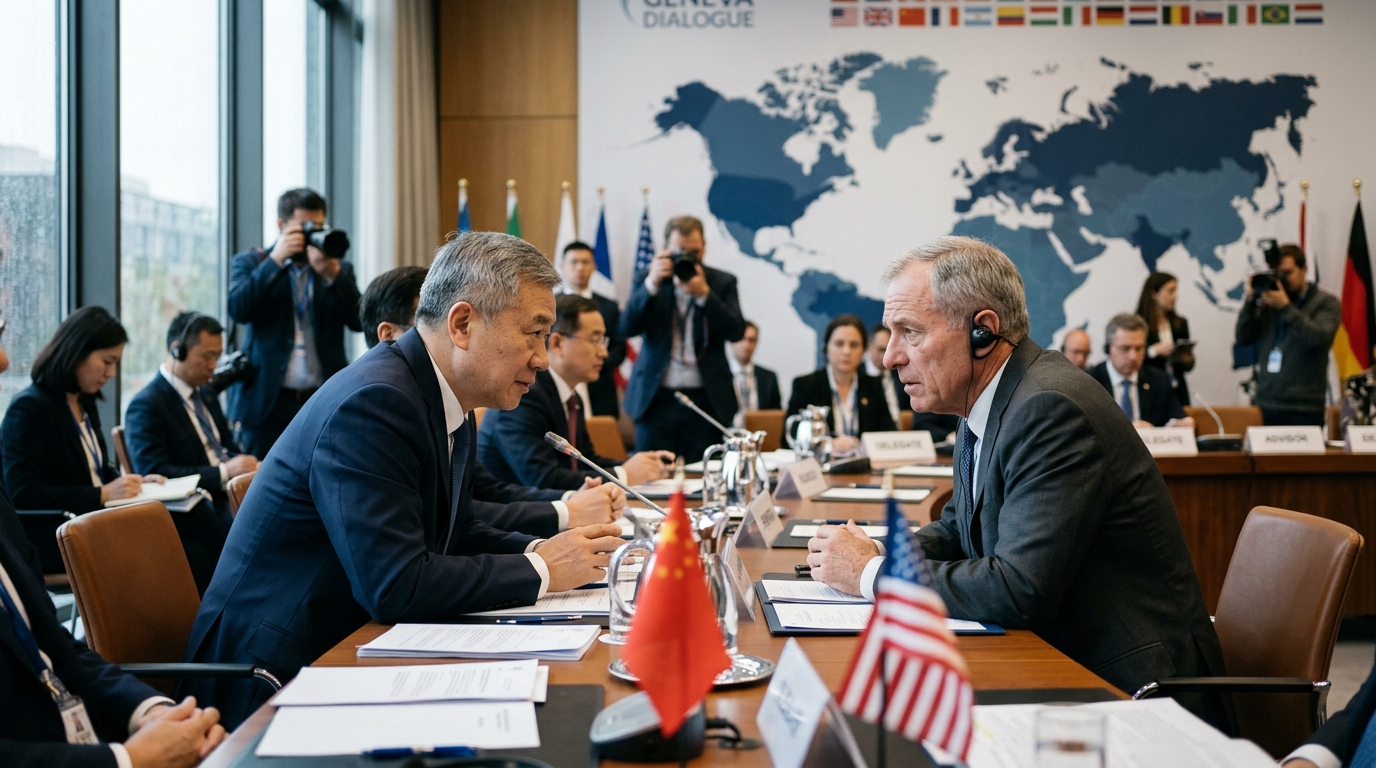
Geneva, the city that has historically hosted humanity's most critical diplomatic showdowns—from nuclear arms control to Middle East peace talks—is now the stage for a new, perhaps more existential challenge: the governance of Artificial Intelligence (AI). As delegations from the United States and China meet to discuss the risks of the technology, the question looming is not whether they agree on the need for control, but whether deep-seated geopolitical mistrust will allow for any meaningful cooperation.
The Thucydides Trap in the Digital Realm
The meeting in Geneva is not a mere technical discussion; it is an attempt to establish "guardrails" for a technology that is evolving faster than diplomacy itself. For Washington, the priority is clear: preventing the use of AI in developing biological weapons, ensuring nuclear weapons remain under human control, and protecting national security from sophisticated cyberattacks. For Beijing, the agenda is more complex. China seeks to be recognized as an equal regulator in the global system while simultaneously fearing that Western regulations are a pretext for containing its technological rise.
The strategic rivalry between the two nations, often described as a modern "Thucydides Trap," finds in AI the ultimate battlefield. Dominance in semiconductors, access to massive datasets, and the ability to train Large Language Models (LLMs) are the modern equivalent of nuclear warheads. However, unlike the Cold War, the two economies are so inextricably linked that a full decoupling seems nearly impossible, making cooperation on safety a necessary evil.
Red Lines and Convergence Points
Despite the tensions, there are areas where interests align. Both sides recognize that unregulated AI could destabilize financial markets or trigger unintended escalations in military conflicts. The Bletchley Declaration of 2023 laid the groundwork, but Geneva is tasked with turning general principles into concrete protocols.
- Nuclear Command and Control: Agreeing that AI should never have the authority to launch nuclear weapons is the most straightforward point of convergence.
- Information Warfare: This is a point of intense friction. China uses AI for internal suppression and censorship, while the US accuses Beijing of foreign disinformation campaigns.
- Open Source vs. Closed Models: The debate over whether powerful AI models should be open to the public divides not only governments but the scientific community itself.
The Geopolitics of Semiconductors
No discussion about AI in Geneva can ignore the "Chip War." The Biden administration’s restrictions on exporting advanced Nvidia semiconductors to China remain the biggest point of contention. Beijing views these restrictions as a hostile act aimed at strangling Chinese innovation. Conversely, Washington argues it cannot allow China to use American technology to bolster its military capabilities. This power asymmetry makes negotiations exceedingly difficult, as China demands the lifting of sanctions as a quid pro quo for cooperation on safety issues.
Conclusion: A Negotiated Future
The success of the Geneva talks will not be measured by the signing of a grand treaty, but by the establishment of a permanent channel of communication. In the age of AI, a lack of communication can lead to algorithmic errors with catastrophic consequences for the planet. If the US and China can find common ground, even at the minimum level of safety, then Geneva will have once again fulfilled its historical role. If not, the world risks entering a period of "digital anarchy," where the power of algorithms exceeds the wisdom of leaders.




