

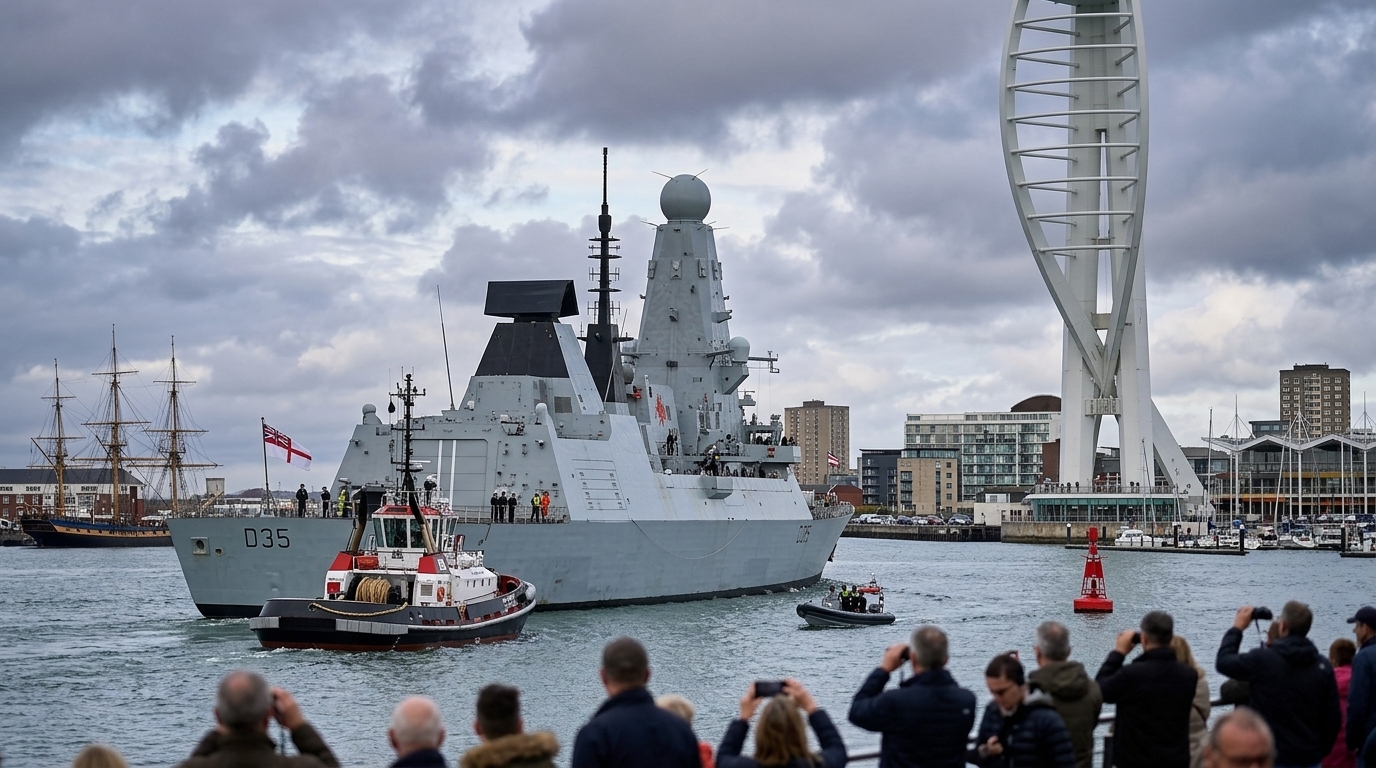
In a move that underscores the escalating instability in the world's maritime arteries, the UK Ministry of Defence has announced the deployment of HMS Dragon to the Middle East. The Type-45 destroyer, one of the most advanced air-defense ships in existence, is expected to join an international effort to ensure freedom of navigation in the Strait of Hormuz, a critical choke point for the global economy.
The Strategic Weight of the Strait of Hormuz
The Strait of Hormuz is not merely a geographic passage; it is the jugular vein of the global energy market. Measuring just 21 miles wide at its narrowest point, this passage handles approximately 20% of the world's oil consumption and vast quantities of Liquefied Natural Gas (LNG) every day. Any disruption in this region has an immediate and painful impact on fuel prices from London to Tokyo.
London's decision to dispatch HMS Dragon comes at a time when regional tensions have reached a boiling point. Drone attacks and attempts to seize tankers have made navigation a high-risk endeavor. HMS Dragon, equipped with the Sea Viper missile system, is specifically designed to intercept aerial threats, including guided missiles and drone swarms, making it the ideal choice for protecting merchant vessels.
Technological Supremacy and Deterrence
HMS Dragon belongs to the Type-45 class, which forms the backbone of the Royal Navy's air defense. Its ability to simultaneously track hundreds of targets over hundreds of miles allows it to act as a "protective umbrella" for entire ship convoys. In today's battlefield, where asymmetric threats from inexpensive drones can cause billions in damage, the presence of such a vessel acts as a potent deterrent.
However, the mission is not without its perils. Deploying such a formidable warship can be interpreted by Tehran and its allies as a provocation. The UK must balance the need for trade protection with the avoidance of a direct military confrontation that could drag the entire region into war. The British government emphasizes that the mission is purely defensive, but history has shown that in the Strait of Hormuz, the line between defense and offense is often blurred.
Geopolitical Implications and 'Global Britain'
This deployment fits into the broader framework of the "Global Britain" strategy, which seeks to maintain UK influence beyond European borders post-Brexit. By strengthening its presence in the Indo-Pacific and the Middle East, London sends a signal that it remains a first-tier player in global security.
- US Cooperation: The mission of HMS Dragon is expected to be closely coordinated with the US Central Command (CENTCOM), reinforcing the Washington-London axis.
- Supply Chain Protection: In an era of inflationary pressures, keeping maritime routes open is vital for price stability in the UK domestic market.
- Diplomatic Leverage: The ship's presence serves as leverage for a return to diplomatic negotiations, demonstrating that the West is prepared to defend its interests.
In conclusion, the deployment of HMS Dragon is a reminder that global peace often depends on the ability to project power at critical geographic nodes. As the ship transits the Mediterranean toward Suez, analysts are closely watching the reaction of regional powers. The success of the mission will be judged not only by the prevention of attacks but by the ability to maintain equilibrium in one of the most volatile environments on the planet.





