

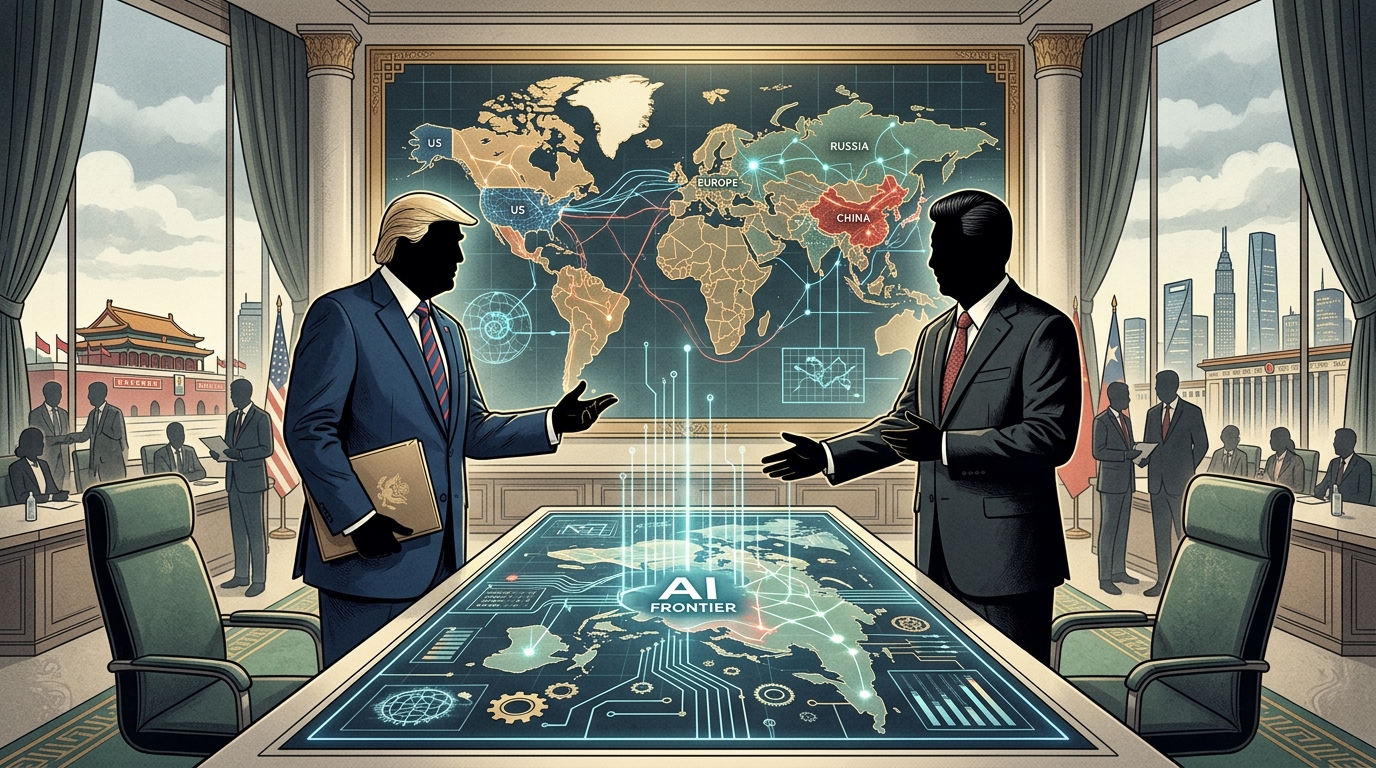
In an era where the global geopolitical chessboard increasingly resembles a zero-sum game, Donald Trump's visit to Beijing in May 2026 marks a pivotal turning point. The world's two most powerful men, the American President and his Chinese counterpart Xi Jinping, sat down to discuss an agenda ranging from traditional flashpoints like Taiwan and Iran to the new 'holy grail' of power: Artificial Intelligence.
AI as the New Nuclear Frontier
The discussion on Artificial Intelligence was no longer just about economic growth or manufacturing automation. On the table was the burning issue of Lethal Autonomous Weapons Systems (LAWS) and the need for a 'red phone' in case decision-making algorithms spiral out of human control. The United States, having regained ground in semiconductor production, is seeking a 'no-first-use' agreement for AI in nuclear command systems—a proposal China views with caution but also realism. Technological supremacy is no longer just a matter of prestige, but of survival.
- Export controls on advanced GPU chips.
- Common standards for the ethical use of AI in surveillance.
- Safety protocols to prevent algorithmic escalation in regional conflicts.
Taiwan and Iran: The Traditional Fault Lines
Despite the emphasis on technology, old wounds remain open. Taiwan remains the permanent point of friction, with Trump seeking a 'realistic peace' that ensures freedom of navigation and the uninterrupted flow of technological components, while Xi reiterates the non-negotiable 'One China' policy. The innovation here lies in the proposal for a demilitarized digital zone, where economic activity would continue unhindered despite political differences.
"Peace in the 21st century is not just signed on paper; it is encoded in silicon," said a senior diplomat involved in the talks.
Regarding Iran, Washington asked Beijing to leverage its economic influence over Tehran to curb its nuclear program, offering in return tariff relaxations affecting Chinese exports. China, as the largest buyer of Iranian oil, holds the key to stability in the Middle East—a region Trump wishes to 'stabilize' to focus on domestic competition with China.
Economic Realism and the Return of Diplomacy
This meeting highlights a new form of 'Realpolitik.' It is not about friendship, but a mutual recognition that a total war—whether commercial or military—would destroy both economies. The presence of top tech executives on the sidelines of the summit underscores that AI companies are now equal players in international diplomacy. The remaining question is whether the commitments made in Beijing will withstand the pressures of nationalist voices on both sides of the Pacific.





