

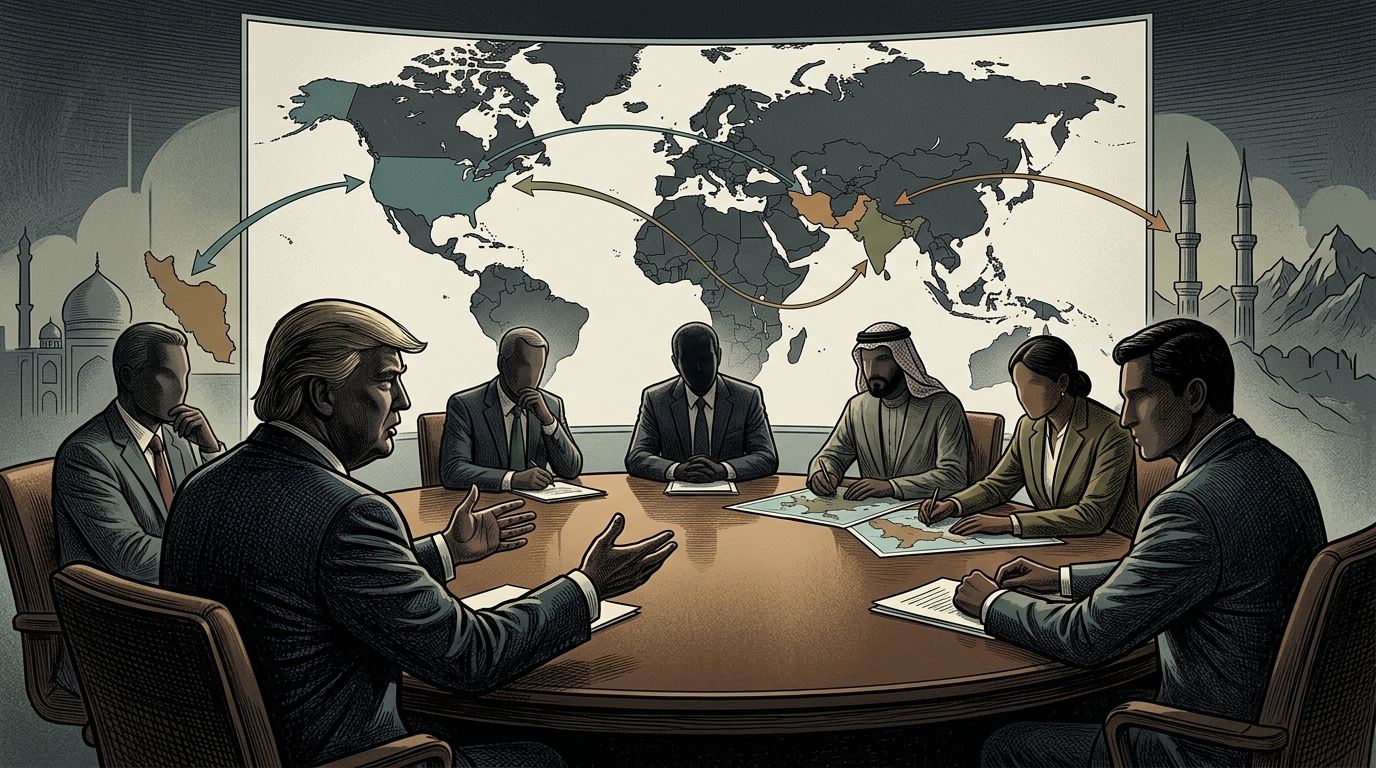
In a move reminiscent of the most high-stakes moments of his first term, President Donald Trump has revealed behind-the-scenes details of the unfolding diplomatic showdown with Iran. According to the U.S. President, his decision to cancel a last-minute scheduled trip by close associates Steven Witkoff and Jared Kushner to Pakistan acted as a catalyst for an "improved" proposal from Tehran. The statement, "They offered a lot, but not enough," encapsulates the core of Trump's foreign policy philosophy: pressure is not just a tool, but the engine of negotiation itself.
The Strategy of 'Walking Away' as Leverage
The cancellation of the trip to Pakistan, which was intended to serve as a backchannel for communication with the Iranian leadership, was no random administrative decision. In Trump's world, the willingness to walk away from the negotiating table is the ultimate proof of strength. Pakistan, historically maintaining a delicate balance between Washington and Tehran, had been chosen as the neutral ground for a discussion that could shift the balance of power in the Middle East. When the U.S. felt that Iran was "stalling," the cancellation was sent as a clear signal that time is not unlimited.
Analysts point out that this tactic aims to bring Iran into a state of "strategic suffocation." With the Iranian economy reeling from sanctions and internal social discontent simmering, the leadership in Tehran appears to be seeking an exit strategy that allows them to maintain prestige while securing economic relief. The "better proposal" Trump referenced likely includes concessions on the nuclear program or the role of regional proxies—topics that were previously considered "red lines" for the Ayatollahs.
Pakistan and the Role of the Mediator
But why Pakistan? The choice of Islamabad as a meeting venue highlights the need for a mediator who understands regional sensitivities. Pakistan shares a border with Iran and maintains a complex but necessary relationship with the U.S. The involvement of Kushner and Witkoff shows that Trump prefers using a tight circle of trusted individuals, often bypassing traditional bureaucratic channels of the State Department. This "personal diplomacy" allows for speed but also carries the risk of misinterpretation.
- The trip's cancellation was viewed by Tehran as a harbinger of new, harsher sanctions.
- The Iranian proposal was reportedly sent via diplomatic channels just minutes after the official cancellation announcement.
- Trump insists on a "Grand Bargain" covering not just nuclear issues, but also ballistic missiles and regional influence.
The Aftermath: 'Not Enough'
The phrase "not enough" is perhaps the most significant part of the statement. It suggests that the U.S. is in no hurry to close a deal just for the sake of closing one. Trump is seeking a victory he can present to his domestic audience as the ultimate vindication of his policies. For Iran, the dilemma is existential: how much can it give without collapsing the ideological framework of the Islamic Revolution? The Middle East watches with bated breath, as a deal could lead to de-escalation in Yemen, Lebanon, and Syria, while failure could bring the region to the brink of generalized conflict.
In this geopolitical chess game, every move is calculated. Trump is betting on his opponent's economic weakness, while Iran is betting on the international community's fatigue from constant crises. The fact that Tehran rushed to improve its proposal shows that, despite the harsh rhetoric, there is an urgent need for compromise. However, in the "Art of the Deal," the final page is never written until the signatures are dry, and Trump seems willing to wait until he gets exactly what he wants.




