

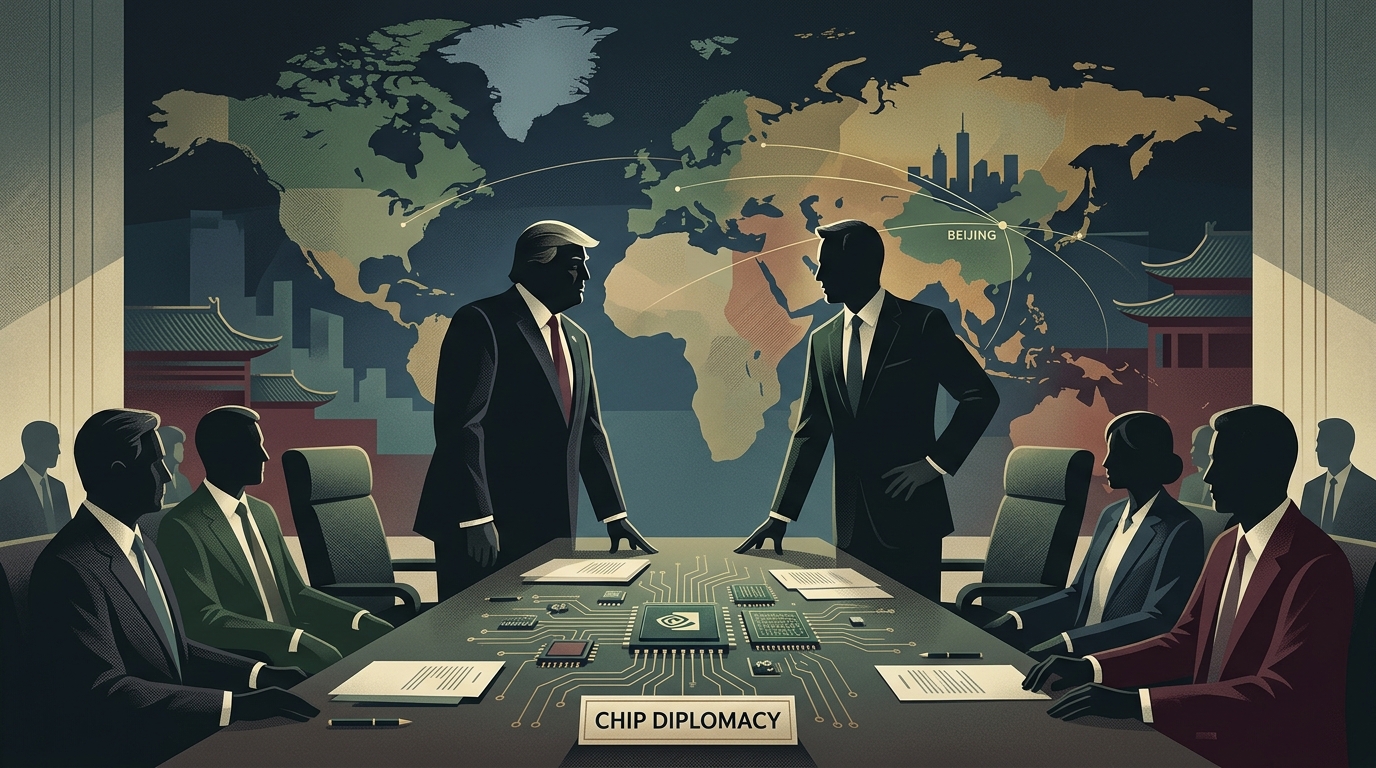
In a move that defies traditional diplomatic norms and highlights the new hierarchy of global power, President Donald Trump landed in Beijing today for a pivotal summit with his Chinese counterpart, Xi Jinping. However, the news dominating international headlines is not just the meeting of the two leaders, but the presence of a third figure in the presidential entourage: Jensen Huang, the iconic CEO of Nvidia.
Trump's decision to include the most powerful man in the semiconductor world in the official delegation sends a clear message: Artificial Intelligence (AI) and processors are no longer just commercial products, but the "new oil" upon which the next phase of US-China relations will be built. This visit comes at a time when the global economy is in flux, with the US striving to maintain its lead in AI while China struggles to bypass suffocating technology export restrictions.
The Rise of 'Corporate Diplomacy'
Jensen Huang's presence in Beijing marks the pinnacle of what analysts call "corporate diplomacy." For years, Nvidia has been at the center of US restrictions, as its graphics cards and AI accelerators form the foundation for developing both military and civilian AI systems. Huang's participation suggests a potential shift by the Trump administration toward a more "transactional" approach, where access to Nvidia's technology could be used as leverage for concessions from Beijing on trade and security issues.
"This is not just a trade deal. It is the renegotiation of the terms of digital sovereignty in the 21st century," says a senior State Department official who requested anonymity.
According to sources, the agenda includes creating a "security framework" for exporting less powerful chips to China in exchange for Beijing's commitment to limit state support for Chinese semiconductor companies directly competing with American firms. Nvidia, which saw its China revenue hit by sanctions, has every reason to desire a normalization of relations.
The 'Xi' Factor and Chinese Self-Reliance
For his part, Xi Jinping welcomes Trump with an agenda focused on "technological dignity." China has invested billions of dollars into the "Made in China 2025" program, aiming for full independence from Western technology. However, the gap in manufacturing advanced semiconductors remains significant. Huang's presence might offer Xi a "golden bridge" to secure the necessary computing power for Chinese industry to remain competitive without appearing to cave to American pressure.
- Potential easing of tariffs on Chinese tech products.
- Agreements to establish joint research centers for AI safety.
- Commitments regarding stability in Taiwan, the world's semiconductor hub.
Taiwan remains the "elephant in the room." Any deal involving Nvidia and China directly impacts TSMC, the primary manufacturer of Nvidia's chips. Analysts worry that a Trump-Xi rapprochement centered on chips could leave Taipei exposed if the US decides that commercial access to the Chinese market outweighs geopolitical security guarantees.
Global Market Implications
Markets reacted with enthusiasm to the news, with Nvidia's stock rising 4% in pre-market trading. Investors see this move as the end of a prolonged "chip cold war" that threatened to split the global supply chain in two. However, the European Union is watching developments with skepticism. A bilateral US-China tech agreement could leave Europe on the sidelines, forcing it to choose sides or face new barriers in accessing critical technologies.
In conclusion, the Beijing summit is not a traditional diplomatic meeting. It is a show of force where the economic interests of Silicon Valley giants align—at least temporarily—with Washington's foreign policy. Whether Jensen Huang proves to be the "peacemaker" of the digital age or merely a pawn in a dangerous geopolitical game remains to be seen from the communiqués of the next 48 hours.





