

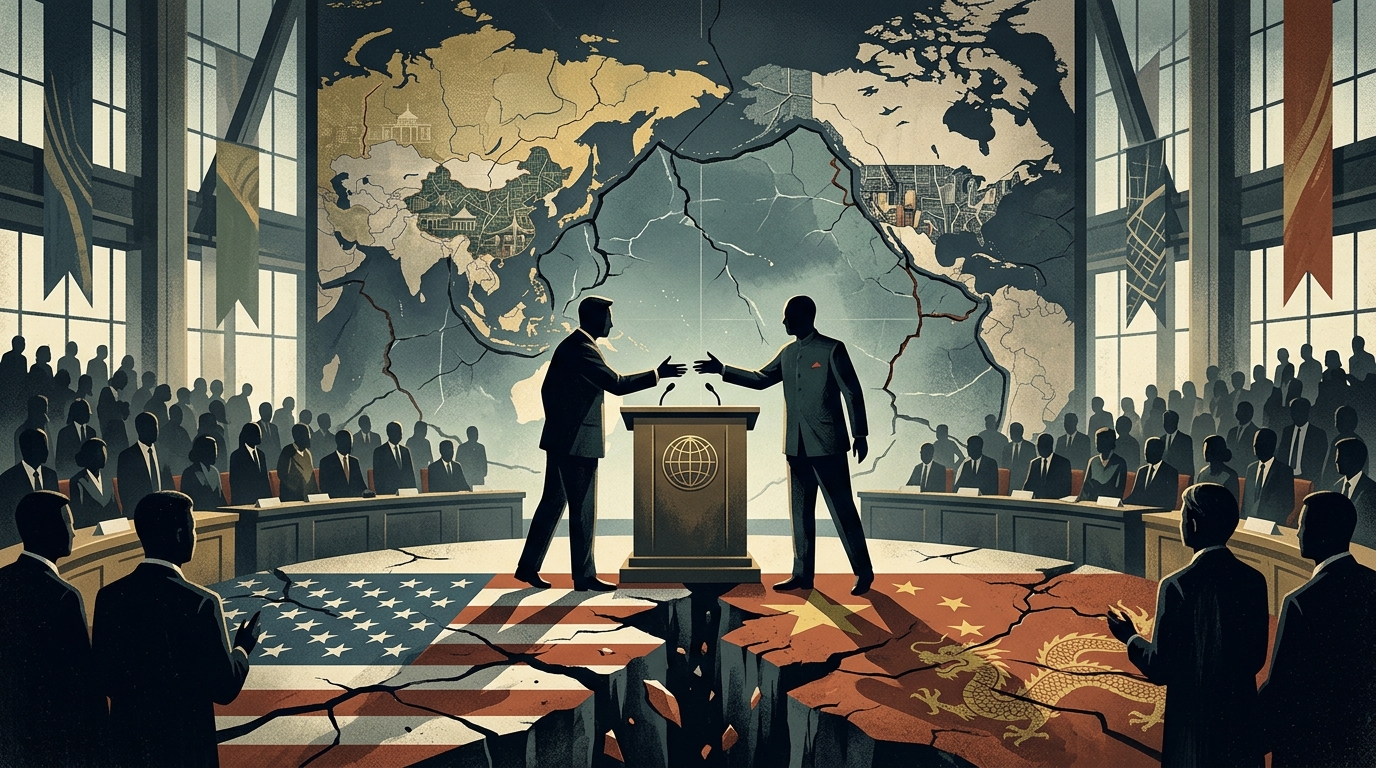
In the current geopolitical landscape of May 2026, the word "stability" has become one of the most overused, yet vacuous, terms in the diplomatic lexicon. As the United States and China continue their precarious dance on the global stage, official rhetoric regarding "managed competition" stands in stark contrast to the aggressive maneuvers on the chessboard of technology, trade, and military might. The recent analysis highlighted by Fortune Greece underscores a bitter truth: promoting stability may be the "highest goal" of the US, but it remains a target that recedes the more it is pursued.
The Rhetoric of Calm vs. The Reality of Sanctions
For the administration in Washington, stability does not signify a return to the era of full cooperation, but rather the creation of a framework where competition does not escalate into total conflict. However, for Beijing, American calls for stability ring hollow. From the Chinese perspective, the US is attempting to "freeze" the status quo at a moment when American hegemony is being challenged, utilizing trade restrictions and strategic alliances (such as AUKUS) to contain China's rise.
The contradiction is palpable. At the same time that senior officials meet in neutral territories to discuss avoiding accidents in the South China Sea, the US Department of Commerce expands its list of Chinese entities barred from accessing critical semiconductor technologies. What the West terms "de-risking," the East perceives as "containment." In this climate of mutual suspicion, stability is little more than a temporary smokescreen.
The Technological Cold War and Artificial Intelligence
By 2026, the battle for dominance in Artificial Intelligence (AI) has become the central theater of confrontation. It is no longer just about trade; it is about who will define the rules of the future. Stability is undermined by the very nature of technological progress. When a new breakthrough in quantum computing or large language models can provide a decisive military edge, neither side is willing to lag behind in the name of peace.
- Export restrictions on high-end chips have forced China to invest billions in domestic production, accelerating the process of decoupling.
- The application of AI in autonomous weapons systems is creating a new arms race that is not governed by traditional nuclear arms control treaties.
- Digital sovereignty has become a matter of national survival, making compromise nearly impossible.
The notion that the two economies can remain deeply intertwined while their leaderships prepare for the worst-case scenario is the definition of a geopolitical paradox. "Stability" in this context is a dynamic state of constant tension, where the slightest miscalculation can trigger a chain reaction in global markets.
The Taiwan Thorn and Regional Security
No discussion of US-China relations can bypass the issue of Taiwan. For Beijing, reunification is a "historical necessity" that is non-negotiable. For Washington, protecting Taiwan's democracy and its strategic position is vital for US credibility in the Indo-Pacific. "Stability" here means maintaining an ambiguity that becomes increasingly difficult to sustain as military activity in the strait intensifies.
"Stability is not the absence of conflict, but the ability to manage crises before they become uncontrollable," analysts from Fortune note.
However, this ability is waning. Communication channels between military leaders are frequently severed as a means of leverage, leaving the door open for misunderstandings. Europe, for its part, watches with bated breath, attempting to balance its economic ties with China against its defensive reliance on the US. The illusion that the Old Continent can remain neutral is collapsing under the weight of new geopolitical realities.
Conclusion: Toward a New Architecture or Toward Conflict?
As we move into the second half of the decade, the myth of stability must be replaced by an honest admission of structural rivalry. Attempting to present the relationship as "stable" serves markets in the short term but masks long-term risks. Real stability would require a new international architecture that recognizes the multipolarity of the world—something neither superpower seems fully ready to accept.
The question that remains unanswered is whether humanity can afford the cost of this confrontation. With the climate crisis and global health threats demanding cooperation, the "myth" of stability in US-China relations may be the most dangerous luxury we have allowed ourselves.





