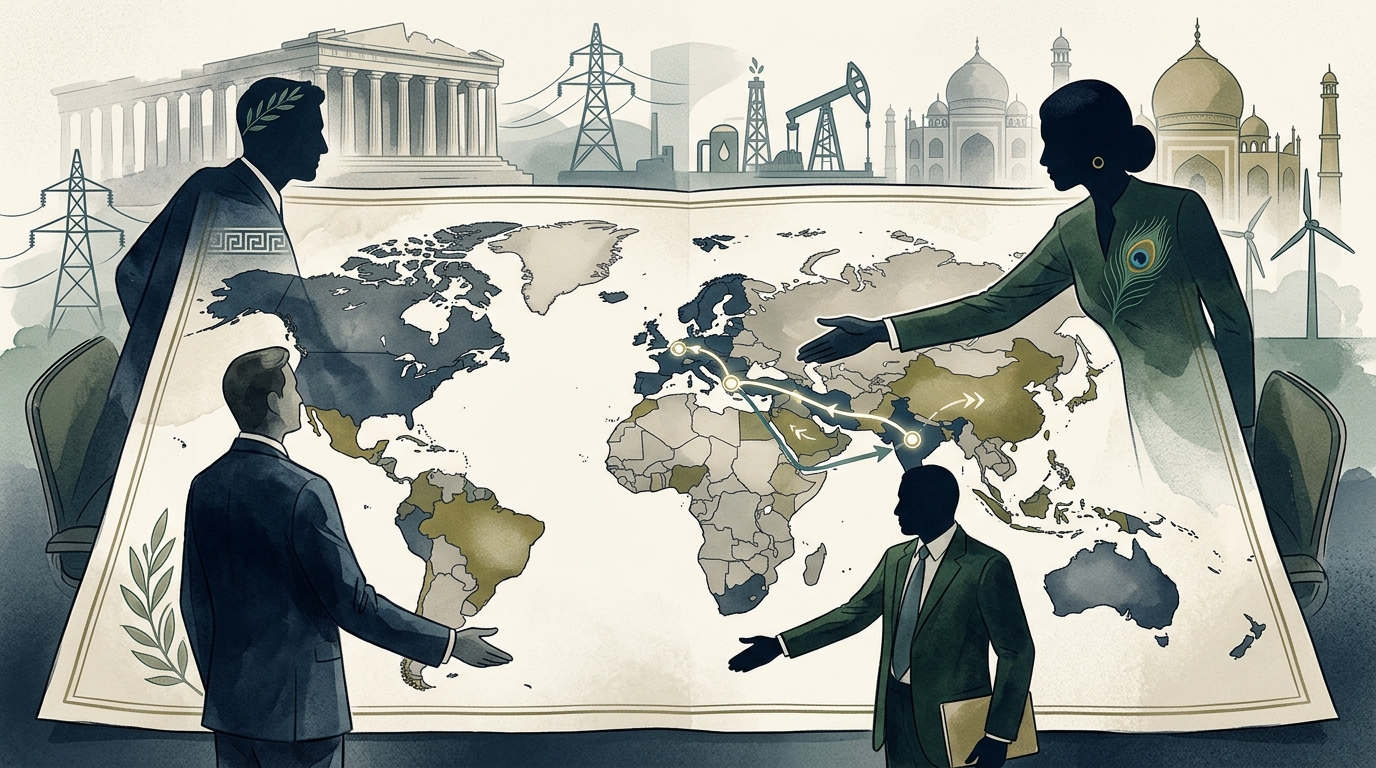
The geopolitical chessboard of the Eastern Mediterranean is being rearranged, with Athens and New Delhi now positioning themselves as central players in a new axis connecting the Indo-Pacific region to the European continent. The recent emphasis on Greece's full support for the India-Middle East-Europe Economic Corridor (IMEC) by the Minister of Environment and Energy, Theodoros Skylakakis, is not merely a diplomatic courtesy but the confirmation of a profound strategic pivot. This partnership, spanning from commercial shipping to energy security, aims to establish Greece as India's "natural port" in the European Union.
IMEC: A Geopolitical Answer to Contemporary Challenges
The IMEC corridor, announced on the sidelines of the 2023 G20 summit in New Delhi, is a multi-modal ship-to-rail transit route designed to reduce trade transit time by 40%. However, for Greece, its significance transcends logistics. As the Greek side emphasized, IMEC is a project that guarantees stability in a region plagued by geopolitical turbulence. Greece's participation as the eastern gateway to Europe grants the country the role of a "gatekeeper" for trade flows from the booming Indian economy.
This strategic choice comes at a time when Europe is desperately seeking alternative supply routes, moving away from dependence on single players or unstable paths. India, on the other hand, sees Greece as a reliable partner within the EU, with ports like Piraeus and Thessaloniki offering the necessary infrastructure to receive Indian products and energy exports.
Energy at the Core: Green Hydrogen and Interconnections
The Athens-New Delhi partnership is not limited to shipping containers. The major stakes lie in energy. Greece aspires to transform into an energy hub for transporting green energy from India and the Middle East to Central Europe. At the heart of the discussions is the development of infrastructure for green hydrogen transport, as well as the creation of electricity interconnections that will allow for the export of clean energy.
- Green Hydrogen: India is investing billions in hydrogen production from renewable sources, and Greece possesses the geographical location to act as a storage and distribution station.
- Electricity Interconnection: The vision for a unified grid connecting Asia to Europe via Greece is gaining traction, enhancing the continent's energy autonomy.
- Liquefied Natural Gas (LNG): Greek LNG terminals can serve the needs of the wider region, acting complementarily to Indian energy strategies.
Minister Skylakakis stressed that energy security is inextricably linked to the diversification of sources and routes. In this context, India emerges as a strategic ally that can offer not only resources but also expertise in sectors such as Renewable Energy Sources (RES).
Challenges and Perspectives
Despite the enthusiasm, the path toward the implementation of IMEC is not without obstacles. Instability in the Middle East, particularly following recent conflicts, has raised concerns regarding the project's timeline. However, the Greek government remains committed to the goal, believing that long-term ties with India transcend temporary crises.
"Greece and India share common values and a common vision for a world based on international law and maritime security," government sources state.
The Greek Prime Minister's visit to New Delhi and the reciprocation by the Indian leadership have created a climate of trust that translates into business agreements. Indian conglomerates have already expressed interest in investing in Greek airports, ports, and the technology sector, confirming that this relationship is built on solid foundations.
In conclusion, strengthening energy and economic ties with India represents a move of high geopolitical value for Greece. It is not just about economic growth; it is about fortifying the country in a rapidly changing world, placing Athens at the heart of the new global trade and energy routes.