

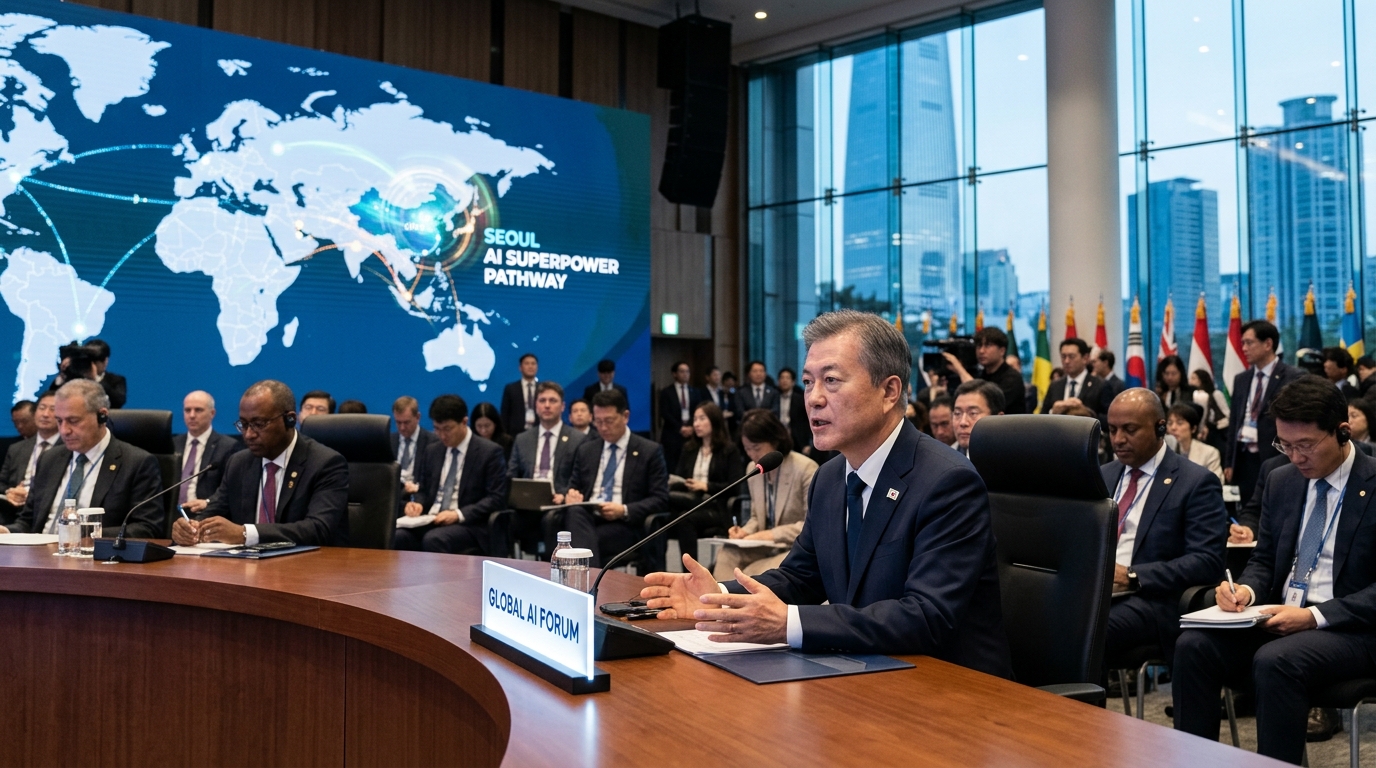
In the heart of East Asia, a nation that once rebuilt itself from the ashes of war to become an industrial giant is now preparing for its most critical transition yet. South Korea is not merely seeking to follow the developments in Artificial Intelligence (AI); it aims to define them. The recent commitment by President Yoon Suk Yeol's administration to invest 9.4 trillion won (approximately $7 billion) in AI and AI semiconductors by 2027 is just the tip of the iceberg in a national strategy that blends geopolitical power with technological supremacy.
The Semiconductor Battle and Memory Dominance
South Korea's strategy is built upon an undeniable advantage: its control over the global memory market. While Nvidia dominates the processors (GPUs), these processors are virtually useless without the High Bandwidth Memory (HBM) produced by giants like SK Hynix and Samsung Electronics. Seoul understands that AI is not just software, but hardware as well. By investing in the next generation of so-called 'AI chips,' the country seeks to make itself an indispensable link in the global supply chain, shielding its economy against market fluctuations.
Competition with Taiwan and TSMC is fierce, but South Korea is betting on vertical integration. Samsung's ability to both design and manufacture chips gives it a potential speed advantage. However, the challenge remains: dependence on American design technology and pressure from China create a narrow geopolitical path that Seoul must navigate with extreme care. The 'Chip Wars' are not just about business; they are the front line of modern diplomacy.
The AI-G3 Goal: Aiming for the Global Top Three
The government has set an ambitious goal known as 'AI-G3.' This means South Korea aims to rank among the top three AI powers globally, alongside the United States and China. To achieve this, it is not content with hardware production alone. It is promoting the development of domestic Large Language Models (LLMs), such as Naver's HyperCLOVA X, which are optimized for the Korean language and local culture, offering an alternative to the dominance of Silicon Valley's English-centric models.
Furthermore, the integration of AI into the public sector and citizens' daily lives is unprecedented. From 'smart' governance to the application of AI in education and healthcare, South Korea uses its population—among the most tech-savvy in the world—as a living laboratory for innovation. This ecosystem is bolstered by state subsidies for startups developing specialized AI applications for manufacturing and shipbuilding, traditional pillars of the Korean economy that are now being 'digitally reborn.'
Geopolitical Balances and Existential Challenges
The path toward becoming an AI superpower is not without obstacles. South Korea finds itself in a difficult position between the US, its primary security ally, and China, its largest trading partner. Restrictions imposed by Washington on technology exports to China directly affect the interests of Korean companies that maintain factories on Chinese soil. Seoul is attempting to balance this by strengthening R&D cooperation with the US while simultaneously seeking new markets in Southeast Asia and Europe.
At the same time, the country faces an internal existential threat: demographic collapse. With the lowest fertility rate in the world, South Korea views AI not just as an economic opportunity, but as a necessity for the survival of its social fabric. Automation and AI are expected to fill the gap left by a shrinking workforce, maintaining productivity levels despite an aging population. In this sense, AI is the 'digital youth' that the country desperately needs to sustain its momentum.
Conclusion: A New Model of Growth
South Korea's commitment to becoming an AI superpower serves as a lesson in how a state can mobilize resources to meet the challenges of the 21st century. It is not just about technology; it is a comprehensive restructuring of the economy, society, and foreign policy. If Seoul manages to maintain its lead in semiconductors while innovating in software, it may indeed become the essential 'third pole' in a world at risk of technological bifurcation. The stakes are high, but the country's history has shown that South Korea rarely loses when it comes to technological transformation.





