

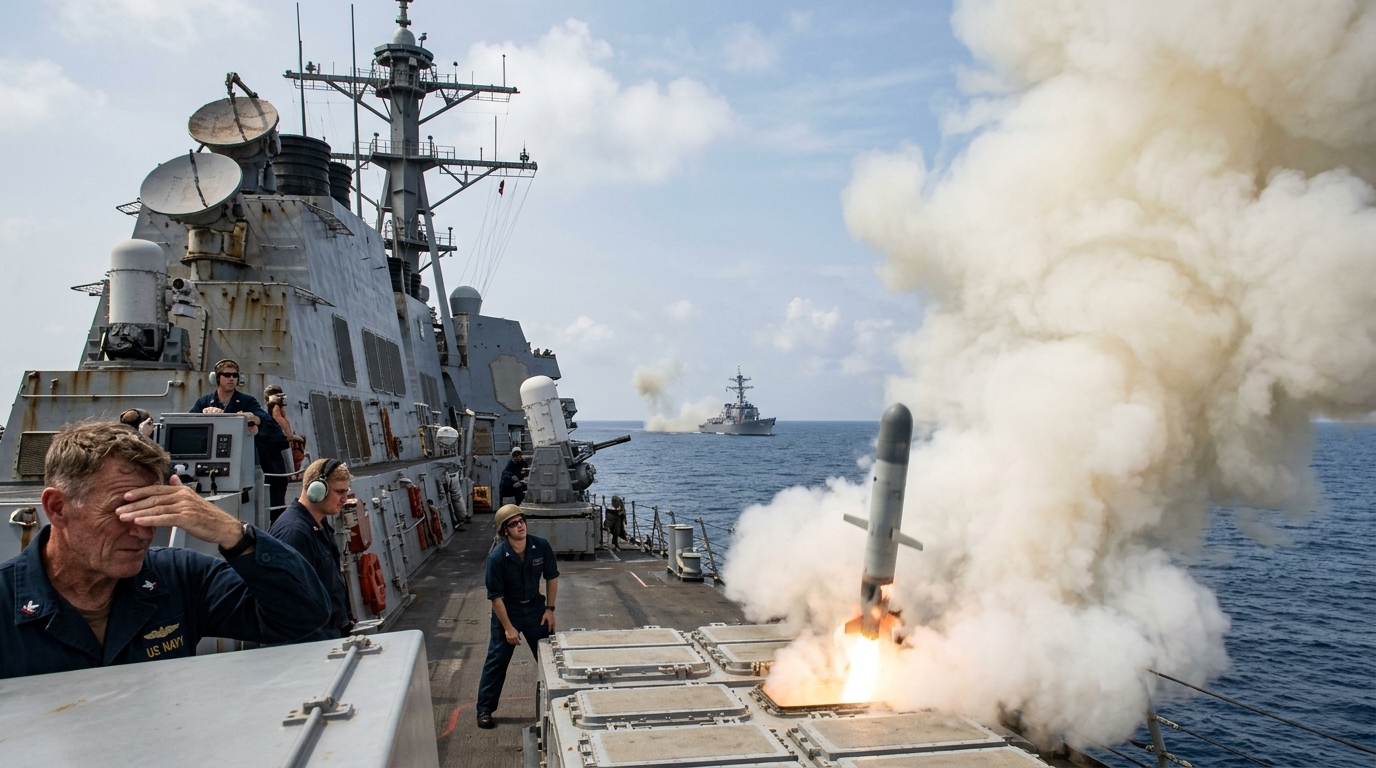
In the modern geopolitical arena, the traditional notion of military supremacy is undergoing a violent revision. It is no longer just about who possesses the most sophisticated fighter jet or the 'smartest' air defense system, but about a raw, almost cynical economic reality: the 'obscene economics' of warfare. This term describes the staggering gap between the trivial cost of offensive means and the crushing cost of defense—an imbalance that threatens to bankrupt Western arsenals long before their ammunition runs out.
The Asymmetric Threat: $20,000 Drones vs. $2 Million Missiles
Russia's invasion of Ukraine and recent conflicts in the Middle East have exposed a truth that NATO military planners preferred to ignore. The use of cheap, improvised, or mass-produced drones, such as the Iranian-made Shahed, has turned warfare into a game of attrition where the attacker spends thousands and the defender spends millions. When a Patriot interceptor missile, costing approximately $4 million, is launched to down a drone built with off-the-shelf components worth $20,000, the mathematical conclusion is foregone. This economic asymmetry is not just a tactical problem; it is a strategic hemorrhage.
Artificial Intelligence (AI) exacerbates this phenomenon. The ability to swarm hundreds of cheap autonomous units can saturate even the most advanced air defense systems. The West, trapped in the dogma of 'quality over quantity,' is finding that quality has a limit beyond which quantity acquires its own, terrifying quality. The need for reindustrialization is urgent, but here arises the greatest paradox of our time.
The Dependence Paradox: Rearmament via Beijing
The most disturbing element in the efforts of the U.S. and its allies to replenish their stockpiles is the deep, structural reliance on China. Despite the rhetoric of 'de-coupling' or 'de-risking,' the American defense industry remains tethered to Chinese raw materials and components. From rare earth elements essential for guided missile magnets to chemical compounds for explosives and low-end semiconductors, China holds the keys to Western production.
According to analyses, a significant percentage of subsystems used in U.S. weapons systems originate, directly or indirectly, from Chinese sources. This creates a state of strategic hostage-taking: the U.S. is attempting to build a deterrent power against China using materials controlled by China itself. If Beijing decided tomorrow to impose a full embargo on critical mineral exports, the production of F-35s and Javelin missiles would face immediate collapse.
Return to Industrial Mass and the Role of AI
For decades, the West believed that the war of the future would be surgical, brief, and information-based. The reality in Ukraine has shown that war remains an industrial-scale affair. The consumption of artillery shells and missiles far outstrips the production rates of European and American factories. Transitioning to a 'war economy' in peacetime is politically difficult and economically painful.
AI is being touted as the solution to lower costs. The development of low-cost 'attritable' systems—weapons cheap enough to be expendable—is the Pentagon's new priority through programs like 'Replicator.' The goal is to produce thousands of drones within 18-24 months to offset China's mass advantage. However, the success of these programs again depends on the ability to secure supply chains that do not originate in Shenzhen.
Conclusion: A New Geopolitics of Production
The 'obscene economics' of warfare is forcing the West to reconsider the foundations of its national security. Military power is no longer decoupled from trade policy and domestic manufacturing. The battle for supremacy in the 21st century will not be decided only on battlefields or in AI algorithms, but on production lines and in mines. Depending on an adversary for the means of your defense is a historical anomaly that Washington is now struggling to correct, in a race against time and economic gravity.





