

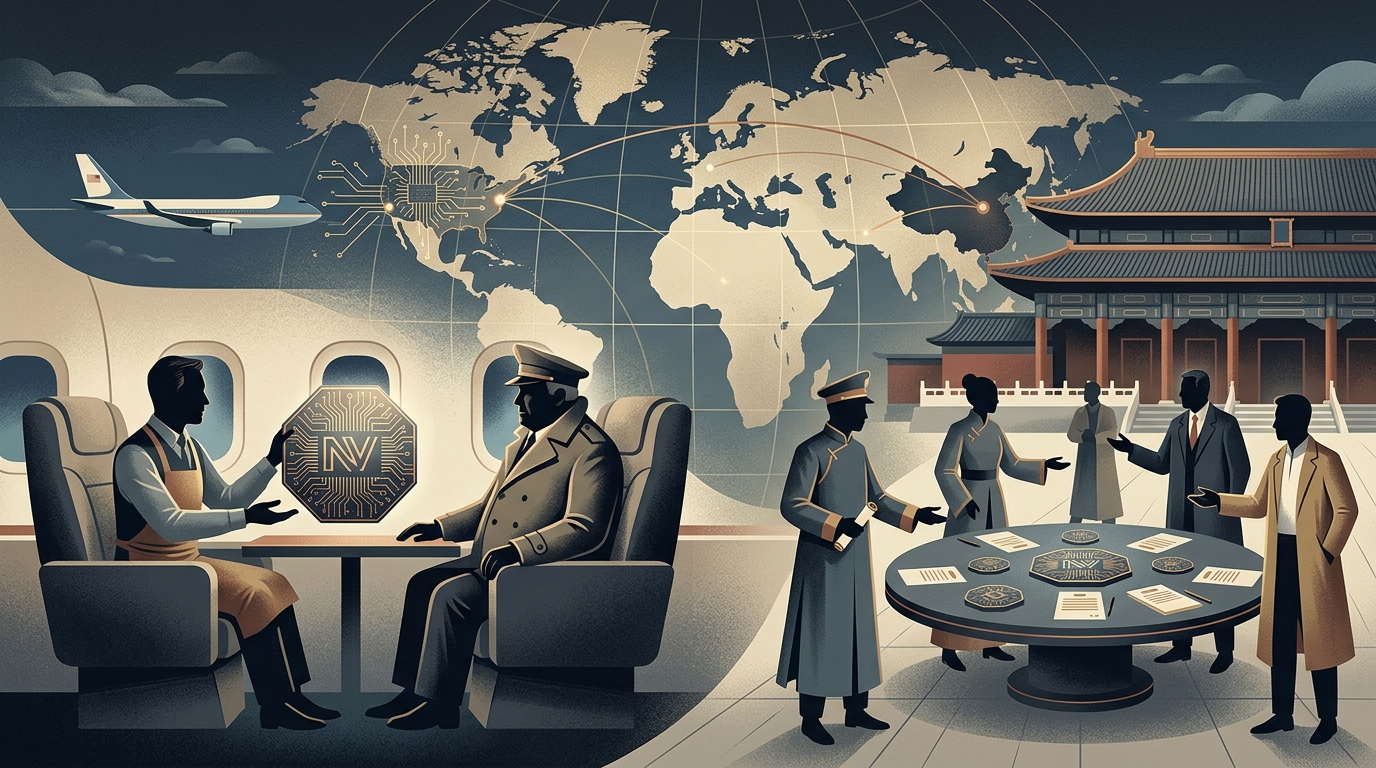
In a move that highlights the unprecedented convergence of technological prowess and state diplomacy, Jensen Huang, the visionary CEO of Nvidia, was spotted boarding Air Force One alongside President Donald Trump. This flight, bound for a high-stakes summit with Chinese President Xi Jinping, is more than just a logistical arrangement; it is a profound statement of power. In the 21st century, semiconductors have replaced oil as the world's most strategic commodity, and Nvidia, with its absolute dominance in Artificial Intelligence infrastructure, represents the strongest card in Washington's hand.
The Strategic Weight of Nvidia in Modern Geopolitics
Huang’s presence by Trump’s side strongly suggests that the agenda for the talks in Beijing will be heavily centered on technology export controls. For years, Washington has sought to limit China’s access to advanced AI chips, citing concerns over military applications and the development of sophisticated surveillance systems. However, for Nvidia, China remains a vital market, accounting for a significant portion of its annual revenue. Huang’s challenge is to convince the Trump administration that maintaining a controlled commercial relationship with China is preferable to a total blockade, which could inadvertently accelerate Beijing’s development of domestic alternatives.
Analysts observe that Trump, with his signature transactional approach to foreign policy, views Nvidia as a primary lever of influence. If China desires access to the technology powering the next industrial revolution, it will have to offer substantial concessions regarding the trade deficit and intellectual property protection. The inclusion of a CEO in such high-level diplomatic maneuvers echoes past eras of industrial titans, but with a digital twist: Huang is not there merely as a businessman, but as the 'architect' of the arsenal that will define global hegemony.
Beijing’s Response to the 'Chip War'
From Beijing’s perspective, Xi Jinping is expected to frame 'technological containment' as a non-negotiable red line. China has funneled billions of dollars through its 'Big Fund' to establish an independent semiconductor supply chain. Huang’s presence on Air Force One will likely be interpreted by Beijing as a display of force and an attempt by the U.S. to weaponize the global market. Chinese firms like Huawei and Biren Technology are working feverishly to fill the void left by U.S. restrictions, but the technological gap between their offerings and Nvidia’s Blackwell architecture remains vast.
- Export restrictions on H20 chips and their impact on Chinese data centers.
- The possibility of new tariffs on products integrating Chinese AI technology.
- The security of Taiwan and TSMC’s pivotal role in Nvidia’s manufacturing.
Trump and the 'CEO-Diplomacy' Model
Trump’s approach marks a radical departure from the more institutional and bureaucratic methods of previous administrations. By choosing to have Huang at his side, he bypasses traditional diplomatic channels and places business logic at the heart of foreign policy. This 'CEO-Diplomacy' model carries risks, as the interests of a single corporation—no matter how large—do not always align perfectly with long-term national security or international alliances. However, in Nvidia’s case, the company has become so intrinsically linked to U.S. national power that the two are now virtually inseparable.
"We aren't just negotiating over trade; we are negotiating over who will own the operating system of the future," a senior White House official stated under condition of anonymity.
In conclusion, the Trump-Xi summit, with the shadow of Jensen Huang looming over the negotiating table, signals the transition to a new world order. It is an order where lines of code and GPU architectures carry the same weight as nuclear deterrents and billion-dollar trade pacts. The outcome of this summit will determine whether the world is heading toward a technological 'Iron Curtain' or a new, albeit fragile, balance of power.





