

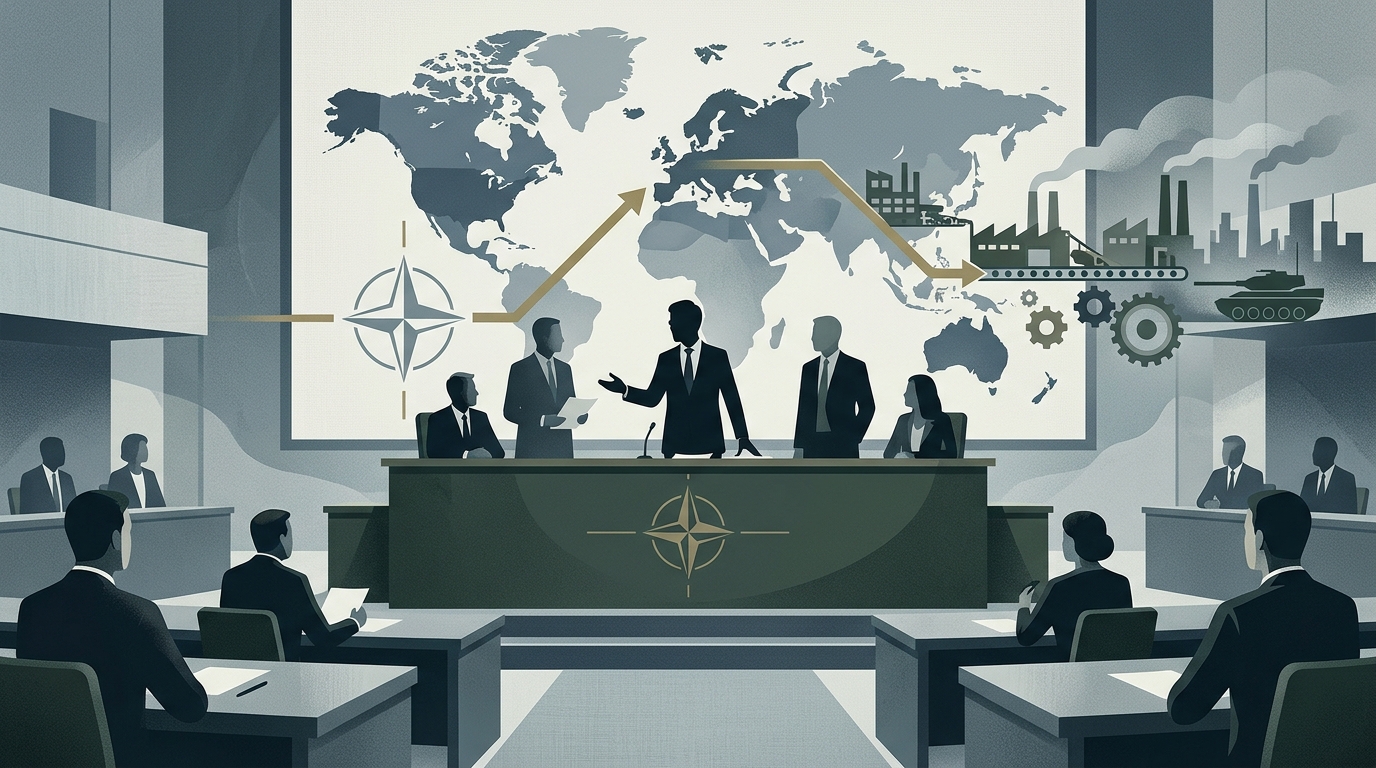
At a critical juncture for European security, NATO Secretary General Mark Rutte has issued a resounding announcement that signals the Alliance's transition into a permanent state of enhanced readiness. Against the backdrop of ongoing challenges on the Ukrainian front and the urgent need to replenish national stockpiles, Rutte announced the intention to sign defense contracts worth tens of billions of dollars, sending a clear message to the defense industry: demand is no longer temporary; it is structural.
The Strategy of "Industrial Mobilization"
Mark Rutte, taking the helm of the Alliance during a period of intense geopolitical instability, appears to understand that deterrence depends not only on diplomacy but also on industrial capacity. The "tens of billions of dollars" in contracts he referenced are not just about purchasing new weapon systems; they are about building a stable, long-term relationship with the defense sector. For decades, European nations enjoyed the so-called "peace dividend," cutting spending and allowing production lines to atrophy.
Today, the reality is starkly different. Rutte is urging allies to guarantee long-term orders so that companies can confidently invest in new factories and technologies. The focus is on artillery ammunition, air defense systems, and advanced drones—technologies that have proven decisive on the battlefields of Ukraine. The logic is simple: industry needs predictability to scale up production, and NATO is prepared to provide it through multi-year commitments.
Ukraine: Allied Responsibility and the Cost of Inaction
A central point of Rutte’s intervention was the call for allies to take "full responsibility" regarding Ukraine. Despite significant aid flows, war fatigue is beginning to set in within some capitals. The Secretary General warns that any retreat would be perceived as a sign of weakness by Moscow, with unpredictable consequences for the entire continent.
"Ukraine’s security is our security. This is not charity; it is an investment in our democratic survival," he emphasized.
Rutte’s strategy involves creating a mechanism to ensure that aid to Kyiv does not depend on the political fluctuations of individual member states. The goal is the "institutionalization" of support, making it an integral part of NATO's long-term defense planning. The challenge is significant, as it requires European governments to balance their budgets during a period of inflationary pressure, prioritizing defense spending over social services.
Geopolitical Implications and the US Role
Rutte's move also comes as a response to internal pressures within the Alliance, particularly from Washington. With an eye on US political developments, NATO is trying to demonstrate that Europe can and must carry a greater share of the burden. The announcement of multi-billion dollar contracts serves as a reassurance to the US that European allies are finally getting serious about their defense.
At the same time, strengthening the defense industrial base within NATO has a technological dimension. Integrating Artificial Intelligence and autonomous systems into new contracts is essential to maintaining a qualitative edge over adversaries like Russia and China. Rutte appears to be promoting a model of "smart defense," where the quantity of munitions is matched by the precision of cutting-edge technology.
In conclusion, Mark Rutte’s leadership begins with a clear commitment to rearmament. The success of this strategy will be judged by the speed at which these contracts are executed and the ability of member states to maintain unity in the face of a prolonged war of attrition. The message is clear: peace in 21st-century Europe is not a given; it is purchased at a high price.





